Journal · Technique & materials
Why Scale Matters in Abstract Painting
Physical scale turns an abstract painting from an object you look at into a space you stand inside: a large-format canvas fills enough of the field of vision that the room around it recedes, while a small one stays an object, read up close. Alyne Perfeito's largest piece, Genesis of Flame (120 × 200 cm), is built for that first effect.
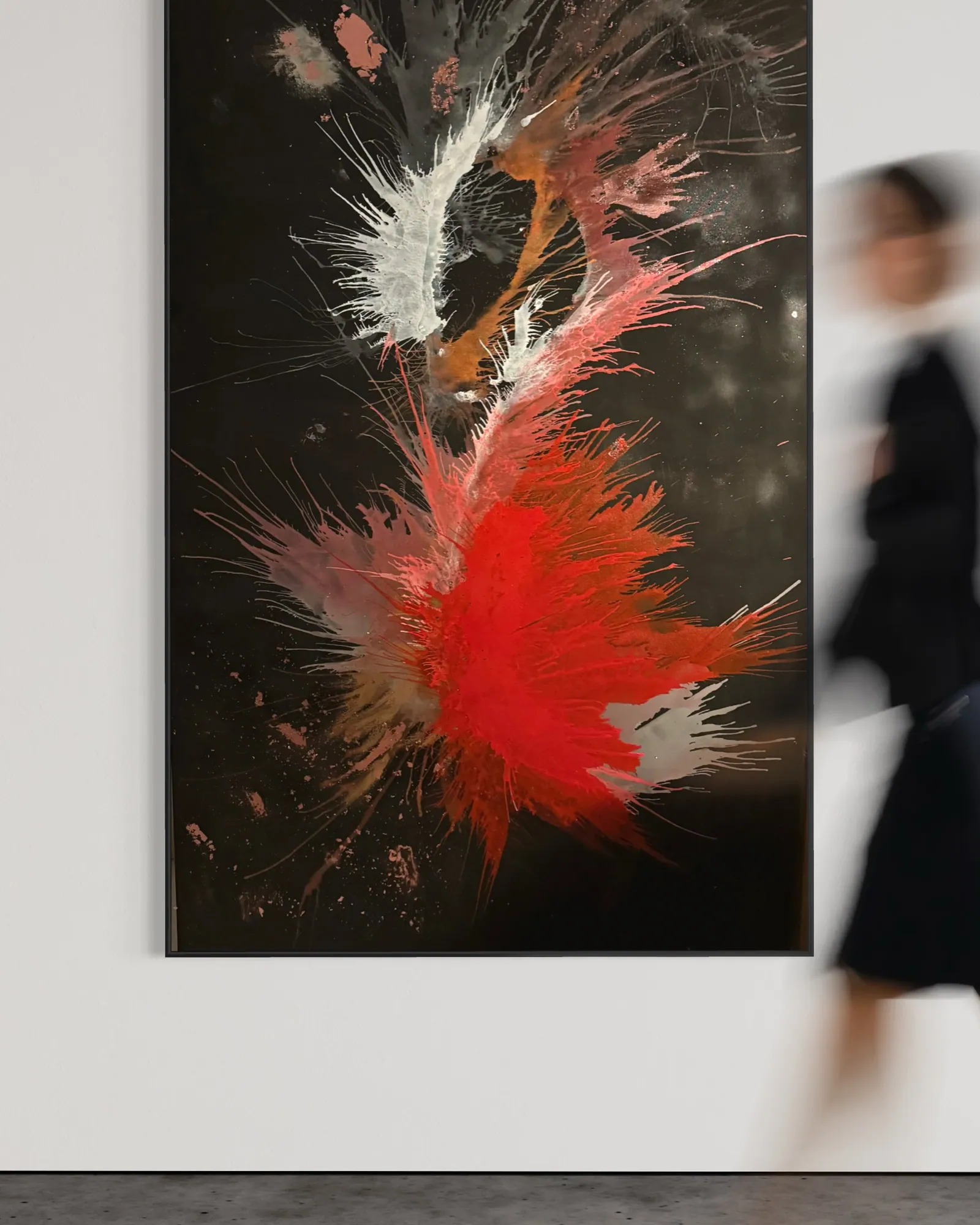
What actually changes when a painting gets larger than you
Size is not a neutral variable in how a painting is experienced — it changes the physical relationship between the viewer and the work. A painting small enough to take in in a single glance, at arm's length, stays an object: something set apart from you, framed by the wall around it, read the way you'd read a page. Once a canvas grows larger than the body — tall enough that the eye has to travel, wide enough that peripheral vision picks up color spilling past its edges — the wall around it starts to recede from attention, and the painting stops behaving like an object on a wall and starts behaving like an environment the viewer is standing inside.
This is a question of physical proximity and field of vision, not of subject matter. It applies with particular force to abstract painting, because there is no represented scene to hold the eye at a fixed, legible distance — no figure or horizon line telling you how far back to stand. Color, gesture and texture read differently depending on how much of your vision they occupy, so scale becomes one of the artist's primary tools for deciding whether a piece is meant to be regarded from across a room or entered at close range.
Rothko and the large-format tradition of surrounding the viewer
The clearest documented case of an artist using scale deliberately for immersion is Mark Rothko. Commissioned in 1958 to paint a series for the Four Seasons restaurant in New York's Seagram Building, he built a scaffold in his studio matching the restaurant room's own dimensions so he could paint directly at that scale. Tate, which now holds nine of the resulting canvases, describes the works as "designed to immerse audiences," and quotes Rothko's own account of his intent: his paintings, he said, "are involved with the scale of human feelings, the human drama, as much of it as I can express." Recalling the feeling he wanted the murals to produce, he described wanting viewers to feel as if "trapped in a room where all the doors and windows are bricked up."
The same logic shaped the one room Rothko helped design himself: the Rothko Room at The Phillips Collection in Washington, D.C., opened in 1960 as the first American museum space dedicated to his work. Rothko personally asked Duncan Phillips to lower the lighting and replace the chairs with a plain wooden bench, and the museum notes his own preference for exhibiting his paintings "in a scale of normal living" — large enough to occupy a room the way a piece of architecture does, not so large that it turns into spectacle. The result, kept dim and quiet, was referred to by Phillips himself as a kind of "chapel." In both cases, scale is doing the same job: reducing the distance between viewer and color until the room itself starts to feel like part of the painting.
The intimate register: what small-scale abstraction does instead
None of this makes small-format abstraction a lesser version of the same idea — it is a different relationship, built on a different distance. A painting sized to be read at arm's length, in a hallway, on a shelf, or beside a reading chair, invites the kind of close, unhurried looking that a large canvas across a room cannot: brushwork, layering and the physical texture of the paint become legible in a way they lose at a distance. Small scale keeps the painting an object you return to and study, the way you'd handle a book rather than walk into a building.
In practice, most collections — including this one — sit on a spectrum between these two poles rather than at either extreme. A piece under roughly 70 × 100 cm tends to behave as an intimate object, read up close in a hallway, a reading nook or beside a desk. A piece at 100 × 150 cm and above starts to behave as an environment, felt from across a room before it is read in detail. Neither register is more serious than the other; they answer different questions about how, and from how far, a painting is meant to be lived with.
Matching scale to the wall, not just the room
Choosing scale for immersion means starting from where the viewer will actually stand, not from the size of the blank wall. A wide, uninterrupted wall seen from a sofa, a dining table or a hallway at a distance of three meters or more is the setting where a large-format piece reads at its full strength — the same principle behind Rothko's Seagram scaffold, scaled down to a living room. A wall passed at close range, or a room with no seated vantage point more than a couple of meters away, tends to suit a smaller, more intimate piece better, regardless of how much empty wall is available.
Genesis of Flame (120 × 200 cm, Heart of Chaos series, 2025, R$ 8.800) is the largest piece currently in the collection, and it was built with exactly this effect in mind: a red nucleus igniting out of a black field, sized so that from across a room it reads first as color and motion filling the wall, and only up close resolves into its individual gestures. It is the piece we point to first whenever someone asks what a large-format work is actually meant to do in a room.
From the studio
The Atelier's Perspective
Scale is one of the first decisions I make on a new canvas, before a single mark goes down, because it decides what kind of experience the piece is going to be. With Genesis of Flame I wanted the eruption at its center — that red, breaking out of the black — to be big enough that you feel it before you've had time to analyze it, the way you notice weather before you notice its cause. That only works at a scale close to or larger than the body standing in front of it. A smaller version of the same composition would read as a picture of an explosion instead of something closer to standing near one.
My training as an architect is probably why I think about this in terms of the room before the canvas. A large piece has to hold its own from across a room, in changing light, competing with furniture and conversation — it has to work as architecture, not just as image. A small piece gets a different kind of attention: someone standing close, alone, for longer. I don't think one is more ambitious than the other. I do think it's a mistake to pick a size based only on the wall's dimensions without asking where in the room a person will actually be standing when they look at it — that question decides more about the final piece than the palette does.
Frequently asked
Does an abstract painting have to be large to feel immersive?
No — immersion in the Rothko sense (a large canvas filling enough of the visual field that the surrounding room recedes) does need a large format, roughly 100 × 150 cm and up, viewed from a few meters back. But a small painting produces its own kind of absorption at close range, where texture and brushwork take over instead of scale. They are two different effects, not a big version and a small version of the same one.
Why did Mark Rothko paint at such a large scale?
Rothko built his large Seagram Building murals on a scaffold matched to the restaurant room's own dimensions, and Tate — which now holds nine of the resulting canvases — describes the works as designed to immerse the audience. Rothko himself said his paintings "are involved with the scale of human feelings, the human drama, as much of it as I can express," and recalled wanting the effect of feeling trapped in a room whose doors and windows are bricked up.
What is the Rothko Room at the Phillips Collection?
It is a small room at The Phillips Collection in Washington, D.C., opened in 1960 as the first museum space in the United States dedicated to Rothko's work, designed in collaboration with the artist himself. Rothko asked for dim lighting and a plain wooden bench instead of chairs, and the museum notes his preference for showing his paintings "in a scale of normal living" — large, but scaled to inhabit a room rather than to overwhelm it.
How do I know if my wall calls for a large or a small abstract painting?
It depends on where you actually stand or sit when you look at that wall, not on how much blank space is there. A wall seen from a sofa, dining table or hallway three meters back or more tends to suit a large-format piece, since that distance is what lets a big canvas read as an environment rather than an oversized object. A wall passed at close range, or a nook with no seated vantage point, usually suits a smaller, more intimate piece better.
Can a small abstract painting still feel immersive up close?
Yes, in a different register. Instead of filling your peripheral vision from across a room, a small painting rewards close, sustained looking — the texture, layering and brushwork that a large canvas keeps at a legible distance become the main event at arm's length. It's a private, object-scale kind of absorption rather than the room-scale one large-format work produces.
Weighing a large-format piece for your space?
Send a photo of the wall and where you usually sit or stand near it, and we'll tell you whether a large-format piece like Genesis of Flame will read the way it's meant to — before you decide.
Sources
- Tate — 2026-09-26
- Tate — 2026-09-26
- Tate — 2026-09-26
- The Phillips Collection — 2026-09-26
- The Phillips Collection — 2026-09-26
- Perfeito Studio -- internal catalog source — 2026-09-26
Published on