What was Abstract Expressionism
Abstract Expressionism was an American painting movement that began in New York in 1943 and lasted until late 1965. It replaced representational subject matter with gesture, scale, and color as the carriers of emotion, producing two currents — action painting and color field painting — through artists such as Jackson Pollock, Willem de Kooning, and Mark Rothko.
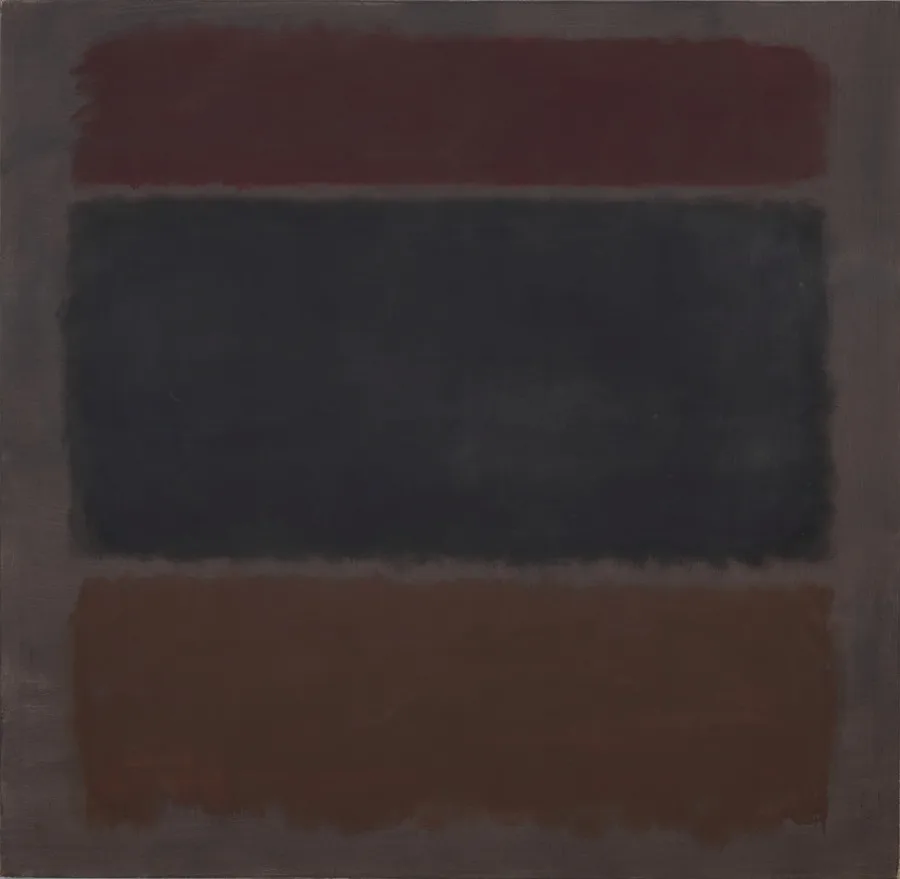
When and Where Abstract Expressionism Began
Abstract Expressionism developed in New York City during the 1940s and 1950s, in the years immediately following the Second World War. Historians mark 1943 as the movement's starting point and late 1965 as its end — an arc of just over two decades in which a small group of New York-based painters redefined what a painting could be.
The painters at its center — including Jackson Pollock, Willem de Kooning, and Mark Rothko — became known collectively as the New York School. Their work answered the mood of the postwar years with a new visual language, one built on gesture, scale, and raw material rather than the European styles that had dominated painting until then.
Two Currents Within One Movement: Action Painting and Color Field
Abstract Expressionism was never a single style — it held two distinct approaches under one name.
Action painting treated the canvas as a site of physical process. Jackson Pollock's poured and dripped paintings are the clearest example: paint applied through motion and gesture, turning the canvas into what critic Harold Rosenberg described as an arena for action rather than a space for composing a picture.
Color field painting worked in the opposite register. Mark Rothko, Clyfford Still, and Barnett Newman built compositions from large, simplified areas of color, using the field itself — its scale, its edges, its saturation — as the emotional content of the work, with little or no gestural mark-making.
The Artists Who Defined the Movement
Historians and museums consistently point to the same core group of painters when describing Abstract Expressionism:
- Jackson Pollock — developed the poured and dripped technique that became the public face of action painting.
- Willem de Kooning — combined gestural abstraction with fragmented figuration, most recognizably in his Woman paintings.
- Mark Rothko — built luminous, stacked fields of color meant to be experienced at close range and large scale.
- Clyfford Still and Barnett Newman — pushed color field painting toward jagged, unbroken expanses of a single hue.
- Lee Krasner and Arshile Gorky — Krasner's rhythmic, all-over compositions and Gorky's biomorphic abstraction helped shape the movement's language alongside its best-known men.
- Helen Frankenthaler, Robert Motherwell, Franz Kline, and Hans Hofmann — extended the movement's range, from Frankenthaler's stained canvases to Kline's black-and-white architectural gestures.
Why the Movement Mattered: New York Replaces Paris
Abstract Expressionism is treated as a turning point in art history for a specific reason: it was the first art movement developed in the United States to be recognized internationally as an avant-garde in its own right, rather than an American echo of a European style.
Its success in the late 1940s and 1950s is credited with shifting the center of the international art world from Paris to New York, the city that became the new reference point for advanced painting. By the time the movement is generally considered to have ended, in late 1965, the New York School had already opened the way for the movements that followed it, from Color Field abstraction to Minimalism.
The Legacy: How Abstract Expressionism Still Shapes Painting
Abstract Expressionism's end in late 1965 did not close its influence. Its two currents fed directly into the movements that came after it: the color field side, through artists like Helen Frankenthaler, helped open the way to Hard-Edge Abstraction in painters such as Frank Stella and Ellsworth Kelly, while its handling of color and texture carried forward into early Minimalism, in artists like Robert Ryman.
The influence continues in contemporary practice. Painters working today still draw on the systematic, poured, or stripped-back approaches the movement established — Scottish painter Calum Innes's pared-back compositions and British painter Ian Davenport's poured, glossy stripe paintings both extend that lineage into the present.
From the studio
The Ateliê's View: Where This Language Meets Ours
Reading Abstract Expressionism as an architect changes what I notice first — not the story a painting tells, but how the field of it occupies a wall. That's the lens I bring into two of my series. In Matter & Silence, works such as Silent Interval build a canvas the way color field painters worked: as a single field, layered and sculpted rather than illustrated, meant to be read as presence in a room before it is read as image. In Heart of Chaos, the register flips toward the other current of the movement — gesture, ignition, pigment applied in motion rather than composed — closer in procedure to action painting's physical urgency than to its finished look.
None of this claims my place in that art-historical lineage — it's a note on method, from someone trained to read scale and light before pigment. What both currents share, in my studio as in 1950s New York, is the decision to let the material itself carry the weight of the piece.
Frequently asked
When and where did Abstract Expressionism emerge?
Abstract Expressionism developed in New York City through the 1940s and 1950s. Historians date the movement from 1943 to late 1965. The painters at its center were based in New York and became known as the New York School — the first time an American art movement was recognized abroad as an avant-garde in its own right, rather than a version of a European style.
Who are the key artists associated with Abstract Expressionism?
The core group includes Jackson Pollock, Willem de Kooning, Mark Rothko, Clyfford Still, Barnett Newman, and Lee Krasner, alongside Arshile Gorky, Helen Frankenthaler, Robert Motherwell, Franz Kline, and Hans Hofmann. Between them they cover both currents of the movement — Pollock and de Kooning on the gestural, action-painting side, Rothko, Still, and Newman on the color field side — which is why the group is usually discussed as one movement with two languages rather than a single style.
What is the difference between action painting and color field painting within the movement?
Action painting treats the canvas as a record of physical movement — Jackson Pollock's poured and dripped paintings are the clearest example, with gesture and process as the content of the work. Color field painting, practiced by Mark Rothko, Clyfford Still, and Barnett Newman, instead uses large, simplified areas of color, with almost no visible brushwork, letting scale and saturation carry the emotional charge. Both currents fall under Abstract Expressionism, but they produce very different paintings.
Why is Abstract Expressionism considered a turning point for American art?
It was the first art movement developed in the United States to be recognized internationally as an avant-garde in its own right, rather than an extension of a European style. Its success in the late 1940s and 1950s is credited with shifting the center of the international art world from Paris to New York, establishing the city as the new reference point for advanced painting instead of the French capital.
Is Abstract Expressionism still influencing painters today?
Yes. Its two currents fed directly into later movements — the color field side helped open the way to Hard-Edge Abstraction and early Minimalism, while action painting's emphasis on process influenced performance-based art. Contemporary painters continue to work in that lineage directly: Scottish painter Calum Innes and British painter Ian Davenport both build on the poured, stripped-back approaches Abstract Expressionism established, decades after the movement's own end in late 1965.
Sources
- TheArtStory — 2026-08-10
- Tate — 2026-08-10
- TheArtStory — 2026-08-10
- The Cleveland Museum of Art — 2026-08-10
See how the ateliê works with color and gesture
Matter & Silence and Heart of Chaos are the two Perfeito Studio series closest to this lineage — original, one-of-one works, available for private acquisition.
Talk to the studio on WhatsApp
Published on