Contemporary artists working in Rothko's territory
“Similar to Rothko” is really a technical question: which artists build broad fields of color from thin, translucent layers, leave the edge to breathe rather than drawing it, and scale the canvas to a standing body rather than a page. Verified names sharing that procedure include Barnett Newman, Clyfford Still, Ad Reinhardt, and Helen Frankenthaler.
What Rothko actually does -- and why a screen erases it
From around 1949 onward, Rothko's mature paintings settle into a consistent structure: two or three soft-edged rectangles of closely related color, stacked on a large vertical field, with no drawn boundary separating one from the next. The edge is the whole trick. Rather than a taped or ruled line, the boundary is a zone where one thinned color stops and another begins, so it reads as breathing rather than as a shape that was outlined and filled in.
That softness comes directly from technique. Rothko worked on raw, unprimed canvas, brushing on a thin layer of binder mixed with pigment, then building up overlapping washes of heavily diluted oil paint -- coats thin and dry enough to layer without turning to mud, so that light passes through several translucent films rather than bouncing off one opaque surface. The depth in a Rothko is optical, produced by that stack of thin layers, not by any single strong color.
Scale was never decorative. In 1951 Rothko explained why he worked so large: “I paint very large pictures... precisely because I want to be very intimate and human,” and he is recorded as recommending viewers stand as little as eighteen inches from the canvas, close enough that the field extends past the edge of vision. A photograph cannot reproduce any of this -- the thin layering flattens into a single printed color, the breathing edge becomes either a hard line or a blur, and the scale collapses entirely, since a phone screen renders a small study and a three-meter canvas at the exact same size. What is being described in this article is a physical encounter with paint and distance, not an image file.
His contemporaries: the procedure, not the reputation
Rothko worked in New York from the 1940s alongside painters pushing the same large, reduced field toward different extremes. Barnett Newman found his mature format in 1948 with Onement I: a single vertical band -- his “zip” -- masked off with tape against a flat, unbroken field of color. Where Rothko's edge dissolves, Newman's is deliberately hard and drawn, which makes the two painters a useful contrast rather than a pair. Clyfford Still, a contemporary of Rothko's from the same Abstract Expressionist generation, worked in the opposite direction from thin glazes: thick, jagged, torn-edge fields built up with heavy impasto across enormous canvases. Nearly his entire output -- by the terms of his own will -- now belongs to a single institution, the Clyfford Still Museum in Denver, which opened in 2011. Ad Reinhardt pushed reduction further still: his Black Paintings (1954-1967) were made by mixing black oil paint with small amounts of red, green, or blue, letting it sit for weeks so the pigment separated from the solvent, then applying a matte, brushless surface whose faint color distinctions only appear under sustained, close looking -- an even more extreme withdrawal of incident than Rothko attempted.
A second group shares Rothko's actual staining procedure more directly. Helen Frankenthaler devised the soak-stain technique in 1952, pouring turpentine-thinned paint onto raw, unstretched canvas so it soaked into the weave rather than sitting on top of it -- closer kin, technically, to Rothko's washes than Newman's taped zips ever were. Morris Louis, after seeing Frankenthaler's work in 1953, adopted the method for his Veils (1957-1960): diluted Magna acrylic poured, with no brush at all, onto unprimed canvas tacked to a stretcher he tilted by hand. Agnes Martin worked differently again -- hand-ruled graphite grids across six-foot canvases, closer to Minimalism than to color field -- but she shared Rothko's conviction that a painting only resolves through slow, undistracted, in-person attention. Brice Marden, a full generation younger, used encaustic -- pigment suspended in beeswax -- to give his monochrome panels of the 1960s and 70s a lustrous, layered depth in the same technical family as Rothko's glazes, before shifting into gestural, calligraphic line in the 1980s. He continued painting until his death in 2023.
Where to see the work
Reproductions cannot carry scale, layering, or the breathing edge -- so seeing the paintings in person is not a preference, it is the only way the argument in this article actually lands. Rothko withdrew from his 1958 Seagram Building restaurant commission after two years of work, returned his fee, and instead donated nine of the resulting paintings to Tate in 1969. They now hang together in a dedicated room at Tate Modern in London, shown at the height, lighting, and wall color Rothko specified. The Rothko Chapel in Houston, commissioned by John and Dominique de Menil in 1964 and dedicated in 1971, holds fourteen of his paintings across an octagonal, non-denominational chapel that Rothko helped design.
In the United States, the National Gallery of Art in Washington, DC holds the largest public collection of Rothko's work, following a 1986 gift from the Mark Rothko Foundation of roughly 1,000 paintings and works on paper. Both the Museum of Modern Art and the Whitney Museum of American Art in New York also hold and periodically display his paintings, each drawing on a different slice of his career.
And today?
Naming a living painter as “the next Rothko” is a claim about stature that no one can honestly make. What can be checked is procedure -- five technical signals that separate work genuinely operating in this territory from a poster or a decorative gradient print:
- A broad field, not a single flat swatch -- a sustained passage of closely related color occupying most of the surface.
- An undrawn edge -- boundaries that fade or bleed rather than being taped, ruled, or hard-cut.
- Translucent layering -- several thin coats built up so light passes through the stack, visible as a faint depth or shimmer rather than one printed color.
- Scale decided for viewing distance -- a canvas sized for how close a body is meant to stand, not for how it will crop on a screen.
- A restrained palette -- a small number of related hues, not full-spectrum contrast.
Living painters working with some of this vocabulary today are verifiable and worth naming directly. Suzan Frecon (b. 1941), represented by David Zwirner since 2008, builds oil paintings from a narrow range of earth-based colors over long stretches of time; her 2008 survey was held at the Menil Collection in Houston -- the institution founded by the same family, John and Dominique de Menil, who commissioned the Rothko Chapel across the city, though the two bodies of work are otherwise unconnected. Sean Scully (b. 1945, Dublin), who divides his time between New York and London and shows with Lisson Gallery and Thaddaeus Ropac, has spent a fifty-year career on large blocks and bands of layered, gradated color. Pieter Vermeersch (b. 1973, Belgium), represented by Perrotin, builds luminous gradient canvases through a slow, methodical blending process so the surface appears to shimmer and dissolve as a viewer moves past it. Callum Innes (b. 1962, Edinburgh), represented by Ingleby Gallery, layers pigment onto canvas and then dissolves sections of it away with turpentine washes, leaving a residue rather than a drawn form.
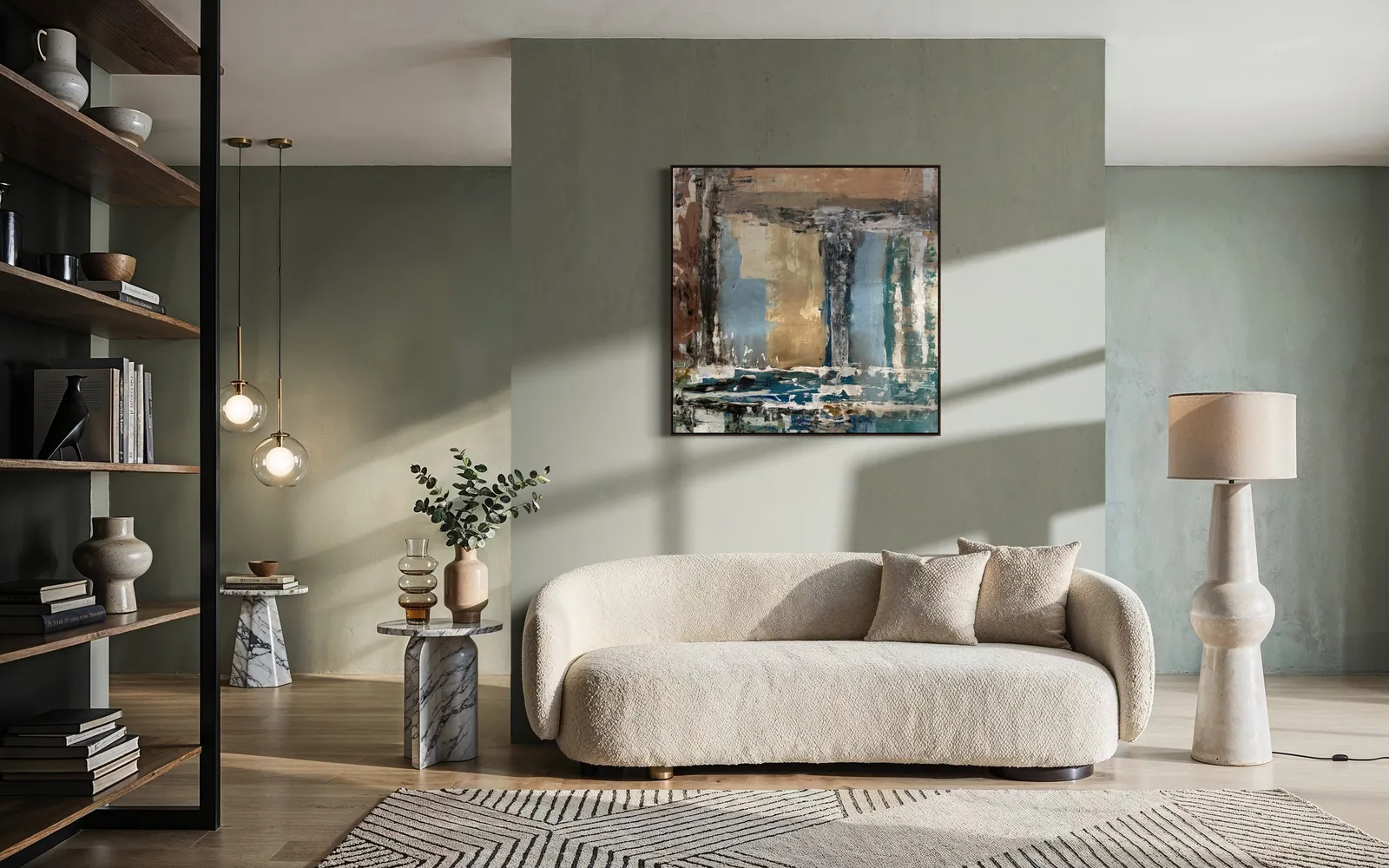
Perfeito Studio, a working studio in Brasília, operates with several of the same signals in its Terra & Ether and Matter & Silence series -- broad, restrained fields; paint built up and scraped back in thin passes; large format decided for a wall rather than a screen. That is offered here as a description of a working method, not as a claim to stand beside any name above.
From the studio
From the studio
What I chase in Matter & Silence and in Terra & Ether is not a reference to any one painter -- it is a question about restraint: how much pigment I can build up, scrape back, and build up again before a field stops reading as color and starts reading as a place you could stand inside. I work slowly, in thin passes, because one flat coat never holds light the way four or five worn-back layers do.
I am early in this career. I have no gallery, no institution, and no exhibition history to point to -- only the work itself, and a record kept from the first piece onward. What I can say honestly is that the pieces leaning hardest into broad, restrained fields are the ones a photograph fails the most: the point of a large canvas is that it changes as you move in front of it, and that only happens in a room, not on a screen.
Frequently asked
What does it actually mean for an artist to be "similar to Rothko"?
<p>Technically, it means sharing his procedure, not his stature: broad fields of closely related color, edges left to bleed rather than drawn, paint built up in several thin translucent layers instead of one flat coat, and a canvas sized for the distance a body actually stands from it. Market history and institutional collections are a separate question from procedure, and this page addresses only the second.</p>
Which of Rothko's contemporaries worked in the same territory?
<p>Barnett Newman, Clyfford Still, and Ad Reinhardt were part of the same New York circle from the 1940s onward, each pushing the large reduced field toward a different extreme -- Newman's taped, hard-edged "zips," Still's thick jagged impasto, Reinhardt's nearly invisible Black Paintings. Helen Frankenthaler and Morris Louis worked more directly with Rothko's own vocabulary of thin, stained color soaked into raw canvas. Agnes Martin and, a generation later, Brice Marden shared his insistence that the work only resolves through slow, in-person looking.</p>
Can I buy a Rothko?
<p>In practical terms, no. Rothko's market operates at museum and major-auction level -- his current auction record is $98.39 million, set at Christie's in May 2026 for <em>No. 15 (Two Greens and Red Stripe)</em>. Nearly every painting he made now belongs to a museum, a foundation, or a small number of major collectors. The realistic way to own an original working in this procedural territory is to buy from a living artist, at a living artist's price.</p>
Will a large color-field painting appreciate in value?
<p>There is no honest way to promise that, for Rothko's market or anyone else's. Historical Color Field prices reflect seven decades of exhibition history, museum acquisition, and scholarship that cannot be replicated by a painting made today, including ours. Buy a piece because you want to live with it, not on an expectation of resale value.</p>
Where can I see Rothko's paintings in person?
<p>The Seagram Murals hang in a dedicated room at Tate Modern in London -- nine paintings Rothko donated after withdrawing from the restaurant commission they were made for. The Rothko Chapel in Houston holds fourteen paintings in the octagonal, non-denominational chapel he helped design with the de Menil family, dedicated in 1971. The National Gallery of Art in Washington, DC holds the largest public collection, following a 1986 gift of roughly 1,000 works from the Mark Rothko Foundation, and both MoMA and the Whitney in New York hold and periodically show his paintings.</p>
Sources
- Wikipedia — 2026-07-26
- Tate — 2026-07-26
- Rothko Chapel — 2026-07-26
- National Gallery of Art — 2026-07-26
- MoMA — 2026-07-26
- Whitney Museum of American Art — 2026-07-26
- Wikipedia — 2026-07-26
- Clyfford Still Museum — 2026-07-26
- Wikipedia — 2026-07-26
- Dia Art Foundation — 2026-07-26
- Helen Frankenthaler Foundation — 2026-07-26
- Morris Louis (morrislouis.org) — 2026-07-26
- Wikipedia — 2026-07-26
- David Zwirner — 2026-07-26
- Wikipedia — 2026-07-26
- Ocula — 2026-07-26
- Ingleby Gallery — 2026-07-26
- HENI — 2026-07-26
Ask the studio directly
Questions about the Terra & Ether or Matter & Silence series, or about a specific piece? Alyne replies personally, in English or Portuguese.
Talk to the studio on WhatsApp
Published on