Journal · Exhibitions & museums
Where to see abstract art in New York
For abstraction specifically, three institutions anchor the canon: the Museum of Modern Art (MoMA), the Solomon R. Guggenheim Museum, and the Whitney Museum of American Art — each holding different anchor works, plus Dia Beacon upstate for large-scale minimalism and the Chelsea/Tribeca galleries for living artists.
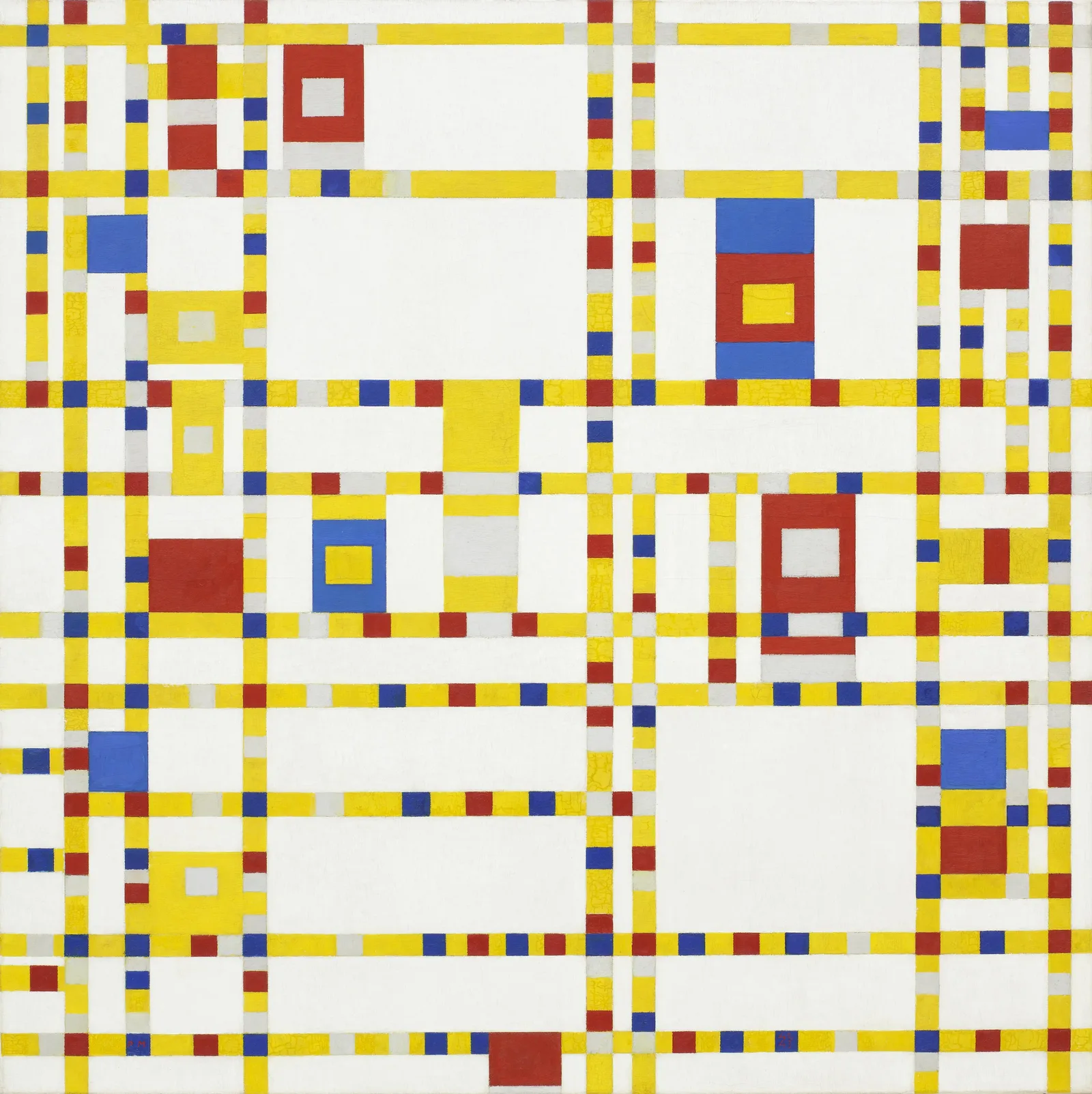
MoMA, the Guggenheim, and the Whitney: what each holds
Three institutions anchor the canon of abstraction in Manhattan, and each is strongest in a different register. The Museum of Modern Art (MoMA) holds the paintings most people picture first: Jackson Pollock's One: Number 31, 1950 has been in the collection since 1968, alongside Piet Mondrian's Broadway Boogie Woogie (1942–43) and Barnett Newman's Vir Heroicus Sublimis (1950–51) — a canvas Newman insisted be seen from close range, not across a room. MoMA also holds Mark Rothko's No. 3/No. 13 (1949), one entry point into a body of work spread across several cities and institutions.
The Solomon R. Guggenheim Museum is the place for Kandinsky specifically. Founder Solomon Guggenheim began acquiring the artist's work in 1929, and the museum's holdings — more than 150 pieces — are the largest collection of Kandinsky in the United States and the third-largest in the world, after the Centre Pompidou in Paris and the Lenbachhaus in Munich. A dedicated gallery rotates a themed selection from the collection.
The Whitney Museum of American Art takes the narrower, deeper angle: abstraction made in America. Rothko's Four Darks in Red (1958) is in the Whitney's collection, alongside Joan Mitchell's gestural Hemlock and Norman Lewis's American Totem (1960) — a reminder that the Abstract Expressionist story includes artists who took decades longer than Pollock or Rothko to receive institutional recognition.
Why abstraction, especially, has to be seen in person
Abstraction loses more in reproduction than almost any other kind of painting, for a specific reason: representational work still reads at a glance on a screen, because you're checking a picture against a mental model of the thing it depicts. Abstraction has no such shortcut — its meaning is built from scale, surface, and the accumulation of decisions across a canvas, and a photograph collapses all three into a flat rectangle of a fixed, arbitrary size.
Newman built Vir Heroicus Sublimis nearly eight feet wide because he wanted a viewer standing close enough that the canvas filled the field of vision — a physical relationship no screen, at any resolution, reproduces. Pollock's poured lines carry a literal thickness and sheen that shift as you move past the canvas; a photograph fixes, as a single flat value, what a body in the room experiences as continuously changing with the light and the angle of approach. This isn't a sentimental argument for museum visits — it's a description of what the work is actually made of.
Dia Beacon: the day trip that resets your sense of scale
Dia Beacon, a train ride up the Hudson from Manhattan, occupies a former Nabisco box-printing factory renovated with artist Robert Irwin and the architecture firm OpenOffice. The building's nearly 300,000 square feet of column-free floor and skylight-driven natural light exist for a reason: much of what Dia holds was made to occupy a whole room, not hang on a wall alongside other paintings.
The collection is strongest in large-scale minimal and post-minimal work: Richard Serra's torqued steel spirals, Donald Judd's serial floor pieces, and Agnes Martin's grid paintings, shown together with Louise Bourgeois, Dan Flavin, Sol LeWitt, and Robert Ryman, among others. Seeing a Judd or a Serra at Dia, at the scale and in the light the artist intended, recalibrates what "large" means before you walk into the next gallery show — which is exactly why it belongs on this itinerary, not as an afterthought.
Where to see abstraction by living artists
The museums above answer where abstraction has already been canonized; a different question is where it's happening now. New York's answer isn't a museum at all — it's a pair of gallery districts, Chelsea and Tribeca, described here deliberately without street addresses, because galleries in both neighborhoods relocate, expand, and close often enough that a specific address is out of date within a year or two.
Chelsea holds the largest blue-chip programs — multi-decade relationships between a gallery and a fixed roster of artists, several exhibitions a year, museum-scale rooms. Tribeca has become the newer center of gravity since 2020, as younger and mid-career galleries moved in chasing lower rents and storage above the flood line; a single afternoon there can realistically cover several spaces on foot. Both districts show living abstract painters working today, in direct contrast to the historical holdings at MoMA, the Guggenheim, and the Whitney.
From the studio
From the studio
I paint in layers — acrylic built up in passes, sometimes with metallic pigment or mixed media worked into the surface before the next layer goes down — and that is exactly what I look for when I stand in front of someone else's abstract painting. Not the overall composition first, but the edge: where one layer stops and the next begins, where a brushstroke was clearly the last mark made and where it was buried under something applied afterward. That sequence is where the actual decisions live, and it's the part a reproduction erases first.
It's also why I photograph real surface detail of my own work rather than only the full canvas — a close crop of texture, pigment, or an edge where two passes meet tells a collector something a clean, evenly lit full-piece shot can't. I'll say this plainly: I have never shown in New York, I hold no placement in any institution, and I am early in my career, working from a studio in Brasília rather than inside a gallery program. I'm not placing myself next to Pollock or Kandinsky here — I'm naming the city where I'd eventually like my work to circulate, and being straightforward about how far that is from where I stand today.
Frequently asked
Where can I see abstract art by living artists in New York?
<p>Not primarily in a museum — the historical museums (MoMA, the Guggenheim, the Whitney) hold work by artists no longer working. Living abstract painters show mainly through the city's gallery districts, chiefly Chelsea and Tribeca, where programs rotate exhibitions several times a year.</p>
Can I acquire contemporary abstract work directly from a studio?
<p>Yes, from some working artists, including Alyne Perfeito. Pieces are acquired through a direct conversation with the artist rather than through a gallery, and typically include a certificate of authenticity, a curatorial dossier, and a signed acquisition agreement in place of a gallery's provenance record.</p>
Where can I see Rothko in New York?
<p>Rothko's paintings are held across more than one New York institution rather than a single one: the Museum of Modern Art holds <em>No. 3/No. 13</em> (1949), and the Whitney Museum of American Art holds <em>Four Darks in Red</em> (1958). Both are part of the museums' permanent collections; check each institution directly for current display before a visit.</p>
Where can I see Kandinsky in New York?
<p>The Solomon R. Guggenheim Museum. Founder Solomon Guggenheim began collecting Kandinsky's work in 1929, and the museum's holdings of more than 150 pieces are the largest Kandinsky collection in the United States.</p>
Is Alyne Perfeito's work part of any museum or gallery collection in New York?
<p>No. Alyne Perfeito has no institutional placement and no gallery representation in New York or anywhere else. She works directly from her studio in Brasília, Brazil, and sells directly to collectors.</p>
Sources
- MoMA — Jackson Pollock, One: Number 31, 1950
- MoMA — Piet Mondrian, Broadway Boogie Woogie
- MoMA — Barnett Newman, Vir Heroicus Sublimis
- MoMA — Mark Rothko, No. 3/No. 13 (1949)
- Wikipedia — Four Darks in Red (Whitney Museum of American Art)
- Guggenheim Museums and Foundation — Kandinsky
- Whitney Museum of American Art — About the Collection
- Dia Art Foundation — Dia:Beacon
- Hyperallergic — What's Really Luring New York City's Galleries to Tribeca?
- Wikimedia Commons — File: Piet Mondrian, 1942 - Broadway Boogie Woogie.jpg
Ask the studio directly
Comparing New York's museums to a studio in Brasília? Alyne answers her own messages, in English or Portuguese.
Talk to the studio on WhatsApp
Published on