If you like Abstract Expressionism, what can you actually collect now
The honest answer: the originals are museum-level, off the market for any private collector. The real route is different — historical works on paper and editions, or living artists still working the same procedure: the mark as record of gesture, scale, speed, matter.
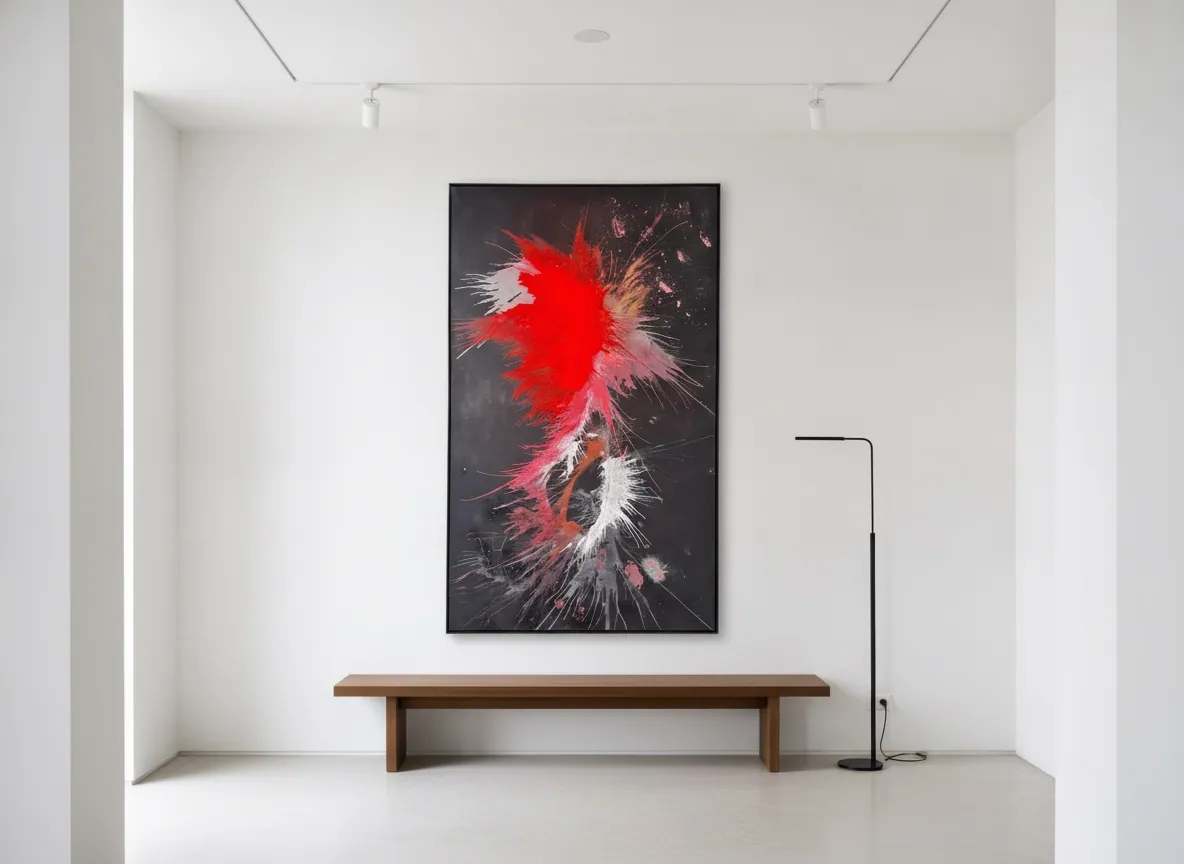
What the gestural wing actually does
Pollock's drip, de Kooning's slashing figure, Kline's black beams across white canvas — these are not decoration. Each mark is a record of a body in motion: the arm's speed, the wrist's pressure, the exact instant the painter decided a canvas was finished and stepped back. That decision — where to stop — is arguably the whole discipline. A gestural painting can look uncontrolled and still be the product of someone who knew precisely when more would ruin it.
This is a different procedure from Rothko's colour field, where the surface is built slowly in soaked, hovering rectangles and the effect is atmospheric rather than physical. The gestural wing of Abstract Expressionism — Pollock, de Kooning, Kline, Motherwell, Krasner, Mitchell — works at the speed of the body, not the speed of light through a stain. Scale matters here for a specific reason: a large canvas forces the whole arm, sometimes the whole body, to move, and the mark carries that motion at a size a small sketch cannot.
The artists, and where their work lives
Six names anchor this wing of the movement, and their major works sit in the world's most rigorous public collections — not because of hype, but because institutions spent decades deciding they belonged there.
- Jackson Pollock (1912–1956) — his drip paintings, including One: Number 31, 1950, are held by the Museum of Modern Art in New York.
- Willem de Kooning (1904–1997) — Woman I (1950–52), his best-known and most contested painting, has been in MoMA's collection since 1953.
- Franz Kline (1910–1962) — his black-on-white paintings are held by MoMA, the Art Institute of Chicago, and the Peggy Guggenheim Collection in Venice.
- Robert Motherwell (1915–1991) — his lifelong series Elegy to the Spanish Republic, more than 250 works over four decades, includes pieces held by MoMA and the Metropolitan Museum of Art.
- Lee Krasner (1908–1984) — married to Pollock, and for decades read mainly through that marriage rather than her own painting; her work is in MoMA's collection, which has also given her its own retrospective.
- Joan Mitchell (1925–1992) — who called herself “the last Abstract Expressionist,” working in the movement's vocabulary decades after New York moved on; the Whitney Museum holds her 1956 painting Hemlock.
Krasner and Mitchell are routinely left out of shorter lists of the movement, usually because they were women working alongside men whose names became shorthand for the whole period. Their inclusion here is not a correction for its own sake — it matters because the honest answer to “what can I collect” runs through all six equally, and none of the six is for sale outside museum-level auction rooms and the most resourced collectors and institutions.
What a collector can realistically acquire today
Two realistic paths exist, and each has an honest trade-off.
Works on paper, prints, and authorized editions by the historical names. Lithographs, screenprints, and drawings connected to Pollock, de Kooning, Kline, Motherwell, Krasner, and Mitchell do circulate on the market, usually at a small fraction of a unique painting's value. The trade-off: an edition is, by definition, not the single unrepeated gesture the movement is built on — it is a reproduction or a secondary process, often produced later or through a print studio, and its market depends on its own system of authentication, condition reports, and provenance that a first-time buyer has to learn before purchasing. It is a legitimate way to own something connected to these names. It is not the same object as a painting made in one sitting.
Original work by a living artist working in the same procedure. A painter working today in gesture, scale, and built-up matter offers the opposite trade-off: a unique piece, made in one continuous act, bought directly with no gallery margin — but with no auction history, no institutional collection behind it, and no way to promise it will be worth more later. That absence of a track record is not a flaw to hide; it is the honest condition of buying early, and it is why reading the work and the practice directly matters more than it would with an established name.
Five technical signals for recognising a living artist working in this territory
If the goal is the procedure — not the name — these are the signals that separate a genuine gestural practice from a surface that only looks gestural in a thumbnail:
- The mark reads as motion, not pattern. A brushstroke or pour should show variable pressure and speed — thick where the arm slowed, thin where it didn't — rather than a repeated, decorative rhythm.
- Real physical build-up. Layers of paint, medium, or texture that stand off the canvas and catch light differently depending on where you stand, not a flat surface with a printed or simulated texture.
- Scale that implicates the body. A canvas large enough that painting it required stepping back, reaching, or moving around it, not just working from the wrist at a desk.
- A visible decision to stop. Controlled chaos, not maximal chaos — the clearest sign of a trained hand is knowing where restraint belongs inside an otherwise loose composition.
- A piece that changes in person. Gestural work loses most of its information when compressed into a phone screen; if a piece looks identical in a photo and in the room, the texture and depth that define the procedure probably aren't there.
From the studio
From the studio
Heart of Chaos is where I chase this directly: paint at a scale that forces my whole arm to move, layers built up wet over dry until the surface has real depth, and a moment — always earlier than feels comfortable — where I make myself stop. I don't always get that last part right. Genesis of Flame is the piece where I think I did: a red core breaking out of black, metallic pigment catching differently depending on where you're standing in the room.
I need to say plainly what I am and am not. I am early-career — no gallery, no institutional collection, no auction history, nothing that would let me promise a piece will be worth more later. What I can offer is the procedure itself, honestly: gesture at scale, real matter, and the same kind of restraint the historical painters worked with. None of that is visible in a photo. A gestural painting carries the speed of the arm that made it, and that only reads in person, close, with time to actually look.
Frequently asked
Can I actually buy a Pollock?
Realistically, no. Pollock's paintings are almost entirely in museum collections or a handful of major private holdings, and the few that reach auction sell at levels reserved for the world's largest collectors and institutions. If the goal is to own something connected to his name, the realistic path is a signed print or an authorized edition, not an original painting.
Are prints and editions a good entry point?
They can be, with the right expectations. A signed lithograph or authorized edition by one of these artists is real and legitimate, but it is a different object from a unique painting — produced through a separate process, valued through its own market of condition and provenance, and priced well below an original. It's an honest way in if you understand what you're buying.
Will a living artist's work in this style appreciate?
No one can promise that, and it would be dishonest to say otherwise. A living, unrepresented artist has no auction history and no institutional validation yet — buying now means buying the work itself, for the room and the moment, not a financial position.
What's the difference between this and Rothko-style colour field work?
A different procedure entirely. Colour field, Rothko's territory, is built slowly in soaked, hovering fields of colour where the effect is atmospheric. The gestural wing — Pollock, de Kooning, Kline, Motherwell, Krasner, Mitchell — works at the speed of the body: drips, slashes, built-up matter. See the dedicated piece on artists working in Rothko's register if that's the procedure you're after instead.
Is Heart of Chaos meant to look like these artists' work?
Adjacent in procedure, not in claim. The series shares an interest in gesture, scale, and built-up matter, worked at large format, by an artist who is early in her career and makes no claim to belong in the same sentence as the historical names — only that the same physical questions are being worked through in the studio today.
Want to see Genesis of Flame in person or ask about a specific piece?
No pitch, no promise of appreciation — just a straight answer about technique, documentation, and availability.
Talk to the studio on WhatsApp
Published on