Is art a good investment?
Short answer: original art is not an investment in the financial sense — it is an illiquid asset with no yield, real holding costs, and no guaranteed resale. The sane posture is to buy for the pleasure of living with the piece, knowing the money sits on a wall, not in a statement.
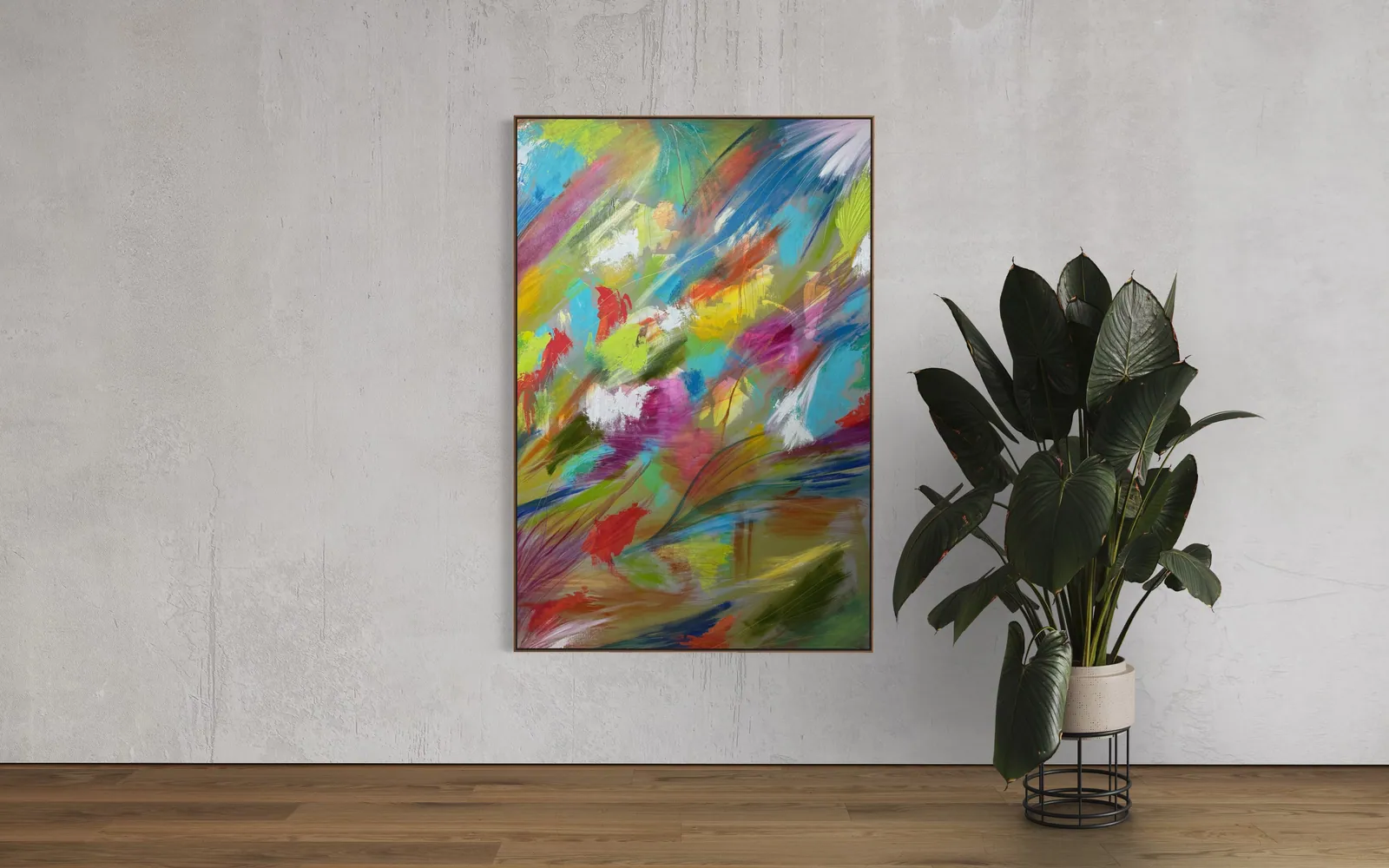
What art is not: fixed income, liquidity, or a live price screen
A painting pays no dividend, carries no coupon, and earns no interest while it hangs on a wall. It also has no daily quote — there is no ticker where you check, at 3pm on a Tuesday, what your canvas is worth. A work's price is only actually tested at the moment someone agrees to pay for it, and that moment can arrive in months, in years, or never.
That is a different animal from stocks, bonds, or funds, which trade on a liquid market with a public price updated continuously. Art — especially from an artist early in her career, with no auction history or established secondary market — has no such mechanism. Selling can be fast or it can be slow, and nothing about owning the piece lets you promise which one it will be.
What actually moves value over decades (when it does)
In the art market broadly, the factors professionals point to as supporting value over the long run are not launch-day hype — they are slower things: an artist's trajectory building year over year, a coherent body of work (series that speak to one another, not disconnected one-off pieces), serious documentation of each piece, clear provenance (who bought it, when, with what certificate), and, eventually, institutional attention — exhibitions, curatorial interest, presence in collections.
None of these factors guarantees appreciation. They are simply what allows a work to be taken seriously if it is ever resold. And here honesty matters: Alyne Perfeito is early in that trajectory. There is no auction history, no decades-long body of work, no institutional recognition yet. That is not a flaw to hide — it is the real stage the work is at today, and any promise to the contrary would be an invention.
The real costs nobody mentions
When someone talks about art as an investment, they almost always skip the costs that come with it:
- Resale commission: if a sale runs through a gallery or auction house, a significant share of the sale value goes to the intermediary — not to the seller.
- Insurance: covering a painting against damage, theft, or loss carries a recurring cost, especially for higher-value works.
- Specialized shipping: moving a large canvas safely is not ordinary freight — it requires art-specific packing and transport.
- Conservation: direct light, humidity, and temperature swings degrade pigment and canvas over the years; keeping a work in good condition has an upkeep cost.
- Time: while a piece sits unsold, the money tied up in it is not earning anything anywhere else.
Added together, these costs can eat up a good part — or more than all — of any eventual gap between purchase and resale price. That is not a hypothetical warning; it is simple arithmetic anyone can run before treating a canvas as a financial asset.
The one rule that survives: buy what you want to live with
Once the promise of a return is off the table, one rule actually holds up: buy the piece you want to look at every day, not the one you hope to sell for more later. If the work is never resold — and most works bought for personal use never are — the "investment" never has to prove itself, because the return was already delivered every day the piece was on the wall.
It is a way of buying art that does not depend on a secondary market existing, on an artist's trajectory maturing, or on any forecast turning out right. It depends on one thing you can already check today: whether the work is worth it to you, now, as it is.
From the studio
From the studio
I never tell anyone that a piece of mine will appreciate. It would be easy to say that in a sales conversation — it sounds good, it helps close — but it would also be a lie, because I have no way of knowing. I am early in my trajectory as an artist. I have no auction history, no decades-long body of work, no institutional curatorship behind my name. Promising appreciation under those conditions would mean selling an expectation I cannot back up myself.
What I do instead is treat every piece as if it might need to be defensible twenty years from now — not because it will become an estate asset, but because that is the minimum seriousness a unique piece deserves. Each work gets its own Archive ID, within the numbering of the series it belongs to. Every sale comes with a certificate of authenticity and a dossier documenting technique, year, and provenance. And I keep the series coherent with one another — I do not jump style to style with no relation — because that coherence, built piece by piece, is what makes a body of work real, not just a pile of unrelated canvases. None of that guarantees anything about the future. It guarantees that, if it ever matters, the documentation will be there.
Frequently asked
Is buying art a good financial investment?
Not in the traditional sense. It is an illiquid asset with no yield and real holding and resale costs — the decision to buy should rest on liking the work, not on an expectation of return.
Will this specific work appreciate?
There is no honest way to promise that. Vibrant Awakening, like every piece in this collection, has no auction history and no secondary market to point to. It can be bought and enjoyed today; whether it is worth more to someone else later is not something anyone can guarantee in advance.
Is buying art from an early-career artist risky?
It is uncertain, like any work with no secondary-market track record. It is not "risky" in the sense of a financial position that can lose money outright — it is simply a purchase with no resale guarantee, which is true of nearly all contemporary art.
What makes a work hold value over time?
Factors observed across the art market in general: a consistent artist trajectory, a coherent body of work, clear documentation and provenance, and eventual institutional attention. None of these factors guarantees appreciation.
Is it worth buying art if I have no plan to resell it?
Yes — that is, in practice, the only way of buying that does not depend on any market forecast: buying the piece to live with it, not to sell it later.
Want to talk about a specific piece, no investment pitch attached?
I would rather explain what a work actually is and what it actually costs than promise a return I cannot guarantee. Reach out directly to Alyne.
Talk to the studio on WhatsApp
Published on