How to judge the real size of a painting from online photos
A photo alone cannot tell you a painting's true size — camera distance and lens compress or exaggerate scale, and a screen has no fixed reference point. The only reliable method is to check the exact centimeter dimensions listed with the work and compare them against a known object, like a standard door or sofa.
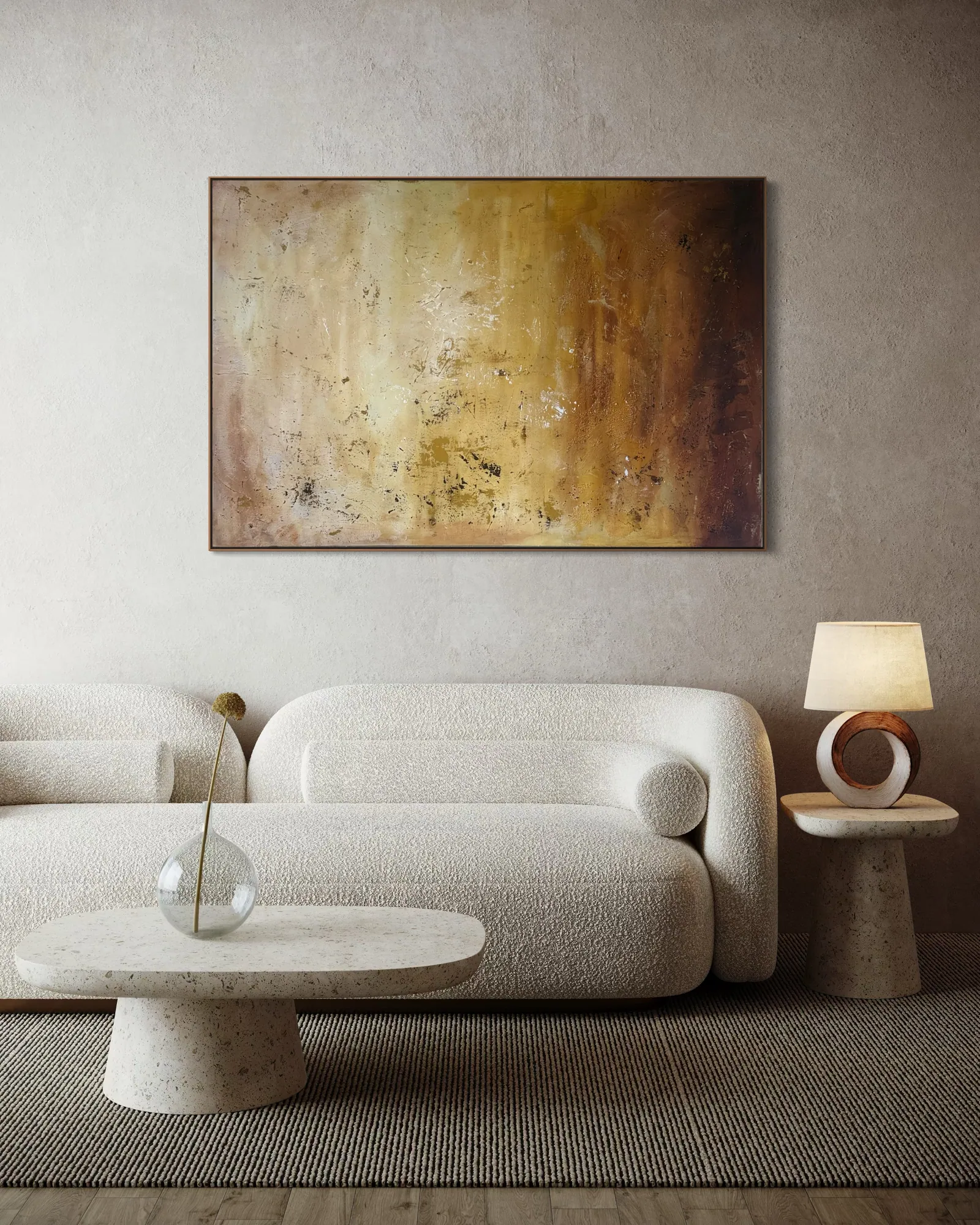
Why a photo alone gets scale wrong
A photograph collapses two different variables into a single flat image: how far away the camera stood, and what lens it used to frame the shot. Neither number reaches you when you look at the picture, but both change how large or small the canvas appears relative to everything else in the frame. A wide-angle lens shot close to the wall makes nearby objects loom large while pushing distant ones smaller and farther away; a longer lens used from across the room compresses the same scene, flattening the sense of depth between the painting and the furniture around it. The distortion comes from the camera's distance from the subject more than from the lens itself — but the practical effect is the same: the painting has not changed size, only the geometry of the photograph has.
This is why the same canvas can look monumental in one image and modest in another: the room it sits in, the angle it was shot from, and the crop applied afterward all do work that has nothing to do with the object's real dimensions. A phone or laptop screen adds a second layer of distortion, since it has no fixed size of its own — the image simply fills whatever window it happens to be opened in.
Read the number before you read the image
The only figure that does not lie is the one printed beside the work: its dimensions in centimeters, as listed by the studio or gallery. At Perfeito Studio, every available piece carries an exact measurement — from Echo of Silence at 50 x 70 cm to Genesis of Flame at 120 x 200 cm — alongside an Archive ID that ties the number permanently to that specific canvas. Read the centimeters first, form a mental sense of the object at that size, and only then look at the photograph to judge color, texture, and composition. Reversing the order — forming an impression from the image and checking the number afterward — is exactly how buyers end up surprised when a piece arrives.
Amber Strata, the work pictured in this guide's mockup, measures 150 x 100 cm (59.1 x 39.4 in) — comparable in width to a small sofa, and, hung correctly, tall enough to hold real presence above one. Holding that measurement in mind before studying the photo is a more reliable habit than trying to judge the canvas against the furniture it happens to be staged with.
Anchor the image to a known object
When a photo does include a recognizable piece of furniture, it can work in your favor — but only if you know its rough real-world size. A sofa's overall height, from the floor to the top of the backrest, typically falls between 76 and 91 cm across most residential designs. A standard interior door in the United States measures 80 inches, or 203.2 cm, tall — a useful mental yardstick if a doorway happens to sit in the same frame as the artwork. Neither number is exact for the specific piece of furniture in front of you, but both give a workable range to check a painting's apparent size against, rather than trusting scale by eye alone.
Gallery convention adds one more anchor. The traditional rule for hanging art on an open wall centers the piece 57 inches — about 145 cm — from the floor, corresponding to average eye level. Above a sofa or console, that rule is set aside for a tighter one: the bottom edge of the frame sits roughly 15 to 20 cm above the furniture, rather than floating at eye height. In a room mockup, the gap between canvas and sofa back is not arbitrary — it follows this convention, which means the visual space you see between them corresponds to a real, roughly consistent distance you can use to check proportions.
What to ask for before you commit
Buying sight-unseen, across a border, does not have to mean guessing. Before committing to a piece you have only seen in photographs, it is reasonable to ask the studio for three things: a straight-on shot taken at eye level rather than from an angle (angled shots are where lens compression does the most damage to your sense of scale); a photo or video that includes a tape measure, a doorframe, or another object of known size next to the canvas; and, where the surface carries texture or relief, a close-up shot in raking light, since flat product photography flattens exactly the detail a textured piece depends on.
A studio working directly with collectors, without a gallery intermediary, should be able to produce this on request within a day or two — it is a normal part of the conversation, not a special favor. If a seller cannot or will not provide it, that itself is useful information.
From the studio
From the studio
I trained as an architect before I trained as a painter, and the habit that stayed with me is measuring the wall before I measure anything else. When I photograph a finished piece for the site, I place it in a mockup room at the true scale it would occupy — sofa, side table, the actual proportions a work like Amber Strata would meet in a real living room — rather than shoot the canvas alone against a blank studio wall, which tells a buyer nothing about how the piece behaves in a space.
I still tell every collector the same thing before they commit, especially the ones writing to me from another country who will never stand in front of the canvas before it arrives: trust the centimeters I give you, not how large the painting looks on your screen. If a photo makes a piece look bigger or smaller than its listed size, ask me for another angle. I would rather send five more photos than have a work arrive and feel wrong on someone's wall.
Frequently asked
Why does the same painting look different sizes in different photos?
Because the camera's distance from the canvas and the lens used to shoot it change how large the painting appears relative to the room around it — a wide lens shot close up exaggerates nearby objects, while a longer lens from farther away compresses the scene. The painting's actual size never changes; only the geometry of each photograph does. This is why the listed centimeter dimensions, not the image, are the reliable figure to work from.
Can I trust the scale shown in a room mockup photo?
A room mockup is useful for judging color, mood, and how a piece might sit above furniture, but it should not replace the listed dimensions. Furniture varies in size from room to room, and camera angle affects how large the canvas looks relative to the sofa or table beside it. Use the mockup to imagine the setting, and use the printed centimeter measurement to know the actual size.
What is the standard height for hanging a painting, and why does it help when judging photos?
The common gallery convention centers a painting 57 inches, about 145 cm, from the floor, at roughly average eye level. Above a sofa or console, that rule is set aside for a tighter one: the bottom of the frame sits about 15 to 20 cm above the furniture. Knowing this convention gives a rough, consistent distance to check against when a mockup photo shows a painting hung above furniture.
What object in a photo is most useful for estimating a painting's real size?
A doorway is one of the more reliable references, since a standard interior door in the United States measures 80 inches, or 203.2 cm, tall. A sofa back is also useful, typically standing 76 to 91 cm from the floor to the top of the backrest. Neither is exact for the specific piece of furniture pictured, but both give a workable range to compare the canvas against.
How should I judge scale before buying a painting internationally, without seeing it in person?
Start with the exact centimeter dimensions listed with the work, not the photo. Then ask the seller for a straight-on shot taken at eye level, plus a photo or video showing a tape measure or another object of known size beside the canvas. A studio selling directly should be able to provide this within a day or two of being asked.
Does Perfeito Studio list dimensions in inches as well as centimeters?
Yes. Every available work lists both centimeters and the approximate inch equivalent alongside the medium, series, and year, so international collectors working in either system have an exact figure to work from rather than needing to convert or estimate.
Sources
- Art Academi — 2026-08-28
- Art Academi — 2026-08-28
- Wikipedia — 2026-08-28
- OMHU — 2026-08-28
- DERCHI — 2026-08-28
Ask for a scale check before you commit
Send the wall you're considering and Alyne will reply with a straight-on photo, a size reference, and — for textured pieces — a close-up in raking light.
Talk to the studio on WhatsApp
Published on