How to buy original abstract art from Brazil
You can buy original abstract art from Brazil directly from the artist's studio, without a gallery intermediary, at Perfeito Studio in Brasília, Brazil. Each of the 18 available works is one-of-a-kind, ships internationally with the method and cost quoted per destination, and arrives with a signed certificate of authenticity and a curatorial dossier.
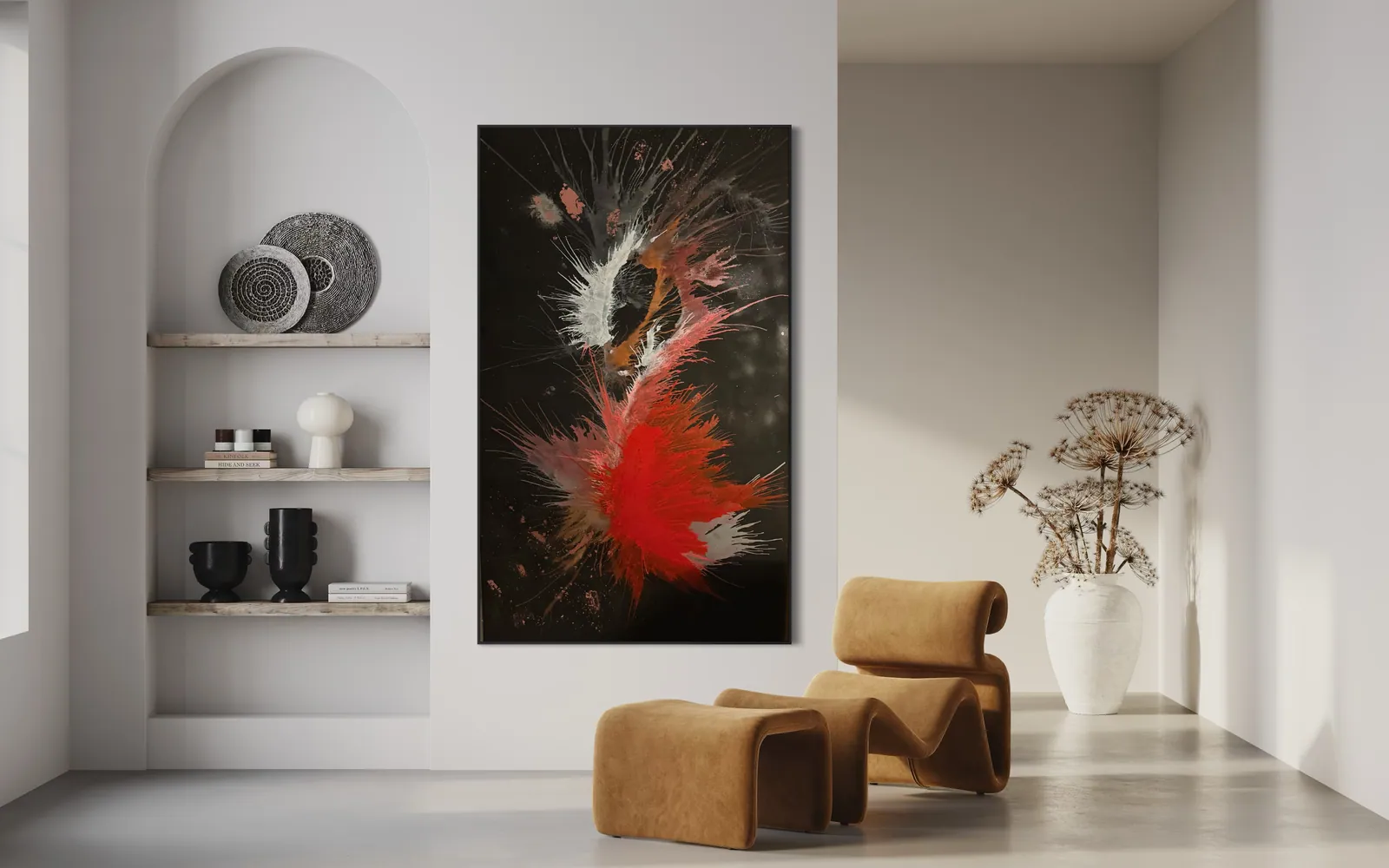
Why buy directly from a Brazilian studio
Most collectors outside Brazil encounter contemporary Brazilian art through a gallery abroad, if at all — and by the time a painting reaches a foreign gallery wall, it has usually passed through a margin, a shipping consolidator, and months of circulation. Buying directly from the artist's studio removes that layer. There is no gallery commission built into the price, and the work you are looking at has typically not been shown or sold before — no waiting list, no prior owner, no secondary-market history.
Perfeito Studio is the working studio of Alyne Perfeito, a Brazilian visual artist and architect based in Brasília, Brazil. She is early in her career — this is not a gallery-represented practice with an exhibition record, and the studio does not claim one. What it offers instead is direct access: you are buying from the person who made the work, who can answer a question about the surface, the pigment, or the intention behind a piece in a way a gallery representative reciting a price list cannot.
The trade-off is real and worth naming. You lose the reassurance of a gallery's vetting and the ability to see the work in person before deciding. What replaces it is a slower, more direct conversation — photographs of the actual surface, video of the texture in raking light, and a dialogue about where the piece will hang before you commit.
What you receive and how authenticity is documented
Every work sold by Perfeito Studio is accompanied by a fixed set of documents, regardless of size or price:
- A signed certificate of authenticity, naming the artist, the title, the medium, the dimensions, and the year.
- A curatorial dossier describing the work's place within its series and the ideas behind it.
- A conservation and installation guide — how to handle, hang, and care for a heavily textured mixed-media surface.
- An Archive ID in the format
AP-<SERIES>-<YEAR>-<NNN>(for example,AP-HOC-2025-001), which identifies the piece permanently in the studio's own catalog. - A signed acquisition agreement confirming the transfer of ownership and the terms of sale.
This is the paper trail that stands in for a gallery's provenance record. It will not carry the weight of an auction house condition report, but it establishes, in writing, exactly what you bought and from whom — which matters if you later insure the work, resell it, or simply want to describe it accurately to a guest standing in front of it.
Shipping abroad: what actually happens
The works in the current catalog are large format, on canvas, with heavy texture and layering — a physical fact the studio takes into account when preparing a shipment. The packing method and the cost are decided case by case, depending on the specific piece and the destination country, and quoted on request directly with the studio — there is no fixed shipping fee published for international orders.
What you should plan for, without a specific number attached to it because it depends entirely on your country and courier: freight cost and any import duties or taxes are the buyer's responsibility, not the studio's. Every country sets its own de minimis thresholds and rates for imported artwork, and these change — the honest answer is to check with your own customs authority or a customs broker before you commit, rather than trust a number that may be out of date by the time your piece ships. The same goes for delivery timelines: international art freight and customs clearance both add variable time on top of production and packing, and the studio will give you a realistic estimate for your specific destination once a piece and a country are confirmed, rather than a generic promise.
How the conversation actually works
There is no online checkout for these works. The process runs through a direct conversation, by WhatsApp, in whichever of English or Portuguese you prefer — Alyne is bilingual and answers her own messages.
A typical exchange looks like this: you share which piece caught your attention (or a series and a size range, if you are still deciding), and in return you receive close-up photographs of the actual canvas — not just the catalog image — along with a short video showing the surface texture in raking light, since that is the one thing a screen cannot convey about these paintings. If you send a photo of the wall where the piece would hang, along with its measurements and the direction of the light in the room, you will get a more specific opinion on scale and framing than a generic size chart could offer.
Once a piece is confirmed, the conversation moves to logistics — packing method, your shipping address, and payment, all quoted for your specific destination. Cross-border payment for a work like this is arranged case by case (international wire transfer is the most common method), and the studio will walk you through the specifics for your country once the piece and destination are set.
From the studio
From the studio
Before I answer a message with a price, I ask for the wall. Not the room — the wall. A photo of it, and which way the light comes in during the afternoon. I trained as an architect before I painted seriously, and I have not been able to unlearn thinking about a piece as something that has to hold its own against a specific volume of space, not float in a generic listing photo.
The other thing I send, every time, before someone from another country commits to a piece: a video of the surface at an angle, with the light raking across it. My work is built in layers — acrylic, metallic pigment, sometimes a matte pass over a gloss one — and that relief is the whole point. A flat catalog photo tells you the color. It cannot tell you that the surface changes as you walk past it, that a ridge of paint catches the light differently at four in the afternoon than it does at nine. If you are going to live with a painting you found on a screen, you deserve to see the one thing the screen is bad at showing.
Frequently asked
How does international shipping actually work for a painting bought from Brazil?
<p>There is no fixed shipping method or fee published — the packing approach and cost are worked out case by case with the studio, based on the specific piece and your destination country, and quoted on request once those are confirmed.</p>
Will I have to pay customs duties or import taxes?
<p>Very likely yes, though the exact rate and threshold depend entirely on your country's own customs rules, which change and are outside the studio's control. Import duties, taxes, and any brokerage fees are the buyer's responsibility. It is worth checking with your local customs authority or a broker for artwork imports before you commit, rather than assuming a fixed percentage.</p>
How do I pay for a piece from outside Brazil?
<p>There is no online checkout — payment is arranged directly with the artist once a piece is confirmed, typically by international wire transfer. The specifics (currency, receiving details, timing) are worked out for your country during the WhatsApp conversation, alongside the shipping method and address.</p>
Is each work actually one of a kind, or are there editions?
<p>Every painting is a unique, single original — there are no editions or prints of these works. Each piece carries its own Archive ID (format <code>AP-<SERIES>-<YEAR>-<NNN></code>) and, once sold, is recorded as unavailable; it will not be reproduced or resold by the studio.</p>
What if I can't see the piece in person before buying?
<p>This is the central trade-off of buying directly from a studio abroad. In place of an in-person viewing, you receive close-up photographs of the actual canvas, a video of the surface texture in raking light, and direct answers to any question about materials or condition, from the artist herself. It is a different kind of trust than a gallery visit, built through a more detailed conversation rather than a showroom.</p>
Talk to the studio before you decide
Send a photo of your wall and the piece you're considering — Alyne replies in English or Portuguese with close-up images, a texture video, and a realistic shipping estimate for your country.
Talk to the studio on WhatsApp
Published on