Journal · Technique & materials
Gestural vs geometric abstraction: what is the difference?
Gestural abstraction records the artist's spontaneous movement, a dripped or dragged mark, as in Jackson Pollock and Willem de Kooning's action painting. Geometric abstraction plans the composition first, from flat color and measured shapes, as in Mondrian's Neo-Plasticism or Op Art. One records an instant; the other executes a plan. Alyne Perfeito's studio works in the first register.
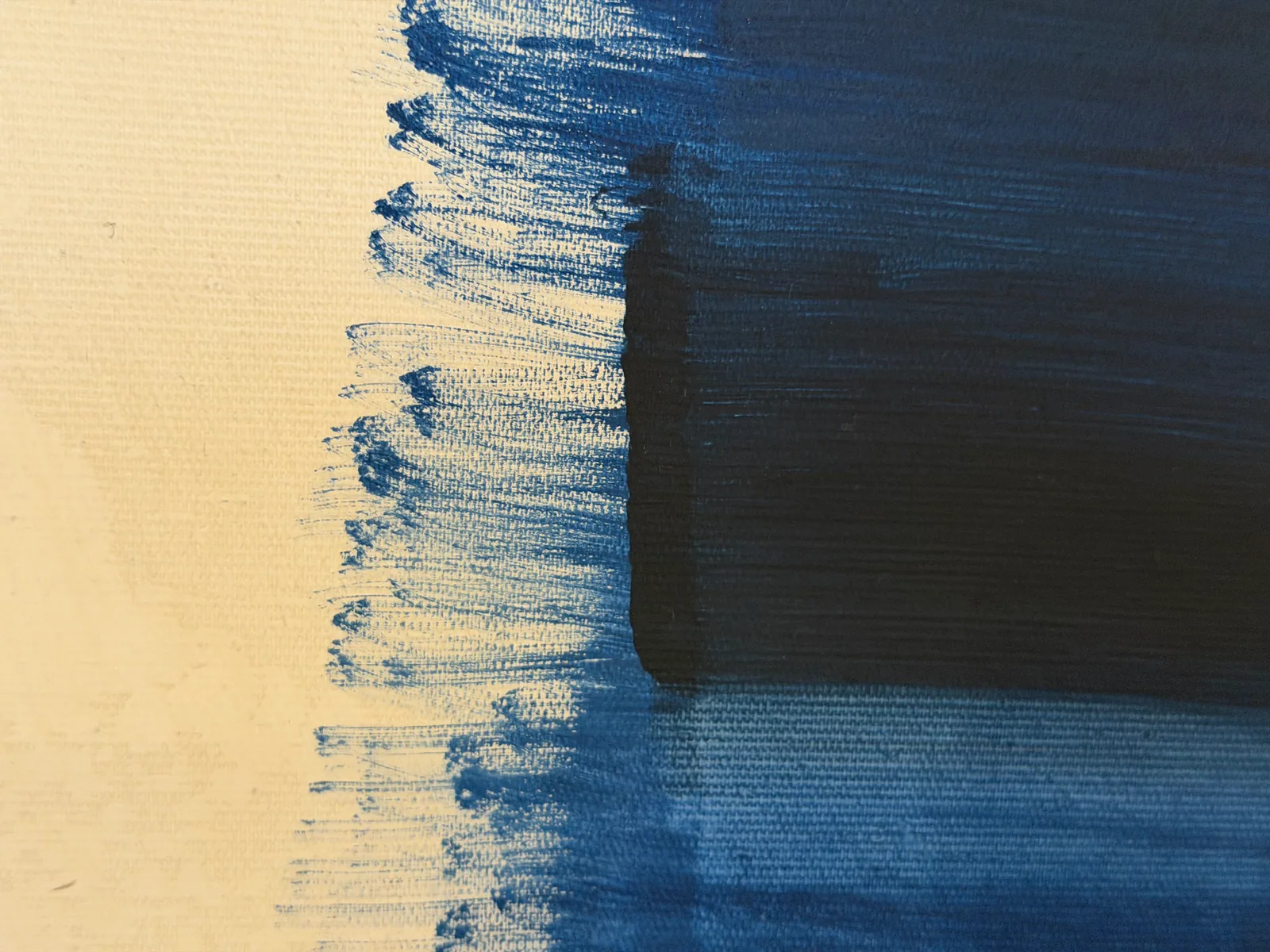
What separates the two approaches, in practice
Both are ways of painting without depicting a recognizable subject, but they start from opposite decisions. Gestural abstraction lets the physical act of painting show — the speed of the arm, the amount of pigment loaded on the brush, the point where a poured line thins and breaks. Tate's own definition of gestural painting describes it as paint applied "in free sweeping gestures," with the artist's inner impulse acted out directly on the canvas rather than translated through a preset design.
Geometric abstraction inverts that sequence. The composition exists as a decision — a grid, a set of flat color fields, a mathematically derived pattern — before a single brushstroke happens, and the execution is often deliberately impersonal, with edges kept sharp and clean rather than expressive. Neither approach is more or less abstract than the other; they simply locate the meaning of the work in different places — one in the record of the gesture, the other in the logic of the structure.
Gestural abstraction: the mark as an event
The clearest historical case for gestural abstraction is action painting, the branch of Abstract Expressionism that critic Harold Rosenberg named in his 1952 essay "The American Action Painters." Rosenberg's term described Jackson Pollock, Willem de Kooning, Franz Kline, and Arshile Gorky — painters working from the 1940s into the early 1960s whose drips, splashes, and sweeping brushstrokes made the physical act of painting part of the finished work, not just the means to it.
Tate traces the wider gestural approach to earlier automatism in Joan Miró's work, and lists Pollock, de Kooning, Kline, Robert Motherwell, and Hans Hofmann among its key figures. Pollock's poured technique — paint applied from sticks, dried brushes, or directly from the can rather than a loaded brush touching canvas — is the most extreme version of the idea: the tool records the gesture almost without mediation.
Geometric abstraction: composition as structure
Geometric abstraction has its own separate lineage, running in parallel to — and often in explicit reaction against — gestural painting. Piet Mondrian's Neo-Plasticism, developed within the De Stijl circle and articulated in his own manifesto essays up to 1923, restricted painting to primary colors and non-colors, only squares and rectangles, only strictly horizontal or vertical lines — a deliberate reduction Tate describes as a search for "a pure representation of the human mind."
The same rational impulse reappeared, independently, in Brazil in the early 1950s. Grupo Ruptura, founded in São Paulo and formally presented in December 1952 by seven artists including Waldemar Cordeiro and Geraldo de Barros, built compositions from mathematical formulas rather than intuition, treating figurative painting as clouded by emotion and pursuing objectivity instead — the group's 1952 exhibition is treated as a founding moment of what became known as Brazilian Concretism. A decade later, Op Art pushed the same logic toward the eye itself: Tate describes it as a 1960s movement that used geometric forms to trigger real optical effects — shimmer, vibration, apparent movement — with Victor Vasarely and Bridget Riley as its leading figures. And hard-edge painting, a term coined by critic Jules Langsner in 1959, named the West Coast reaction to gestural Abstract Expressionism: flat color with sharp, impersonal edges, explicitly tracing back to Mondrian and to Josef Albers.
How to tell them apart in front of a painting
In practice, the fastest test is to look at the edge of a shape. If the boundary between two colors is soft, uneven, or shows the direction and pressure of a brush or a pour, the painting is working in the gestural register. If the boundary is a straight, taped-clean line with no trace of the hand, it is working in the geometric register.
The two are not always mutually exclusive within a single career, or even a single canvas. Hard-edge painting itself only exists because painters reacted against gestural Abstract Expressionism while still working in an abstract, non-representational field. A painter can plan a structure — a division of the canvas into zones — and then let a gestural mark move through or across it, using the tension between the two decisions as the subject of the work.
From the studio
The olhar do ateliê: where this studio's practice sits
Perfeito Studio's own work sits on the gestural, textural side of this line, not the geometric one. Alyne Perfeito builds a surface in layers — pigment, sculpted texture paste, sometimes metallic dust or gold leaf — and then lets a single gesture move through it rather than laying out a grid in advance. In Silent Interval (Matter & Silence series), the black line that runs down the canvas was allowed to thicken, thin, and scatter into droplets before settling, the same way action painting lets the pour record its own trajectory instead of following a ruled path. None of the studio's five series works in the planned, mathematically composed language of Concretism or Op Art — no grid, no taped edge, no color-theory diagram decided before the brush moves. That is a description of a working method, not a ranking: geometric abstraction is not a stage a gestural painter graduates into, and this studio has no plans to change registers.
Frequently asked
What is the main difference between gestural and geometric abstraction?
Gestural abstraction records the artist's physical movement as it happens — a brush loaded with paint dripped, dragged, or flung across the canvas — so the mark carries the trace of that movement, close to Tate's own definition of the term. Geometric abstraction reverses the order: the composition is decided before the brush touches the canvas, built from flat color, straight lines, and measured shapes such as grids or squares. One approach records an instant; the other executes a plan made in advance.
Is Abstract Expressionism gestural or geometric?
It had a gestural branch and a separate branch that was not geometric either. Action painters — Jackson Pollock, Willem de Kooning, Franz Kline, Arshile Gorky — worked in the gestural, improvisatory current that critic Harold Rosenberg named in 1952. The movement's other current, color field painting, used large flat areas of color and is closer to a planned approach, but art historians classify it within Abstract Expressionism, not as geometric abstraction.
Is Op Art gestural or geometric abstraction?
Op Art is geometric abstraction. Tate describes it as a 1960s movement built entirely from geometric forms — grids, stripes, curves — engineered with color theory and the physiology of perception to create optical effects such as shimmer or apparent movement. Its leading figures, Victor Vasarely and Bridget Riley, planned each composition with precision; nothing in Op Art depends on a spontaneous, unrepeatable gesture.
Can one painting combine both approaches?
Yes. A painter can plan a geometric structure — a grid or a division of the canvas into fields — and then work gesturally within or across it, letting drips, texture, or loose brushwork interrupt the underlying order. Hard-edge painting itself grew out of this tension: it emerged in the late 1950s as a deliberate, impersonal reaction to the gestural abstraction that had dominated the previous decade, borrowing the flat color of Mondrian and Josef Albers instead of the loaded brush.
Which approach is closer to Alyne Perfeito's work at Perfeito Studio?
Closer to gestural and textural abstraction. Alyne Perfeito's practice — sculpted relief, poured pigment, marks that record a single continuous movement, as in Silent Interval — works through gesture and material process rather than a pre-planned grid or hard-edge geometry. None of her current series works in the ruled, mathematically composed language of Concretism or Op Art.
See gestural abstraction in the studio's own work
Silent Interval and the rest of the Matter & Silence series work through gesture and sculpted texture, not planned geometry. Ask the studio for detail photographs or availability.
Published on