What was Op Art?
Op Art was a movement of the 1960s built entirely from geometric pattern — no image, no story — designed to trigger real optical effects in the eye: shimmer, vibration, apparent movement. Tate names Bridget Riley and Victor Vasarely as its leading figures, working first in black and white, later in color.
What Op Art actually does to the eye
Op Art, short for optical art, is a style built from geometric pattern rather than image or narrative. Tate defines it directly: "Op art was a major development of painting in the 1960s that used geometric forms to create optical effects," drawing on colour theory and on the physiology and psychology of perception rather than on subject matter. The point is not what a picture shows, but what happens in the eye while looking at it — shimmer, vibration, or an illusion of movement inside a surface that never physically moves.
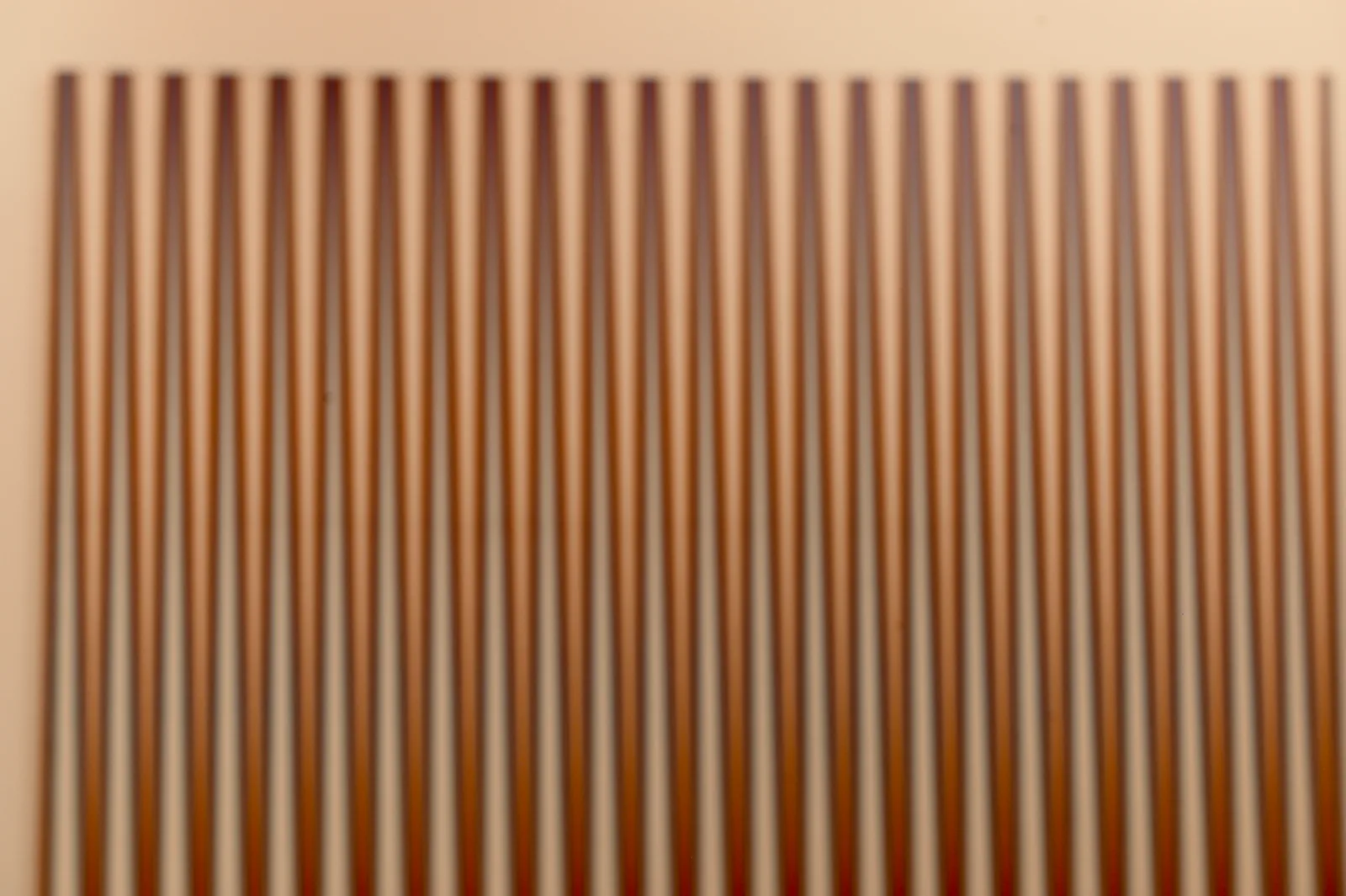
The image on this page, Bridget Riley's Orient IV (1970, Berardo Collection, Lisbon), shows the method in its most literal form: vertical bands of colour, spaced and graded with enough precision that the eye starts reading motion where the canvas is completely still.
Vasarely and Riley: the movement's two central figures
Tate names its leading figures in a single sentence: "Leading figures were Bridget Riley, Jesus Rafael Soto, and Victor Vasarely." Victor Vasarely (1908–1997) is singled out further — Tate describes him as "one of the originators of op art." Bridget Riley, born in 1931 in Norwood, London, built her reputation on black-and-white paintings that work directly on the nervous system: Tate writes that pieces such as Fall (1963, Tate Gallery T00616) "produce a disorienting physical effect on the eye."
Recognition followed fast. Riley was awarded the AICA Critics Prize in 1963, the same year she painted Fall, and in 1968 she won an International Painting Prize at the Venice Biennale — one of the clearest signs that what had started as an optical experiment was being read as serious painting.
1965: the movement gets a name and a blockbuster show
Op Art moved from studio experiment to public phenomenon at the Museum of Modern Art in New York, where the exhibition The Responsive Eye ran from February 23 to April 25, 1965, organized by curator William C. Seitz, before touring to St. Louis, Seattle, Pasadena, and Baltimore. The show gathered artists working in geometric abstraction and optical perception — Vasarely and Riley among them — under a single roof, and gave a wide public its first concentrated look at paintings built to be felt in the eye before they were read as pictures.
From black and white to colour
Op Art is often remembered as strictly black and white, and for its first decade that holds up reasonably well. Victor Vasarely's own foundation dates his "Black-White period" to "1954-1960," describing the underlying method this way: "The principle of the optical illusion proceeds from the plastic unit made up of two contrasting color forms which will be the black and the white until 1960." Riley's own black-and-white breakthrough, Fall, belongs to this same early phase, painted in 1963.
The movement did not stay monochrome, though. Orient IV, the work pictured on this page, is proof: painted in 1970 in bands of ochre and blue-grey, it already works entirely in colour. The Berardo Collection's own catalogue entry describes Riley's broader trajectory this way: she "returned colour to her works and, in the mid 70s, through the use of white, managed to filter one colour into another, so as either to produce a third or to diminish the effect of the other two." The optical vibration survives the shift from black-and-white to colour; it simply moves from tonal contrast to chromatic contrast.
From the studio
Where interval becomes the whole subject
In Riley's stripes, the interval between one line and the next is doing all the work — change the spacing by a millimetre and the vibration changes with it. I don't build optical illusions in my own paintings, and Perfeito Studio has no interest in tricking the eye. But Silent Interval was built around a version of the same question: the piece isn't really about the single dark line that falls through the canvas, it's about the charged, quiet space that separates that line from the block of blue anchoring the lower edge. Riley calculates interval to produce motion; I leave mine empty to produce weight. Different aim, same conviction — that what happens between two marks can carry as much as the marks themselves.
Frequently asked
What is Op Art?
Op Art, short for optical art, is a style of painting built from geometric pattern rather than image or narrative. Tate defines it as a major development of painting in the 1960s that used geometric forms to create optical effects, drawing on colour theory and on the physiology and psychology of perception. The point is not what the picture shows, but what happens in the eye while looking at it: shimmer, vibration, or an illusion of movement in a surface that never physically moves.
Who were the key artists of Op Art?
Tate names Bridget Riley, Jesus Rafael Soto, and Victor Vasarely as the movement's leading figures, describing Vasarely specifically as one of its originators. Vasarely, active from 1908 to 1997, laid the geometric groundwork through the 1950s. Riley, born in London in 1931, became one of the movement's best-known names with black-and-white paintings such as Fall (1963), winning the AICA Critics Prize that year and an International Painting Prize at the 1968 Venice Biennale.
How is Op Art different from Pop Art?
The two movements emerged in the same decade but work with opposite material. Pop Art, as Tate describes it, drew its imagery from advertising, packaging, and consumer culture, treating everyday objects as valid subjects for fine art. Op Art has no subject in that sense at all: it works entirely through geometric pattern, colour theory, and the physiology of perception, aiming to produce a physical, optical effect in the viewer rather than to depict anything from the world outside the canvas.
Does Op Art use color or just black and white?
Both, at different points. The movement's best-known early works are black and white — Victor Vasarely's own foundation dates his black-and-white period to 1954-1960, and Bridget Riley's breakthrough painting Fall, from 1963, works the same way. But Op Art did not stay monochrome: by 1970, when Riley painted Orient IV, now in the Berardo Collection in Lisbon, she had returned colour to her practice, later filtering one hue into another through the use of white.
Is Op Art still influential today?
Yes, though it is no longer a headline movement. TheArtStory notes that although Op Art lost popularity by 1968, its systematic optical effects continue to be explored in visual art and architecture. The legacy shows up less as a revival of 1960s stripe paintings and more as a lasting interest in how geometry, repetition, and colour interval can make a static surface feel like it is moving.
Sources
- Tate — 2026-08-16
- Tate — 2026-08-16
- Tate — 2026-08-16
- Tate — 2026-08-16
- Fondation Vasarely — 2026-08-16
- Colecção Berardo — 2026-08-16
- Wikimedia Commons — 2026-08-16
- Wikipedia — 2026-08-16
- TheArtStory — 2026-08-16
- Tate — 2026-08-16
- Perfeito Studio internal catalog — 2026-08-16
Curious how interval and rhythm work on a canvas?
Silent Interval explores the same question Op Art asks with straight lines — what the space between two marks can carry — worked here in gesture and stillness rather than optical vibration. Message the studio in English or Portuguese for close-up photos of the surface.
Talk to the studio on WhatsApp
Published on