What was Pop Art?
Pop Art was an art movement that emerged in the mid-1950s in Britain and the late 1950s in the United States, reaching its peak through the 1960s. Pop artists turned to advertising, product packaging, Hollywood movies, and comic books as raw material for fine art, deliberately erasing the line between popular culture and the gallery wall.
When and where Pop Art began
Pop Art is, in Tate's own description, "an art movement that emerged in the 1950s and flourished in the 1960s in America and Britain, drawing inspiration from sources in popular and commercial culture." Tate dates it more precisely: "Emerging in the mid 1950s in Britain and late 1950s in America, pop art reached its peak in the 1960s." The 1950s art group The Independent Group is regarded by Tate as the precursor to the British Pop Art movement — a circle of young artists, writers, and critics discussing mass culture before the paintings themselves arrived.
The two strands weren't identical. As Tate puts it: "Early pop art in Britain was fuelled by American popular culture viewed from a distance, while the American artists were inspired by what they saw and experienced living within that culture." The British were working from photographs and imported films; the Americans were working from inside the consumer culture itself.
Why artists turned to advertising and comic books
According to Tate, Pop Art "began as a revolt against the dominant approaches to art and culture and traditional views on what art should be." Young artists felt that "what they were taught at art school and what they saw in museums did not have anything to do with their lives or the things they saw around them every day. Instead they turned to sources such as Hollywood movies, advertising, product packaging, pop music and comic books for their imagery."
In the United States this also meant a reaction against Abstract Expressionism. Tate notes that American Pop artists wanted "to move away from the emphasis on personal feelings and personal symbolism that characterised abstract expressionism" — trading the gestural, subjective mark for hard edges, recognizable objects, and imagery anyone walking into a supermarket would already know by heart.
In 1957, the British artist Richard Hamilton tried to pin down what made the new sensibility different, in a letter to his friends the architects Peter and Alison Smithson. His list has become the closest thing Pop Art has to a manifesto: Pop Art is "Popular (designed for a mass audience), Transient (short-term solution), Expendable (easily forgotten), Low cost, Mass produced, Young (aimed at youth), Witty, Sexy, Gimmicky, Glamorous, Big business."
A case study: Peter Blake's On the Balcony
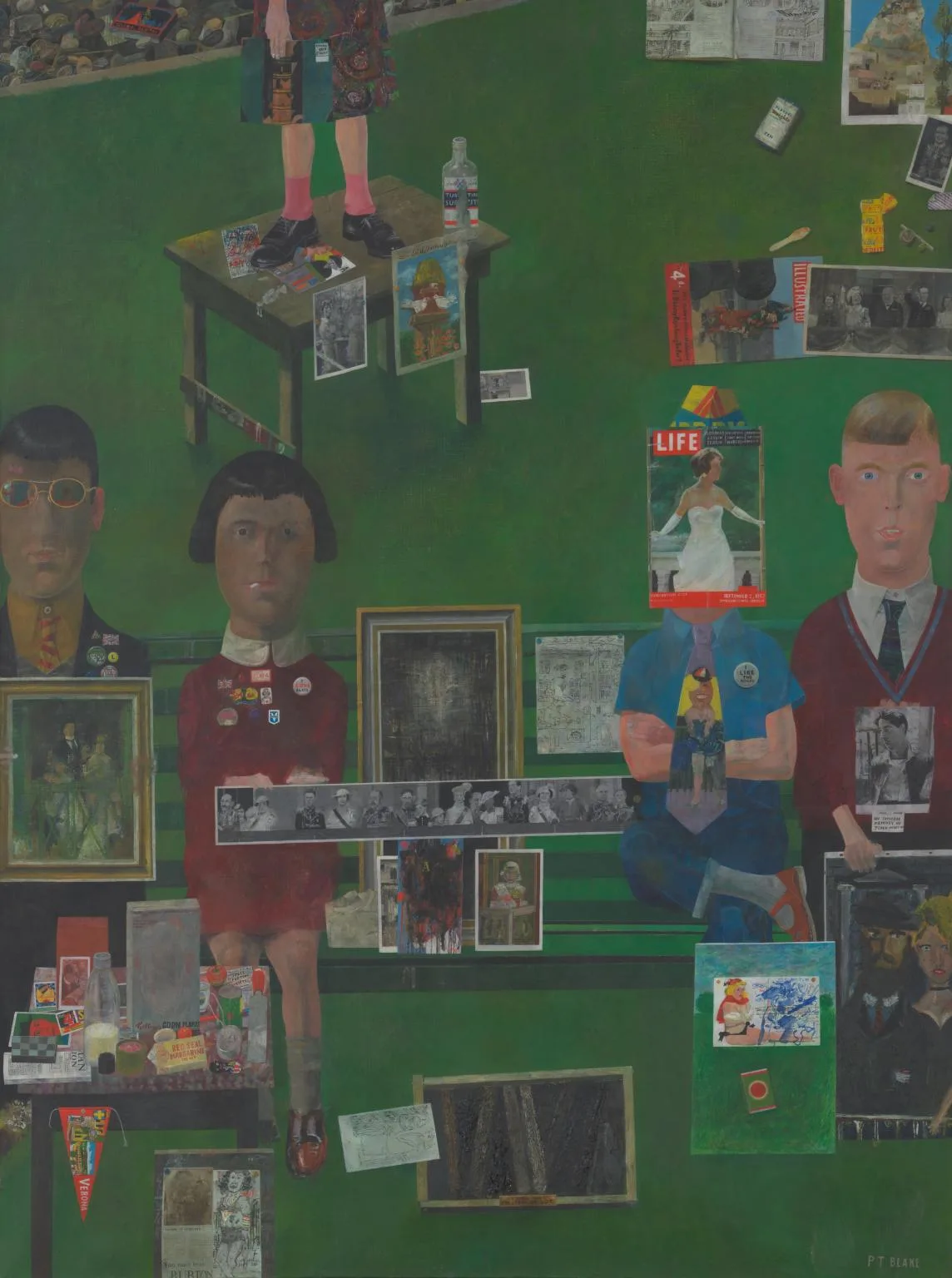
Peter Blake, born in Dartford, England, in 1932 and trained at the Royal College of Art, is described by TheArtStory as the "Godfather of British Pop art." His painting On the Balcony (1955–7), held by Tate under accession number T00566, is one of the earliest and most literal demonstrations of what the movement was doing: rebuilding the raw material of magazines, snapshots, and museum postcards, piece by piece, into a single canvas.
Despite its appearance, On the Balcony is not a collage. Wikipedia describes it as a work that "appears to be a collage but is wholly painted" — every magazine cover, campaign badge, and photograph in the composition is rendered in oil paint. TheArtStory calls this Blake's signature technique of making "metapictures, or paintings of pictures within pictures." The canvas holds around 32 separate references to the theme of a balcony, according to TheArtStory, including a figure at left holding a painted reproduction of Édouard Manet's The Balcony (1868), while a copy of LIFE magazine obscures another figure's head entirely.
The painting measures roughly 121.3 by 90.8 cm and was presented to Tate by the Contemporary Art Society in 1963, six years after Blake completed it.
Fine art or commercial art?
The question Pop Art forces is whether it was serious art, or commercial art with a gallery wall built around it. Tate's own framing answers by refusing the split: "Modernist critics were horrified by the pop artists' use of such 'low' subject matter and by their apparently uncritical treatment of it," Tate writes, but argues that "pop both took art into new areas of subject matter and developed new ways of presenting it in art and can be seen as one of the first manifestations of postmodernism."
That framing outlasted the movement. It's the same question anyone still asks, consciously or not, standing in a gallery: does a subject have to be rare or difficult to qualify as fine art? Pop Art's answer — that a soup can, a comic panel, or a stack of old LIFE magazines can carry exactly as much meaning as a landscape, if the painter treats it that way — is now close to consensus. What was radical in 1957 is mostly assumed today.
From the studio
What Peter Blake's crowded canvas has in common with my empty ones
I've never painted anything that looks like On the Balcony — there isn't a single found image or campaign badge anywhere in my own work, and appropriating other people's pictures has never interested me. But what stops me in front of a painting like Blake's isn't the subject matter, it's the structure: he built an entire canvas out of layers, each one a separate decision about what got to stay in frame. That's a question I ask on every canvas too, just with pigment and metallic dust instead of magazine cutouts.
In Amber Strata, I built the surface in horizontal passages — ochre, bone, oxidized umber — layered until the canvas stopped reading as a painting and started reading as a cross-section of sediment. Nothing in it is a picture of anything else, the way Blake's balcony is full of pictures of pictures. But the underlying decision is the same one Pop Art forced into the open: what gets to count as material worth putting on a canvas, and in what order it goes down. Blake answered that question with the ephemera of 1950s London. I answer it with what's actually in front of me in the studio — pigment, gold leaf, and time.
Frequently asked
What was Pop Art and when did it emerge?
Pop Art was an art movement that used images from advertising, packaging, movies, and comic books as raw material for painting and sculpture. According to Tate, it emerged in the 1950s and flourished in the 1960s in America and Britain, drawing inspiration from sources in popular and commercial culture. British Pop Art began in the mid-1950s, growing out of a group of artists, writers, and critics called the Independent Group; a distinct American strand followed by the late 1950s, and both reached their peak through the 1960s.
Who were the key artists of Pop Art?
Tate's own pages on the movement associate it most closely with Andy Warhol and Roy Lichtenstein in the United States, and with Richard Hamilton, Peter Blake, David Hockney, and Patrick Caulfield in Britain. Hamilton is often credited with writing the movement's clearest definition, in a 1957 letter to his friends the architects Peter and Alison Smithson, describing Pop Art as popular, transient, expendable, low-cost, mass-produced, and aimed at a young audience — a description that reads as much like an account of advertising as of art.
Why did Pop Art use images from advertising and consumer products?
Tate explains that young artists in the 1950s felt what they were taught at art school, and what they saw in museums, had little to do with their own lives. Instead they turned to Hollywood movies, advertising, product packaging, pop music, and comic books for imagery — sources that were already everywhere around them. Using this material also let American artists move away from Abstract Expressionism's emphasis on personal feeling, replacing it with impersonal, mass-produced, and instantly recognizable imagery drawn straight from consumer culture.
Is Pop Art considered fine art or commercial art?
Tate describes Pop Art as one of the first manifestations of postmodernism, precisely because it refused to keep 'high' and 'low' culture in separate categories. Modernist critics at the time were horrified by pop artists' use of such 'low' subject matter, treating it as beneath serious painting. Pop artists disagreed: by painting a soup can or a comic-strip panel with the same weight normally reserved for a landscape, they treated popular, commercial imagery as equally valid material for fine art, without ever fully resolving whether the result was closer to advertising or to painting.
Did Pop Art influence contemporary art today?
There's no single documented line connecting today's art back to Pop Art, but its foundational role is well established: Tate identifies Pop Art as one of the first manifestations of postmodernism, the framework, still central to contemporary art, that treats 'high' and 'low' culture as equally valid material. By making advertising, packaging, and mass media into legitimate subjects for painting, Pop Art permanently widened what counts as a valid subject for fine art — a premise most contemporary artists now take for granted rather than argue for.
Curious how a canvas gets built, layer by layer?
Amber Strata works the same question Pop Art asked in paint — what's allowed onto the canvas, and in what order — just with pigment and gold leaf instead of magazine cutouts. Message the studio in English or Portuguese for close-up photos of the layered surface.
Talk to the studio on WhatsApp
Published on