Journal · Technique & materials
What is impasto in painting?
Impasto is paint or texture paste applied thickly enough that the brush or knife stroke survives as raised, physical relief on the canvas — not a painted illusion of texture, but material that genuinely stands off the surface. The word comes from the Italian for "dough," and the technique runs from Renaissance oil painters to modern abstraction.
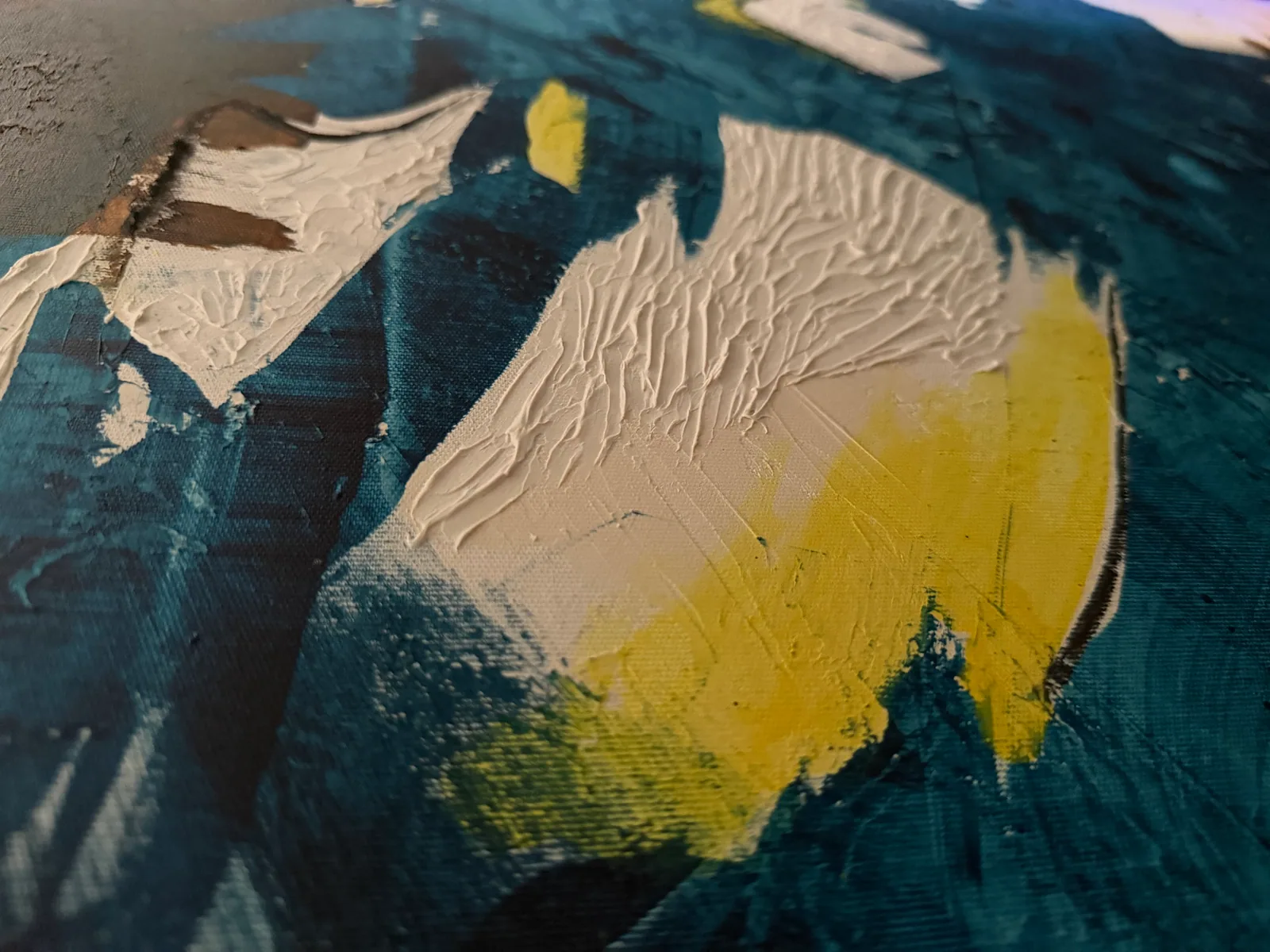
What impasto means, exactly
Impasto refers to an area of thick paint or texture in a painting, applied heavily enough that the marks of the brush or palette knife remain visible as physical relief once the work is dry. The word is Italian, related to the verb "impastare" — to knead or paste — a direct reference to the dough-like consistency paint takes on when built up this way.
The technique appears in the work of Venetian Renaissance painters such as Titian and Tintoretto, and later in Baroque painting through artists like Rubens, becoming increasingly common in nineteenth-century landscape, naturalist, and romantic painting. Van Gogh is the most cited turning point: he used impasto frequently and expressively, covering entire canvases with visible ridges of paint rather than confining the technique to small highlights. In the twentieth century, painters including Frank Auerbach, Jean Dubuffet, Leon Kossoff, Hans Hofmann, and Willem de Kooning pushed the thickness further still, treating the painted surface as a physical reality in its own right rather than a smooth window onto an illusion.
Does it only work with heavy body acrylic?
No. Oil paint is the traditional medium for impasto, and for a practical reason: it is naturally thick and dries slowly, giving a painter time to work the mass of paint with a brush or knife before it starts to set. That is not a limitation on the technique, only the medium it originated in.
Acrylic reaches the same raised, physical relief by adding a heavy body gel — a colorless extender that dries transparent, so it holds the paint's own pigment color once cured. A related but distinct material is modeling paste (also called texture paste), which is not paint at all: it is typically an acrylic base loaded with marble dust for opacity, used to sculpt the relief before color is added, and it dries opaque rather than transparent. In studio practice the two are frequently combined — paste builds the architecture of the relief, paint supplies the color afterward — and acrylic's faster drying time and lighter final weight make it a practical choice for large-format, large-scale works.
Does impasto make a painting more fragile over time?
It can, if the thick layer is built without the sequence heavy paint requires. Conservation guidance for oil impasto is specific on the mechanism: slow-drying colors need to sit on top of fast-drying colors, not the other way around. Reversing that order — a fast-drying layer applied over paint that is still drying slowly underneath — blocks oxygen from reaching the lower layer, leaves it incompletely dried, and is a documented cause of cracking.
The same guidance points to a firm, well-pigmented primer (or a quality texture paste as structural base for very heavy work) and a cool, dry, stable environment during the drying period, which for thick impasto can take considerably longer than a thin paint film. Built with that sequence in mind, impasto is not inherently more fragile than any other oil or acrylic painting on canvas — the risk sits in rushing the layers, not in the relief itself.
How to recognize impasto in a photograph
A flat, front-lit photograph is the hardest condition to judge texture in, because impasto reveals itself through shadow, not color. The giveaway is raking light — light striking the surface at a low angle — which throws small shadows along every ridge left by the brush or knife and separates a genuinely raised surface from a flat one painted to imitate texture.
What to look for: shadows that shift position between two photographs taken under different lighting (a flat print of a texture will not do this); visible directional strokes with a slight three-dimensional edge, rather than a uniform photographic sharpness; and, in a still image, tonal variation within what should be a single flat color, caused by the paint's own peaks and valleys catching light differently. None of this is fully conclusive from a single photo — which is exactly why a serious inquiry on a textured piece should include detail shots under raking light, and ideally a short video, before any decision is made.
From the studio
The atelier's view: the relief in Crossing Currents
I don't build relief in Crossing Currents with oil paint — I work with acrylic and texture paste, applied in layers before color goes on. That's not only an aesthetic choice: texture paste over an acrylic ground dries in hours, not weeks, and that changes the entire working rhythm when I'm building the fields of deep blue that dominate this canvas, along with the earthy browns and the flashes of yellow and white that cut across the composition.
The physical relief there isn't decoration — it's what lets the tension between movement and grounding that gives the piece its name exist on the surface itself, not only in the color. In a photograph, what comes through is the composition; in person, under light that shifts angle through the day, the texture paste's relief appears and recedes, as if the current the painting describes were happening in the skin of the canvas itself.
Frequently asked
What is impasto in painting, in simple terms?
Impasto is paint applied in a layer thick enough that the marks left by the brush or palette knife stay visible as raised, physical relief once the paint is dry, rather than lying flat on the canvas. The word comes from the Italian verb for kneading or pasting, a reference to the dough-like consistency the paint takes on when built up this way.
Does impasto only work with heavy body acrylic paint?
No. Oil paint is the traditional medium for impasto because it is naturally thick and dries slowly, giving time to shape the paint before it sets. Acrylic reaches a comparable raised relief with the addition of a heavy body gel, which dries transparent and holds the paint's own color, or with modeling paste, an opaque, marble-dust-loaded material often used to build the relief before paint is added. Studios frequently combine both approaches on the same piece.
How can you tell that a painting uses impasto just by looking at a photo?
The clearest sign is raking light — light hitting the surface at a low angle, which casts small shadows along every ridge of paint and separates a genuinely raised surface from a flat one only painted to look textured. Look for shadows that move between photos taken under different lighting, visible directional brush or knife strokes with a slight three-dimensional edge, and tonal variation within what should be one flat color. A single front-lit photo is not conclusive; detail shots under raking light or a short video settle it.
Does impasto make a painting more fragile over time?
It can, if the thick layer is built in the wrong order. Conservation guidance for oil impasto specifies that slow-drying colors need to sit over fast-drying colors, not underneath them — reversing that order blocks oxygen from reaching the lower layer and is a documented cause of cracking. A firm, well-pigmented primer, correct drying sequence, and a stable, dry environment during curing reduce that risk substantially. Built with those precautions, impasto holds up as well as any other oil or acrylic painting on canvas.
Is impasto applied with a brush or a palette knife?
Both are used, sometimes on the same painting. A brush gives more control over the direction and shape of individual strokes, while a palette knife lays down and shapes larger masses of paint or texture paste more quickly, leaving flatter planes and sharper edges. The choice is a working preference tied to the effect an artist wants at a given point in the composition, not a rule tied to impasto itself.
Sources
- Tate — 2026-08-19
- Wikipedia — 2026-08-19
- Artists Network — 2026-08-19
- Just Paint (Golden Artist Colors) / EuACA — 2026-08-19
Want to see the impasto up close?
We can send high-resolution detail photographs under raking light and, when useful, a short video showing how the texture reads as the light changes — before any acquisition decision.
Talk to the studio on WhatsApp
Published on