How art auctions work
An art auction moves through four stages: catalog and preview, bidding, the hammer price, and payment — with a buyer's premium of roughly 15% to 28% added on top of the hammer price at major houses. A lot that fails to meet its reserve price stays unsold, a result known as being bought in.
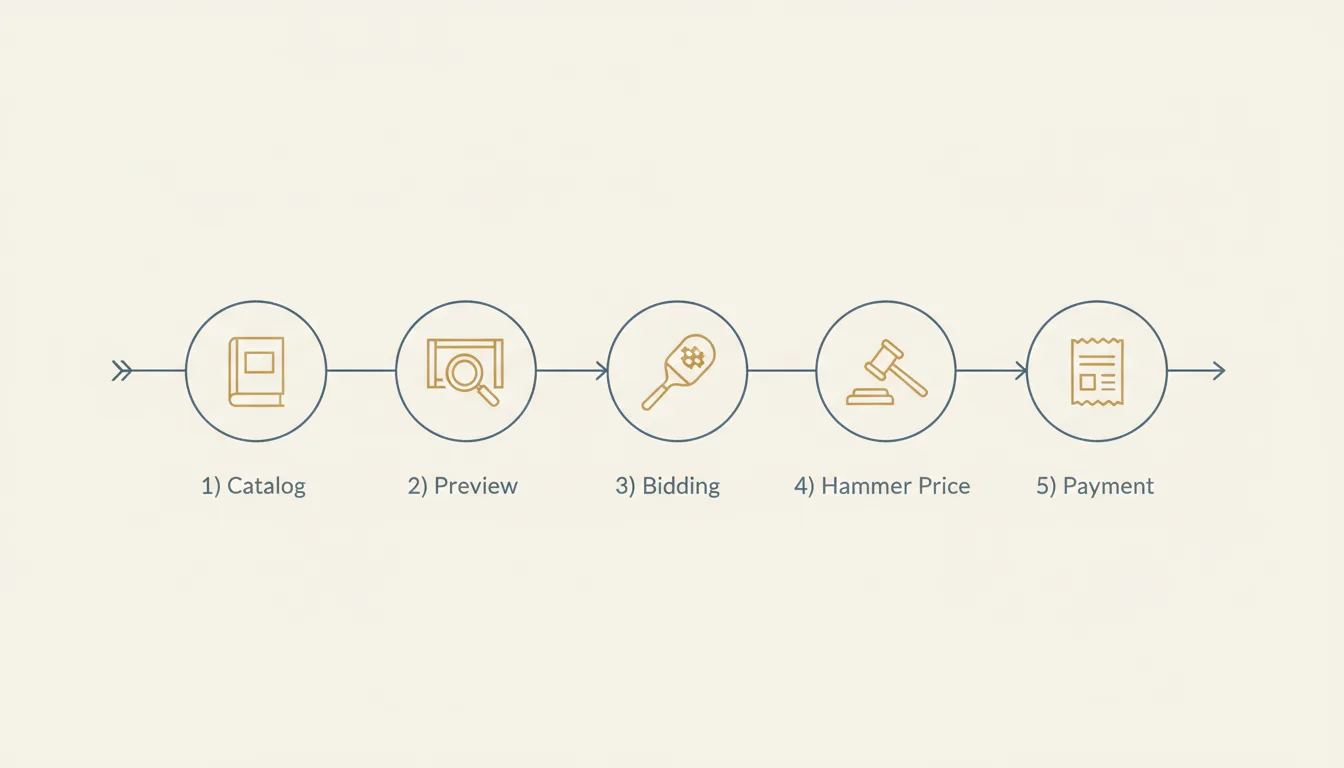
From catalog to hammer: the four stages of an auction
Every auction runs through the same basic sequence, whether it happens in a saleroom or entirely online. First comes cataloguing: the auction house researches, photographs, and describes each lot — including artist, medium, dimensions, and provenance — and estimates a likely price range. The catalogue, in print or online, doubles as the sale's main marketing document.
Before bidding opens, lots go on preview, sometimes called an exhibition — a period when prospective buyers can examine the work in person or, for online-only sales, through detailed photography and a condition report. Bidders then compete through one of several channels: in person with a numbered paddle, by telephone through a house representative, by absentee bid (a maximum submitted in advance), or live online.
When bidding stops, the auctioneer's gavel falls and announces the hammer price — the winning bid, and the number most news coverage quotes. It is not, however, the full cost to the buyer: a buyer's premium and applicable taxes are added afterward, and only then does payment, collection, or shipping follow.
The buyer's premium: what gets added on top of the hammer price
The buyer's premium is a percentage fee the auction house charges the buyer, added to the hammer price, separate from any commission the seller pays. It is not fixed across the industry, and it has been rising: as of February 2026, Sotheby's charges 28% on hammer prices up to $2 million, 22% between $2 million and $8 million, and 15% above $8 million in its New York sales. Christie's, which last adjusted its rates in September 2025, charges 27% up to $1.5 million, 22% between $1.5 million and $8 million, and 15% above $8 million.
Both structures are tiered rather than flat, meaning a single lot can straddle two rates: the premium is calculated on each portion of the hammer price, not applied as one rate to the whole sum. On a lower-value lot, the premium alone can add well over a quarter to the final bill before tax — a cost that matters as much as the hammer price itself when budgeting for a purchase.
Reserve price: why a lot can go unsold
Most lots at auction carry a reserve price — a confidential minimum, agreed between the seller and the auction house, below which the house will not sell the work. If bidding stalls before reaching that floor, the lot does not sell: in trade language, it is "bought in," sometimes marked "BI" or described as "burnt."
A bought-in lot is not simply a non-event. Auction houses generally charge the seller a buy-in fee to cover marketing and cataloguing costs, even though no sale occurred, and a work that fails to sell can carry a reputational discount if it returns to auction later — dealers and specialists often read an unsold history as a signal, whether or not it reflects the work's real quality. This is one reason reputable auction houses advise sellers against setting reserves unrealistically high.
Online-only auctions: a different format, not a lesser one
Alongside live saleroom sales, major houses including Sotheby's run online-only (or "timed") auctions — sales conducted entirely through a digital platform, with a closing time rather than a live auctioneer. Bidders set a maximum bid that executes automatically up to that limit, and Sotheby's platform extends a lot's closing time if a bid lands in the final minute, which can cause lots to close out of their printed order.
The format is legitimate and run by the same specialists who vet live sales, but it shifts real responsibility onto the buyer. Sotheby's own buyer guide states that lots are sold "as is" and encourages bidders to inspect the property at the pre-sale exhibition where one is available — for a purely online sale, that in-person option may not exist, which makes the condition report and photography carry more of the decision than they would at a live preview. A careful buyer treats the condition report and photography as the primary basis for the decision, and asks the specialist department direct questions before bidding closes.
From the studio
From the studio
None of this auction machinery touches how a piece leaves this studio, and that is a deliberate difference, not an oversight. There is no reserve price here, no bought-in designation, no buyer's premium stacked on top of a number after the fact: a work like Amethyst Ground (Terra & Ether series, 2026, 100 × 100 cm) carries one published price, tied to its series and size, from the day its Archive ID — AP-TAE-2026-005 — is assigned. What an auction house builds through cataloguing and condition reports, I build the same way from the start: every piece is photographed, measured, and documented before I know who will eventually acquire it.
I don't think a first-time buyer should need auction fluency to feel safe acquiring an original work. That's the real argument for buying direct from a working studio rather than waiting for a piece to reach a saleroom: the price is the price, the documentation exists from day one, and there is a person — not a specialist department — answering the actual question you're asking.
Frequently asked
Can anyone bid at an art auction?
Yes. Auctions at major houses are open to the public — anyone can register for an account, provide identification and payment details, and receive a bidder number or paddle. Some strictly private sales exist, but the standard saleroom or online-only sale simply requires registration in advance, not an invitation or a professional credential. First-time bidders are welcome, though most specialists recommend reading the condition report and catalogue entry carefully and asking questions before placing a first bid.
What is a buyer's premium?
It's a percentage fee the auction house adds to the hammer price, charged to the buyer on top of what they bid, separate from any commission the seller pays. Rates are tiered by value rather than flat: as of early 2026, Sotheby's and Christie's both charge around 27-28% on lower-value lots, stepping down to 22% and then 15% as the hammer price rises past several million dollars. The buyer's premium, not the hammer price alone, is what determines the real total cost of a purchase.
What happens if a lot doesn't reach its reserve price?
The lot doesn't sell. The reserve is a confidential minimum agreed between seller and auction house, and if the highest bid falls short, the auctioneer withdraws the lot rather than complete the sale, a result the trade calls being bought in. The seller typically still owes a buy-in fee for the marketing and cataloguing already done, and a lot's unsold history can make it harder to sell later, since some buyers read a prior failure to sell as a quiet signal about the work.
Are online-only art auctions legitimate?
Yes. Major houses including Sotheby's run online-only, or timed, auctions through the same specialist departments that vet live sales, and they follow the same registration and payment rules. The real difference is inspection: bidders can't examine a lot in person before the sale closes, so the condition report and photography carry more weight than they would at a live preview. That shifts risk toward the buyer, which is why reading the condition report closely, and asking questions before bidding, matters more in this format.
Is buying at auction cheaper than buying from a gallery?
Not automatically. A winning bid still carries a buyer's premium of roughly 15-28% plus tax, which can rival or exceed a gallery's margin once it's added to the hammer price, and auctions add uncertainty a fixed retail price doesn't have. Buying directly from an artist's studio removes the premium and the bidding risk entirely, replacing both with one published price tied to the work itself, though it also means the piece has no auction history yet.
Thinking about a piece, without the auction machinery?
One published price, full documentation from day one, no bidding and no buyer's premium — ask directly about a specific work.
Sources
- The Art Newspaper — 2026-07-30
- The Art Newspaper — 2026-07-30
- MyArtBroker — 2026-07-30
- MyArtBroker — 2026-07-30
- Sotheby's Institute of Art — 2026-07-30
- Sotheby's (Guide for Buyers) — 2026-07-30
- Perfeito Studio internal catalog — 2026-07-30
Published on