How to choose art when downsizing to a smaller home
When downsizing, decide with a tape measure before you decide with sentiment. Measure every wall in the new home first, then keep only the pieces that fit both the space and daily life — store, sell, or gift the rest with a real deadline, not an open-ended "later."
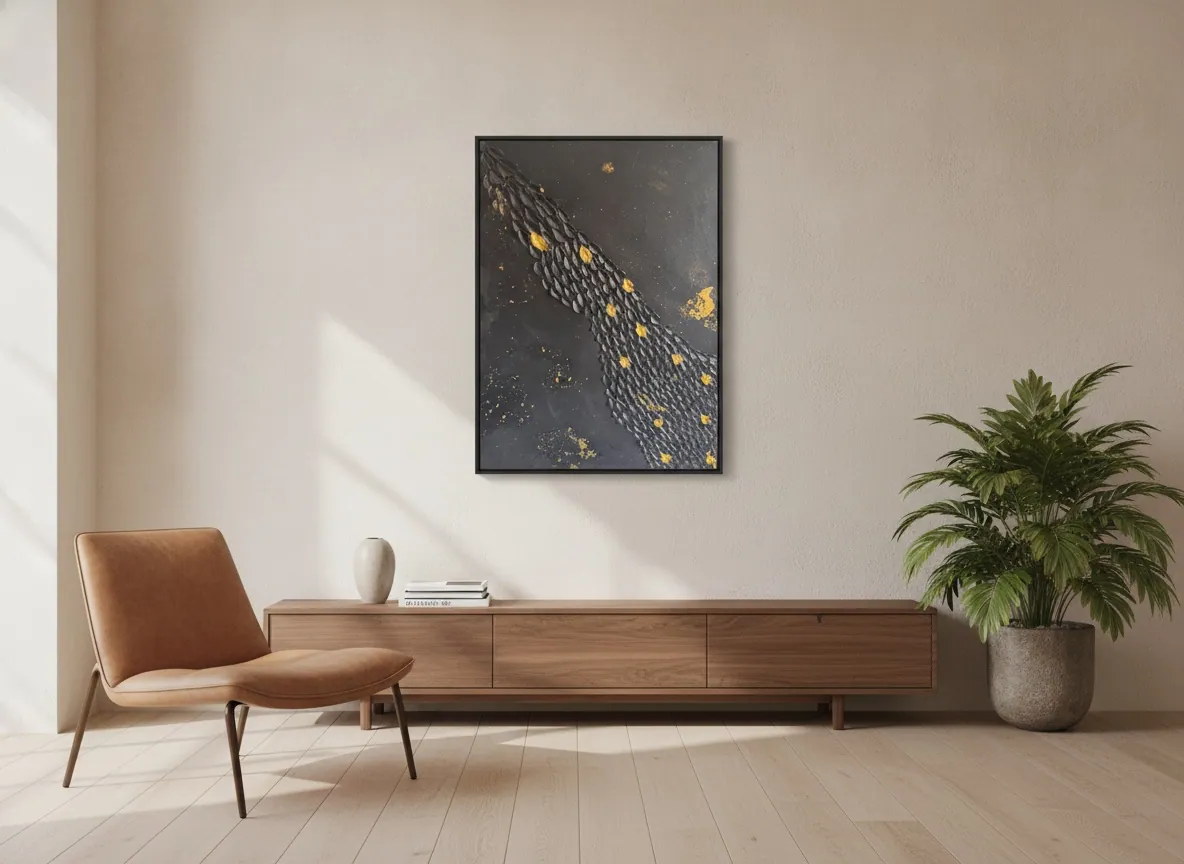
Measure the new walls before you decide anything else
The instinct when downsizing is to start with the collection — walking room to room, deciding piece by piece what you love most. Do the opposite. Before sorting through a single artwork, get the exact floor plan and wall dimensions of the new home, the same first step professional downsizing guides recommend for a move of any kind: obtain the floor plan and precise measurements before making decisions about what stays.
A painting has no fixed identity outside the wall it hangs on. A piece that read as "medium-sized" against a 4-meter living room wall can be the largest thing in a smaller apartment, or conversely, get visually swallowed by a room with low ceilings and heavy trim. Note not just wall width but the clear, uninterrupted run of wall — width minus doorways, switches, and furniture — for every room in the new home before you decide anything is too big, too small, or doesn't fit.
Rank pieces by wall-fit and daily presence, not by value alone
Once you know your actual wall dimensions, rank the collection against them, not against each other's price tags. Ask two questions per piece: does a wall in the new home fit it, and do you actually stop and look at it — not admire it in theory, but look at it, day to day? Pieces that pass both tests earn priority. Pieces that pass only one go to the next section.
Format matters more in a smaller home than it did in a larger one. In the studio's own experience, a single large-format anchor piece (roughly 100–200 cm) can carry an entire main wall and read as intentional rather than crowded — but only one per room, and only if that wall is genuinely uninterrupted. Medium-format works (roughly 60–110 cm) tend to be the more flexible choice for secondary walls, hallways, and rooms with windows or doors breaking up the space, precisely because they don't need a full, clear wall to work.
Decide fast on what doesn't fit — store, sell, or gift, not "later"
For pieces that don't make the cut for the new walls, the worst option is an open-ended "I'll figure it out later," because that default almost always becomes storage with no plan and no end date. Reputable climate-controlled art storage holds work at a stable environment — commonly cited around 68–72°F (20–22°C) with roughly 50% relative humidity — which protects a piece indefinitely and makes short-term storage, while you settle into the new space, a genuinely safe holding pattern.
The distinction is between storage with a plan (you intend to rotate the piece back onto a wall, or into a future home) and storage as an indefinite parking spot. For the second kind, selling, gifting to family with a note about the piece's context, or donating are usually better outcomes than an ongoing unit fee for a piece no one will see. If the process feels too heavy to do alone, a senior move manager or professional organizer can apply this framework without the pressure of making every call solo.
Update insurance and documentation before the move, not after
There is no single fixed schedule for reviewing an art insurance appraisal — how often to update one depends on the artist, the market, the piece's current value, and what your specific insurance carrier requires. But a move is a natural, practical prompt to ask the question, especially for any piece whose value may have shifted since the appraisal was written or whose location is about to change.
It's also the moment to update your own records, separate from the insurance conversation: which pieces are going on the new walls, which are going into storage, and where each one physically is. A collection that fit in your head when everything hung in one house rarely stays that easy to track once part of it is boxed, given away, or sold — write it down while the move is still fresh, not months later.
From the studio
From the studio
I trained as an architect before I trained as a painter, and it shows in how I answer this question when a collector writes in asking whether a piece will "still work" in a smaller space. My answer is almost never about the painting first — it's a request for the wall's exact width and the ceiling height. Scale problems dressed up as art problems are usually architecture problems: the same canvas that anchors a double-height living room can read as either too large or exactly right in a smaller apartment, depending entirely on whether it gets one clear, uninterrupted wall or gets boxed in between a doorway and a bookshelf.
The pieces I build at medium format — around 60 to 110 cm, like Golden Passage — are deliberately the ones I point collectors toward when a room is getting smaller, not because they matter less, but because they ask less of the wall. A large-format piece needs a room willing to give it space uninterrupted; a medium one can move with you.
Frequently asked
How do you decide which pieces of a collection to keep when moving into a smaller home?
Start by measuring the new space, not by ranking the pieces. Get the exact width, height, and any obstructions of each wall before you decide anything — a piece's format only makes sense against real dimensions. From there, separate what you look at daily from what you own out of habit, and keep the small number that answer both: emotionally essential and physically fits. A senior move manager or professional organizer can help apply this without the pressure of doing it alone.
Does a large painting from a bigger house always look wrong in a smaller room, or does it depend on the wall?
It depends on the wall, not the room's total square footage. A large-format piece needs one uninterrupted run of wall roughly matching or exceeding its width — it can dominate a small room beautifully if it owns that single wall, and look cramped in a larger room if it's squeezed between a doorway and a light switch. Measure the clearest, least-interrupted wall in the new home before deciding a large piece doesn't fit — often it's the room that's wrong for it, not the size.
Is it worth selling part of a collection before downsizing, rather than storing it?
It depends on how long storage would actually last. Reputable climate-controlled art storage holds pieces at a stable temperature (around 68–72°F) and humidity (around 50%) indefinitely, so short-term storage while you settle into a new space is a reasonable holding pattern. But storage is an ongoing cost with no end date unless you set one — pieces you're storing just in case, with no real plan to display them again, are usually better sold, gifted to family, or donated than kept in a unit for years.
Should the most valuable or most meaningful piece always get priority in the new, smaller space?
Not automatically — the two criteria don't always point to the same piece, and the wall should be the tiebreaker. A financially valuable piece that doesn't fit any wall in the new home is still a storage or sale candidate; a modest piece you actually stop and look at every day earns real estate a more valuable piece might not. When the two align, valuable and meaningful, that's the easy case. When they don't, prioritize what you'll actually live with day to day.
Does downsizing change how a collection should be insured or catalogued?
It's a good prompt to check both, even though there's no fixed schedule for either. There isn't one standard interval for updating an art appraisal — how often to review one depends on the artist, the market, the piece's value, and what your insurance carrier requires — but a move is a natural moment to ask whether current valuations still hold. It's also the moment to update your own inventory: which pieces are on the wall, which are in storage, and where each one physically is.
Rethinking a piece for a smaller space?
Send the wall's dimensions and we'll talk through whether a piece — yours or one from the studio — is the right scale for it.
Sources
- Robertson Ryan Insurance — 2026-09-23
- Cadogan Tate — 2026-09-23
- Atlas Van Lines — 2026-09-23
Published on