What to do when you run out of wall space for art
Running out of wall space is usually a sign a collection is working, not a problem to panic over. The practical response is to choose between three moves — rotate what's hanging, store what's resting properly, or edit the collection by letting a piece go — rather than defaulting to buying a bigger house or stopping acquisitions altogether.
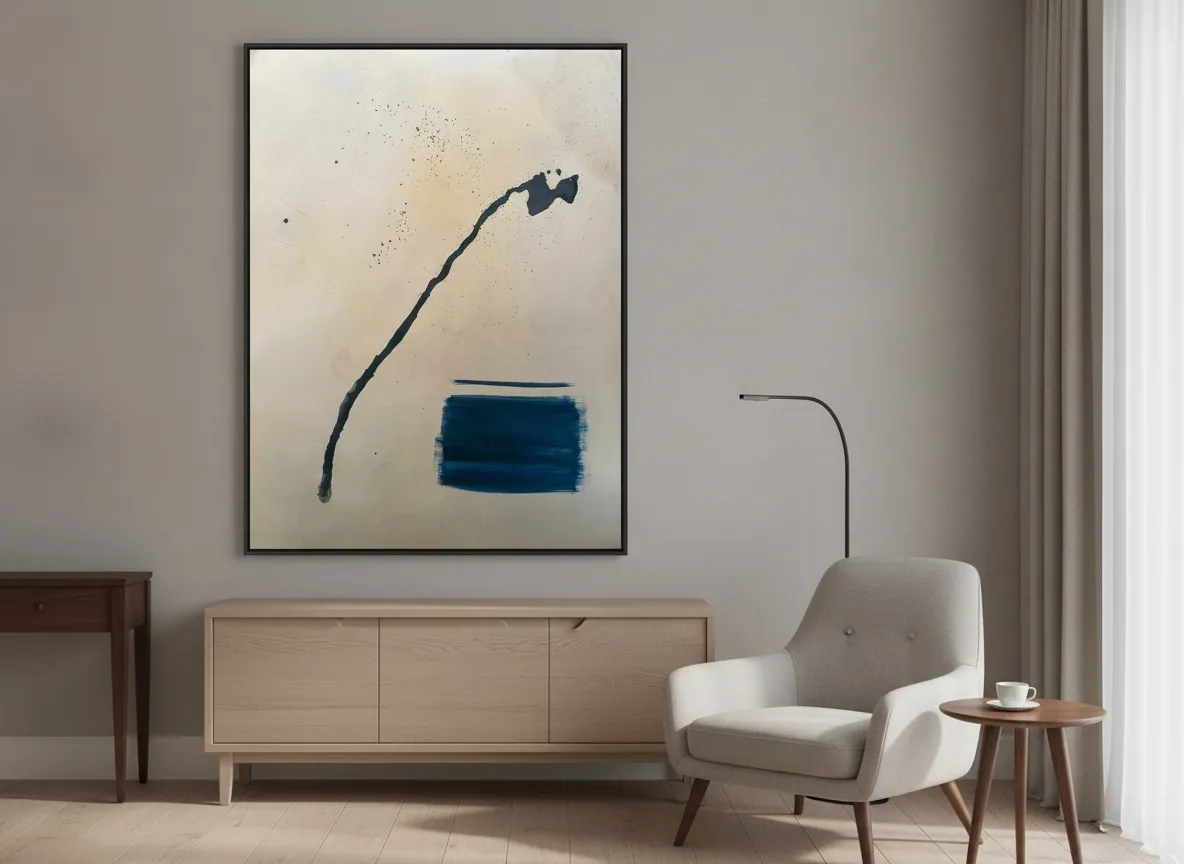
The three real moves once the walls are full
A full wall is not a design failure — it means a collection has reached the point where acquisition and arrangement are no longer the same decision. From here, there are three practical moves, and most collectors end up doing some combination of all three over time: rotate what is hanging so pieces take turns being seen, store what is resting in a way that actually protects it, or edit the collection by parting with a work that no longer earns its place. A fourth option — physically expanding the display area, whether through a corridor, a stairwell, or a room previously used for something else — is worth naming too, since many homes have more hangable wall than the obvious rooms suggest.
The order matters less than the honesty of the exercise. Walking the house room by room, listing what is up and what is boxed, and asking which pieces you would keep if you could only keep half, tends to clarify the decision faster than any general rule can.
A rotation system worth keeping
Rotation only works as a system if it is scheduled rather than aspirational — most collections that “rotate” in theory settle into one static hang because nobody decided when the next swap happens. A workable version: pick an interval — our own practical suggestion to collectors is twice a year, seasonal if the collection is larger — keep a short written note of which pieces are currently resting, and treat the swap as a fifteen-minute task rather than a redecorating project.
The mechanics of handling a painting safely during a swap — how to carry it, how to protect the surface, how long it can sit stacked before it needs to go back up — are covered in full in our guide to rotating artwork at home. What belongs here is the planning layer: a rotation only reduces the wall-space problem if the resting pieces have a real place to go, which is the next question.
Storing what isn't on the wall
A piece resting between rotations still needs real storage, not a spot behind the sofa. The Canadian Conservation Institute's guidelines for painting storage recommend keeping framed paintings supported at least 7–10 cm (3–4 in) above the floor, away from dirt, dust, and any risk of water contact — a low shelf or simple riser solves this for most homes. For temporary stacking against a wall, the same guidelines cap it at four to five paintings leaned together, each separated by a rigid board slightly larger than the artwork, so surfaces and frame corners never touch directly.
Beyond that: a stable interior wall away from exterior temperature swings, out of direct sunlight, and away from attics and basements — the rooms most likely to overheat, flood, or hold damp air — protects a resting piece about as well as most private collectors can manage without a dedicated climate-controlled room.
Editing the collection: what to let go, and why that's normal
Every growing collection eventually holds a piece that made sense at the time and doesn't anymore — bought early, before the eye that chose it had fully formed, or acquired for a wall that no longer exists after a move. Letting that piece go is not a failure of taste; it's what a collection does as it matures. The same discipline museums call deaccessioning happens quietly in private homes every time someone decides a work no longer earns its wall.
The practical question is rarely “is this piece good” — it's “does it still belong here.” A piece can be well made and still be wrong for a collection that has moved toward a different scale, palette, or series. Selling, gifting it to someone who responds to it more than you currently do, or simply returning it to storage while you decide are all legitimate outcomes. The real mistake is letting indecision keep a wall occupied by something you have already stopped seeing.
Documentation matters more as the collection grows
A collection of three pieces is easy to keep in your head; a collection of fifteen isn't. Once a collection reaches the point of running out of wall space, its own paperwork usually needs the same attention: a written inventory with purchase invoices, condition photographs, and certificates of authenticity for each piece, plus insurance coverage that reflects current value rather than what you paid years ago. Independent appraisal guidance recommends updating a collection's appraised value roughly every two to three years, since market conditions and an artist's standing can shift meaningfully over that window — the same logic applies whether a collection is worth thousands or far more.
Every work acquired through Perfeito Studio already carries a signed Certificate of Authenticity, an internal Archive ID, and a dossier — documentation built for exactly this moment, when a collection has grown enough that memory alone isn't a reliable record anymore.
From the studio
The studio's view
The message I get most often isn't “I want to buy a piece” — it's “I love this, but I don't know where it would even go.” That's usually the moment a collection is doing its job: it has stopped being about filling an empty wall and started being about which piece deserves the wall that's left. As an architect, I read that question the way I'd read a floor plan running out of square footage — the answer is rarely to build an addition, it's to decide what the space is actually for.
When that conversation happens over WhatsApp, I ask about the wall as much as the piece: its light through the day, what's already near it, whether the room wants something quiet like Matter & Silence or something that argues back, like a piece from Heart of Chaos. A collection that has run out of room to hang everything usually still has room for one more decision, made carefully — and that's a better outcome than either buying blind or not buying at all.
Frequently asked
How often should I rotate the art I have on display?
Our practical suggestion is twice a year — often enough that resting pieces don't sit forgotten in storage, infrequent enough that rotation stays a short task rather than a project. Collectors with a larger body of work sometimes rotate seasonally instead. What matters more than the exact interval is picking one and keeping a written note of what's currently down, so a swap doesn't turn into a search.
Is it OK to store a painting rolled up instead of stretched?
Only as a last resort, and only for unstretched canvas that hasn't been varnished or built up with heavy texture. Rolling a finished, stretched, or textured piece risks cracking the paint layer or the sculpted surface. For a stretched painting like the ones in most private collections, upright storage against an interior wall, raised off the floor and separated from neighboring frames, is the safer default.
What temperature and humidity is safe for storing art at home?
Stability matters more than hitting an exact number — a closet or interior room that holds a steady temperature and humidity level year-round is safer than one that measures perfectly on a single day but swings with the seasons. Conservation guidance also points collectors away from attics, which overheat, and basements, which are prone to damp and flooding, toward a stable interior room instead.
Should I sell or donate a piece I no longer want on my wall?
Either is reasonable, and the right choice usually comes down to whether you want the transaction (a private sale, or consignment through a gallery) or the tax and legacy considerations that can come with donating to an institution — worth discussing with an accountant in your country. What isn't necessary is guilt: deciding a piece no longer fits your collection is a normal part of collecting, not a judgment on the work itself.
Do I need special insurance once my collection outgrows my walls?
Once a collection reaches meaningful value, most homeowner's or renter's policies stop being enough on their own, and a dedicated fine-art rider or standalone policy — with each piece scheduled at an agreed value — is worth pricing out. This becomes more relevant, not less, once pieces move into storage, since a work in a closet is easy to forget when policies get renewed.
Is buying more wall-mountable art, like a diptych, a way to avoid this problem?
It postpones the problem rather than solving it, and can make a later edit harder, since a diptych or triptych is usually acquired and hung as one decision. If wall space is already tight, a single strong piece — chosen because it can carry a room on its own — tends to serve a maturing collection better than a multi-panel work that needs an equally large amount of new space to make sense.
Thinking about your next piece — or your last available wall?
Tell the studio about the space you have left, and we'll help you figure out whether it calls for a new piece, a rotation, or simply patience.
Sources
- Canadian Conservation Institute (Government of Canada) — 2026-09-13
- AppraiseItNow — 2026-09-13
Published on