How to rotate artwork at home
Rotating artwork at home is safe when it follows ordinary painting-handling care: lift the piece by its frame or stretcher bars, never the hanging wire, and store it upright rather than flat until the next wall is ready. Rotating a few times a year also spreads a collection's cumulative light exposure across more walls instead of one.
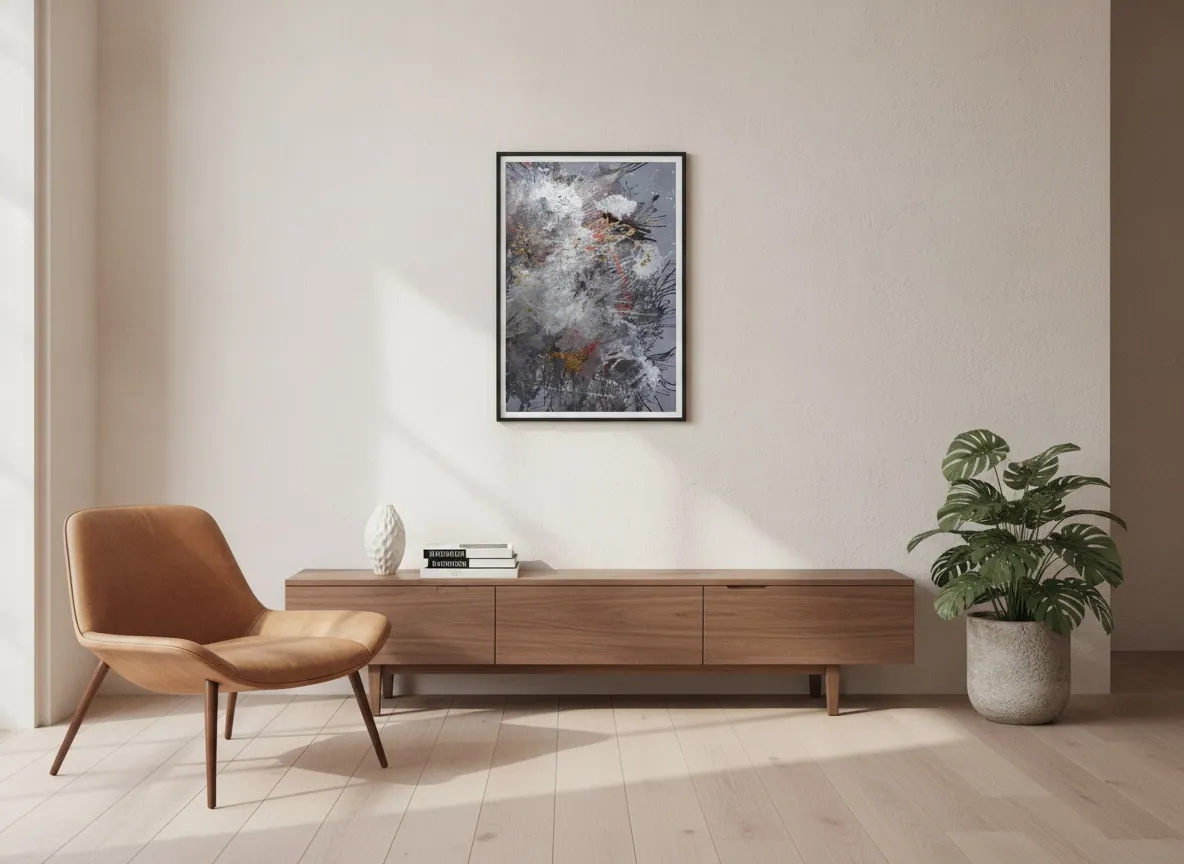
Why collectors rotate art in the first place
There are two separate reasons to move paintings between walls, and it helps to keep them apart. The first is simply that a collection feels different when a piece gets a new wall, a new neighbor, a new angle of daylight — the same reason a museum reinstalls a gallery rather than leaving a hang untouched for a decade. The second is more technical: light damage to a painted surface is cumulative and irreversible, calculated as light level multiplied by exposure time, according to the Conservation Center for Art & Historic Artifacts. A canvas hanging on the same bright wall for years keeps adding to that total every single day it is lit; one that spends part of its life on a dimmer wall, or briefly off the wall altogether, accumulates less.
Buying directly from a studio rather than through a gallery or an advisor means there is no outside registrar reminding you to rotate a loan or refresh a hang — the calendar for it is entirely the collector's own. That is not a drawback so much as a fact worth planning around, especially for a collection assembled piece by piece over a few years rather than installed all at once.
The light-exposure case, in plain terms
Museums Galleries Scotland recommends keeping light levels on a painting at or below 200 lux and identifies ultraviolet radiation, present in direct sunlight and some artificial lighting, as the most damaging factor to a painted surface over time. None of that means a wall with natural light is off-limits — most living rooms and hallways get some daylight — it means the total dose a piece receives over months and years is what matters, not any single afternoon.
This is the same logic institutions use when they rest an object in dark storage between exhibition periods rather than leaving it lit indefinitely: a wall that gets strong afternoon sun is a heavier exposure than a wall lit only indirectly, and a painting that spends part of the year on the second wall, or briefly in storage, is carrying less total light over its lifetime than one left in place year-round. A home collector does not need a light meter to apply the principle — noticing which walls in a house get direct sun for hours at a time, and not leaving the same canvas on the brightest one indefinitely, does most of the work.
Handling and storage, briefly — and the paperwork a rotation can quietly separate
The mechanics of taking a piece down are ordinary painting care, not something specific to this studio's work: a minimum of two people for anything easel-sized, carried by the frame or stretcher bars and never by the hanging wire or one side alone, with the front facing the people holding it. Between walls, a piece waits better upright than flat, and a temporary stack — if one is unavoidable — stays short, separated by boards, and off an attic or a basement, the two rooms that swing hardest in temperature and damp.
What is easy to overlook, for a piece that arrived from a working studio abroad rather than a local frame shop, is that a rotation is also the moment its paperwork tends to drift. Check that the certificate of authenticity, the Archive ID, and any dossier still travel in the same room as the piece itself before it goes into storage — it is a five-minute check now, and the alternative is discovering years later, at resale or insurance time, that the piece and its documentation ended up in different boxes.
What the next wall needs to offer before you hang it there
Before a rotated piece goes up, it is worth checking the new wall the same way you would have checked it before the first hang. Avoid positioning it in the path of direct sun for hours at a stretch — curtains, blinds, or a UV-filtering film on the glass bring a bright window wall within a safer range. Keep it off a wall directly above a heat source such as a radiator or a fireplace, since rising warm air carries dust onto the surface continuously, and Museums Galleries Scotland cites a relative humidity of 50 to 60 percent as the reference range for both display and storage — a reasonable point of comparison between the wall a piece is leaving and the one it is moving to.
From the studio
From the studio
I still think about a room the way I was trained to before I painted seriously: where the light comes from, and how much it moves over a day and over a year. A wall that reads as soft and even-lit in June, when the sun sits high, can turn into a hard afternoon glare by September as its angle drops — the same wall, a completely different light job for whatever is hanging on it. That is one of the things I actually consider when I talk a collector through where a piece will live, and it is also the reason I do not think of a hang as a single decision made once.
The pieces with gold leaf or metallic pigment make this most visible, because they respond to light rather than absorbing it evenly the way a flat matte surface does — a canvas that looks quiet under diffuse morning light can catch and throw back a low afternoon sun in a way that changes the whole room. I do not treat that as a flaw to manage around; I treat it as a reason a collection benefits from being lived with across more than one wall, at more than one time of year, rather than settled into a single spot the day it arrives.
Frequently asked
How often should I rotate the art in my home?
There is no fixed rule — rotation is a choice the collector makes, not a conservation requirement with a set interval. In practice, moving a piece every season or every few months tends to work well for a mid-size painting, since that gives enough time between moves to plan the route and the storage spot properly rather than rushing the handling to keep to a schedule.
Does moving a painting between rooms increase the risk of damage?
The risk sits in the handling, not in the fact that the piece changes rooms. A painting that hangs undisturbed for years and one that gets moved twice a year face the same risk profile while they are on the wall; what differs is the handful of minutes spent taking each one down and putting it back up, which is exactly why following a consistent handling routine matters more than how often you rotate.
Can I stack more than one painting while storing the rest?
Within limits, yes — conservation guidance caps a short-term stack at four or five framed pieces, separated by a board between each one, raised off the floor. For a growing collection bought from a studio rather than assembled piece by piece from different sources, this is also a good moment to check that each stacked piece still has its own certificate and Archive ID with it, so nothing in storage becomes an unlabeled painting a year from now.
Will rotating art actually slow down fading?
It can, because light damage to a painted surface accumulates as a function of intensity and time — a piece that spends part of the year off a bright wall, or briefly in storage, is adding to that total more slowly than one left in the same spot indefinitely. Rotation will not undo any fading that has already happened, since that kind of damage does not reverse; it simply slows how fast new exposure builds up.
Is a bright, sunny room off-limits for rotation?
Not necessarily. A sunny wall is a heavier exposure than a shaded one, but curtains, blinds, or a UV-filtering film on the window bring it into a more reasonable range, and the fact that a piece only spends part of the year there — rather than living there permanently — already limits the total dose compared to a painting installed on that same wall year-round.
Do I need professional help to rotate large paintings?
Likely yes, or at minimum a third pair of hands. Two people is the conservation minimum for an ordinary easel-sized painting; a large-format piece, the kind that anchors a double-height wall, calls for more hands and a route planned before it comes off its hooks — the same care a first installation shipped from the studio would get on arrival.
Not sure which piece belongs on which wall?
Send a photo of the wall you are considering, and the studio will talk through the light, the scale, and whether it is a good fit before anything moves.
Sources
- Canadian Conservation Institute (Government of Canada) — 2026-09-05
- Canadian Conservation Institute (Government of Canada) — 2026-09-05
- Museums Galleries Scotland — 2026-09-05
- Conservation Center for Art & Historic Artifacts (CCAHA) — 2026-09-05
Published on