What makes an art collection coherent?
A private art collection reads as coherent when its pieces share a deliberate through-line — a palette, a scale, a material, or a single artist's evolving body of work — rather than simply accumulating. Coherence comes from a repeated decision, not a large budget or a long wall, and the works can still differ in size or price.
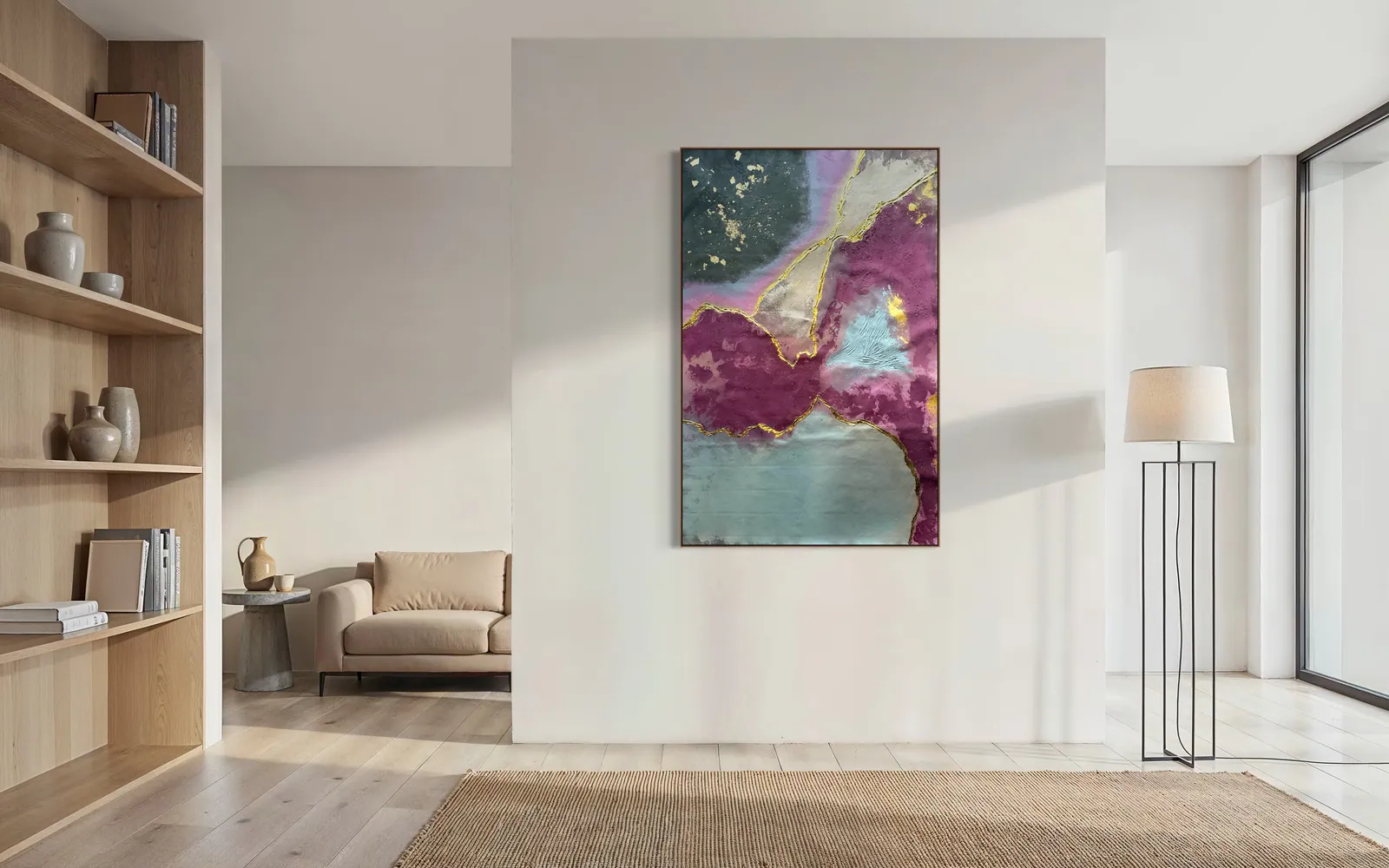
A through-line, not a tally
A random accumulation of art and a considered collection can hang on the same walls and contain a similar number of pieces. What separates them is not quantity, price, or even quality of any single work — it is whether a visitor can name what connects them. Collecting advisors describe this as a curatorial line that links the collection together, an aesthetic through-line that reflects the collector's own eye rather than whatever happened to be available at the time of purchase.
That through-line does not have to be loud. It can be as simple as a recurring palette, a consistent scale across a run of rooms, a shared medium, or a mood the collector keeps returning to. What it cannot be is absent. A collection assembled purely by opportunity — one piece from a fair, one from a friend's recommendation, one because a wall was empty — tends to read as exactly that: a series of unrelated decisions, however good each individual decision was.
Palette, scale, and medium as anchors
Palette is the simplest through-line to see and the easiest to start with. A collector who stays within a family of tones — warm mineral earths, or deep black paired with metallic accents, or a cooler cyan-to-crimson register — creates visual continuity even across very different subjects, sizes, and artists. It is why a single series, like the earth-and-sky pigments running through Perfeito Studio's Terra & Ether works, can anchor a room on its own.
Scale works less obviously but just as reliably. A widely used interior-design convention sizes a piece of wall art to roughly two-thirds to three-quarters (66–75%) of the width of the furniture beneath it, as a way of keeping art and room in proportion. Applied consistently across several walls — always erring toward the same proportion rather than swinging between an oversized canvas in one room and a small print in the next — that ratio becomes a quiet organizing rule for the whole collection, not just a single wall.
Medium is the least visible anchor but often the most durable one. A collector who commits to mixed media with heavy texture, or to works on paper, or to sculpted relief, builds a tactile identity across the collection that survives even a change in subject matter or artist.
Building depth with one artist's body of work
One route to coherence, favored by advisors who work with private collectors, is to consolidate: rather than spreading a budget across many names, a collector returns to an artist already in the collection and acquires a second or third piece from a different stage or series of that artist's practice. The result reads less like a shelf of unrelated objects and more like a documented arc — early work next to later work, one tension explored from two angles.
This is also how a single studio's catalog is structured internally. Perfeito Studio's works sit inside five ongoing series — Heart of Chaos, Matter & Silence, Luminous Rebirth, Black & Gold, and Terra & Ether — and each series is itself a closed investigation of one tension: ignition against darkness, sculpted stillness, chromatic renewal, the dialogue between black and gold leaf, or mineral strata. A collector who acquires two pieces from the same series, rather than one from each, is applying the consolidation principle at a small scale: the two works share a vocabulary before they share a wall.
Documentation keeps the through-line legible over time
Coherence is not only a visual question — it is also a record-keeping one. Collectors who track what they own, its condition, and its history are able to make deliberate additions instead of reactive ones; without that record, even a well-chosen collection can drift, because nobody remembers why an earlier piece was bought or what it was meant to sit beside.
This is one reason every work leaving Perfeito Studio carries a signed Certificate of Authenticity and an internal Archive ID in the format AP-<SERIES>-<YEAR>-<NNN> — for example, AP-TAE-2026-007 for a 2026 Terra & Ether piece. A collector mixing work from several studios can fold that same discipline into their own records: title, medium, dimensions, year, and provenance noted consistently for every acquisition, regardless of who made it. The paperwork will not make an incoherent wall look coherent, but it is what lets a coherent one stay legible five or ten years later, once the reasoning behind each purchase has faded from memory.
From the studio
From the studio
I trained as an architect before I trained as a painter, and I still look at a wall the way I look at a floor plan — as a sequence, not a set of isolated points. When I place a new piece within Terra & Ether, I am not asking whether it stands on its own; every canvas already has to. I am asking whether it continues the conversation the series started — the same mineral weight, the same way light sits on a metallic fragment, carried into a slightly different register.
I think a private collection works the same way, even when it mixes several artists. A room with three unrelated paintings can still feel calm if whoever hung them chose one thread — the same warmth of tone, the same proportion relative to the furniture, the same emotional pitch — and held to it across the room. In my experience, what breaks a collection's coherence is rarely mixing artists or eras. It is mixing decisions: buying once for the wall, once for the price, once for the story, with no thread between the three. Buy for a reason you can name, and the room reads as considered even when the works themselves have very different histories.
Frequently asked
Does a coherent art collection need to be made up of works by the same artist?
No. A collection can include many different artists and still feel coherent, as long as something else ties the pieces together — a palette, a scale, a medium, or an emotional register that repeats from room to room. Owning several works by one artist is one reliable way to build coherence, since a body of work already carries its own internal logic, but it is a route, not a requirement.
What exactly is a 'through-line' in an art collection?
A through-line is the deliberate thread a collector chooses to repeat across acquisitions instead of buying at random. It can be visual (a family of colors, a consistent scale), material (the same medium or technique), or emotional (a mood the collector keeps returning to). The specific thread matters less than the fact that it is chosen and applied consistently.
How does scale affect whether a collection feels coherent?
Scale creates a visual rhythm across rooms. A common design convention sizes a piece to roughly two-thirds to three-quarters of the width of the furniture below it, which keeps the work and the room in proportion. Applying a similar ratio consistently, rather than alternating between oversized and undersized pieces from room to room, makes a collection feel considered rather than accidental.
Can I mix abstract and figurative work and still have a coherent collection?
Yes, as long as the through-line lives somewhere other than subject matter. Two very different compositions — one abstract, one figurative — can sit together comfortably if they share a palette, a similar scale, or a comparable emotional weight. Subject matter is only one of several possible anchors, and often not the strongest one.
Does documentation like certificates and archive numbers actually affect how coherent a collection feels?
Indirectly, yes. Coherence depends partly on a collector remembering why each piece was acquired and how it relates to the rest. Consistent records — title, medium, dimensions, year, provenance, kept the same way for every work regardless of artist — make that reasoning retrievable years later, which is what keeps a deliberate collection from drifting into an accidental one over time.
Is it better to buy one large statement piece or several smaller works for a coherent look?
Neither is inherently more coherent; the deciding factor is whether the choice repeats a rule already established elsewhere in the space. One large piece can anchor a room the way a single strong through-line anchors a whole collection, while several smaller works can achieve the same effect if they share a palette or medium. The studio discusses scale and placement directly with collectors before a piece is chosen, since a photograph of the wall says more than a generic size chart.
Building a collection with a through-line?
Tell the studio about the room and the pieces you already own — Alyne can suggest a work that continues the same palette, scale, or material register, or point you to a piece from a series you've already started.
Sources
- Art Basel / UBS — 2026-09-05
- UOVO — 2026-09-05
- MontCarta — 2026-09-05
Published on