One expensive painting or three affordable ones?
There is no universal answer: one expensive painting delivers a stronger single focal point and concentrated presence, while three affordable pieces offer flexibility, room to build a collection gradually, and lower risk per decision. The right choice depends on the wall, the budget, and whether you want impact now or a collection built over time.
The case for one strong piece
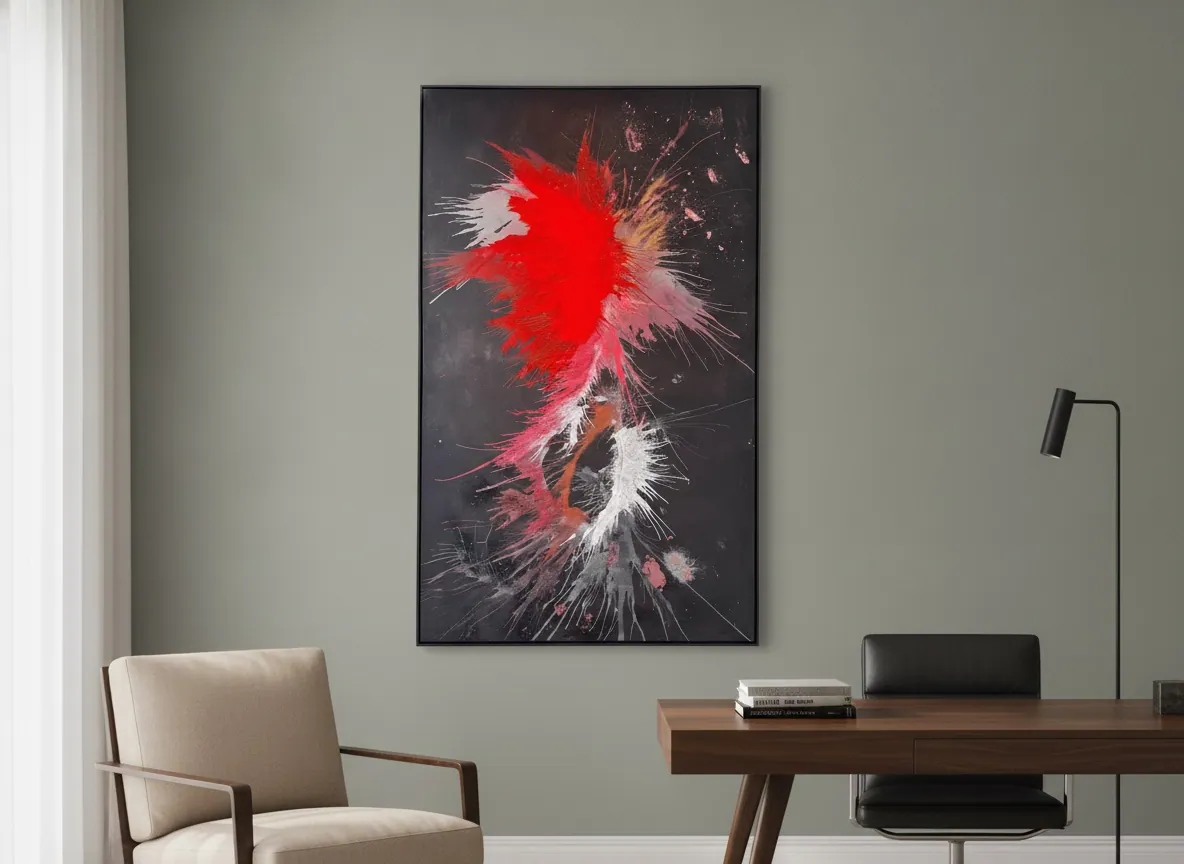
A single large-format work concentrates attention in a way several smaller pieces cannot — it becomes the wall's focal point rather than one element sharing a composition with others. In the Perfeito Studio catalog, Genesis of Flame (Heart of Chaos series, 120 × 200 cm, R$ 8,800) is the clearest example: one canvas built for a wall that can absorb its full scale, where the piece organizes the room instead of negotiating space with anything else.
The tradeoff is commitment. Buying one large piece usually means a longer decision, a bigger single line-item, and a wall that stays fixed on that choice for years rather than evolving gradually. It suits collectors who already know the room, its function, and their own taste well enough to commit to a single statement rather than assembling a mix over time.
The case for several affordable pieces
Multiple smaller works trade concentrated impact for flexibility. They can be spread across different rooms, rearranged as a space changes, and added one at a time rather than in a single decision. For someone still working out what they respond to — a particular series, a technique, a palette — acquiring two or three modest pieces across a year gives more information than committing everything to one large purchase upfront.
Several smaller pieces also read differently as a group: hung together, they build a small collection with its own internal rhythm — a sculpted Matter & Silence piece beside a chromatic Luminous Rebirth piece, for instance — contrasting texture and temperature in a way a single canvas cannot.
What three affordable pieces cost, in real numbers
At Perfeito Studio, the current catalog runs from R$ 2,400 to R$ 8,800, across five series — Heart of Chaos, Matter & Silence, Luminous Rebirth, Black & Gold, and Terra & Ether. The entry point is Echo of Silence (Matter & Silence, 50 × 70 cm, R$ 2,400), a modest sculpted-texture piece.
As a concrete comparison: three entry-tier works — Echo of Silence (R$ 2,400), Celestial Plan (Black & Gold, 50 × 70 cm, R$ 2,700), and Origin of Light (Heart of Chaos, 60 × 80 cm, R$ 3,300) — total R$ 8,400, within a few hundred reais of Genesis of Flame, the single most expensive piece in the catalog at R$ 8,800. At that price point, the real choice is between one large canvas and three modest ones representing three different series, not between "affordable" and "expensive" in the abstract.
It isn't a permanent choice
Acquiring one piece first doesn't rule out the other path later. Many collectors start with a single entry-tier work to see how a piece from the studio reads in their space, then decide — sometimes toward a larger statement piece once a wall and a budget are identified, sometimes toward adding more modest works across series instead. Each acquisition, regardless of size or price, is registered individually with its own Archive ID, Certificate of Authenticity, and dossier — the documentation doesn't scale down with the price tag.
From the studio
The studio's eye
Training as an architect before I painted taught me to read a wall before I read a canvas — its width, its light, what else in the room already competes for attention. When collectors ask me whether to go big or go modest, I usually ask about the room first, not the budget: a corridor or a reading nook rarely needs a 120 cm canvas, and a double-height living room rarely settles for a 50 cm one. Within a series like Terra & Ether, I also build the works to stand alone or as a coherent group — the same stratified logic that holds one canvas together can hold three of them together on a wall, at a fraction of the cost of a single large piece.
Frequently asked
Is a large painting always the better choice for a room?
No, it depends on the wall and how the room is used, not a fixed rule. A large canvas works well when there is a clear focal wall and nothing else needs to compete with it. A smaller or mixed selection tends to work better in a room with multiple walls in view, furniture and objects that already carry visual weight, or when someone is still deciding what they respond to. Neither option is inherently superior; they solve different problems.
How many affordable pieces would match the price of the most expensive painting in this catalog?
At current prices, three of the studio's most accessible works, Echo of Silence (R$ 2,400), Celestial Plan (R$ 2,700), and Origin of Light (R$ 3,300), total R$ 8,400, close to Genesis of Flame at R$ 8,800, the highest-priced piece in the current catalog. Catalog prices change as new works are added, so this comparison reflects the current lineup rather than a fixed ratio.
What is the lowest price to start collecting at Perfeito Studio?
The current entry point is R$ 2,400, for Echo of Silence, a 50 x 70 cm sculpted-texture piece from the Matter & Silence series. Prices across the available works run up to R$ 8,800, depending on scale, series, and materials such as gold leaf or metallic fragments.
Can pieces from different series be displayed together?
Yes. The five series share a common practice but differ in palette and surface: Black & Gold is dark and restrained, Luminous Rebirth is chromatic and fluid, Terra & Ether is mineral and stratified. Combining pieces from different series on the same wall tends to read as variety rather than mismatch, provided the scale and spacing between them are considered.
Does a smaller, more affordable piece still come with documentation?
Yes. Every acquisition, regardless of price or size, includes a signed Certificate of Authenticity, an official invoice or receipt, an Artwork Acquisition Agreement, and an internal Archive ID. Documentation does not scale down with price: a R$ 2,400 piece is registered with the same rigor as the largest work in the catalog.
Should I buy one piece now and add more later, or decide everything upfront?
Either approach works. Buying a single entry-tier piece first lets a collector see how a work from the studio behaves in their space before committing further, while planning for several pieces from the outset can be more efficient if the walls and budget are already mapped out. Both paths are common, and neither forecloses the other.
Considering one piece or several?
Tell the studio about your wall and budget. Alyne can help you weigh a single statement piece against a curated set of smaller works.
Published on