How is original art physically secured aboard a superyacht?
Original art is secured aboard a superyacht through the mounting and the enclosure, not the canvas resisting motion alone: hardware anchored into structural framing, a sealed, climate-buffered frame, and UV-filtering glazing across the large windows a modern saloon is built around. Ordinary hull vibration rarely tears canvas directly — the real problem is the fixing, tested over years.
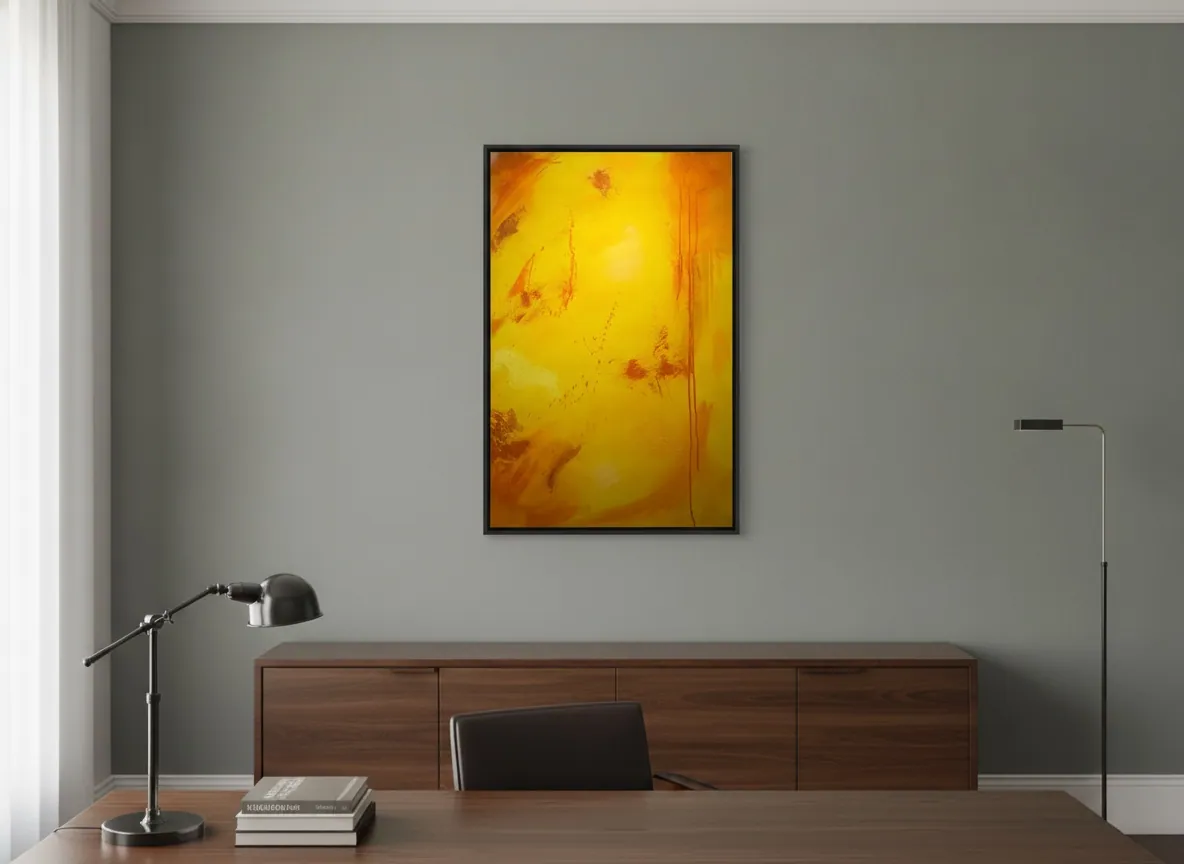
Vibration is a mounting problem, not a canvas-tearing one
Superyacht owners and their advisors consistently flag constant movement and vibration as one of the real risks to art on board, and marine sources describe fixing solutions that are specifically studied and engineered to absorb strain and reduce that risk over the life of an installation. That framing is right, but it is worth being precise about what the vibration actually threatens. Conservation research on physical forces treats ordinary ambient vibration — hull flex, an idling engine, a following sea — as a far smaller hazard to the canvas fibre itself than the much higher vibration levels used in controlled damage testing; general guidance for paintings simply recommends avoiding locations subject to vibration where that is practical.
On a vessel, every wall moves to some degree, so "avoid vibration" is rarely an option — which shifts the real question from placement to fixing. The practical effect of years of constant low-level motion is not a canvas tearing on its own; it is a generic hook working loose, a screw backing out of a soft panel, or an unsecured frame corner knocking against the wall in a seaway. That is a hardware-fatigue problem, and it is solved with hardware, not with avoiding boats altogether.
Salt air and humidity: an enclosure, not a fight against the ocean
The safest relative humidity for a painting on canvas is a stable 40–60%, with as little day-to-day swing as possible — the same target used for any interior holding original paintings. A yacht makes that harder to hold than a house does, because a single door opening onto the deck can pull warm, salt-laden air into an otherwise climate-controlled saloon within seconds. Above roughly 70–75% relative humidity the risk of mould rises sharply, and separately, sustained damp combined with salt is what turns ordinary hardware into a liability: salt-contaminated iron and copper-alloy fittings can begin pitting and staining within weeks once damp, salt-bearing air reaches them — which is exactly why the D-rings, screws and hinges behind a painting matter as much as the canvas itself.
This is why current superyacht design increasingly treats art the way a gallery would from the start: dedicated systems for temperature and humidity control, specified alongside the interior finishes, are built into the project from its earliest phase rather than left to the boat's general air-conditioning. A sealed backing board behind the frame, combined with glazing, adds a second layer on top of that — it buffers the piece from the short daily swings a moving, frequently-opened interior produces, which matters more here than in almost any house.
Large windows mean UV comes standard — filtering it is the job
Modern superyacht saloons are built around glass: floor-to-ceiling windows, skylights and open transoms that flood the interior with daylight. That daylight carries ultraviolet radiation, and the damage it causes to pigments, varnish and paper is cumulative and irreversible — a faded passage of colour does not recover. Total exposure is the product of intensity and time, so a painting absorbs UV bounced through a large glazed area for years even when it never sits in a direct shaft of sun; the traditional museum ceiling for UV exposure — a legacy figure from the incandescent-lighting era still used as a practical reference today — keeps UV levels below 75 microwatts per lumen.
The fix is filtering the glass itself, not just the frame: UV-filtering film applied to windows, skylights or picture glazing blocks the large majority of that radiation and is generally rated for 10 to 15 years of useful life indoors before it needs replacing, degrading faster wherever it takes direct sun and heat. On board, that pairs with a simpler judgment call art advisors already make for yacht interiors — works on paper, photographs and watercolours are the most light-sensitive pieces in a collection, and they read as more vulnerable near a large window than a heavy-bodied acrylic or a ceramic piece, which tend to hold their surface and colour better under the same light.
What installers actually do: fixings, anchoring and a museum-style protocol
On land, a painting is typically hung with a two-part cleat: one bracket fixed to the back of the frame, a matching bracket fixed to the wall, sized to the weight and dimensions of the piece. The same logic carries onto a yacht, with one difference that matters more at sea than on land — the wall-side bracket needs something structural to bite into. A bulkhead or a reinforced batten gives a fastener that solid backing; a decorative panel over an air gap does not, and that distinction is what decides whether the fixing survives years of constant low-level motion or works loose within one season. Superyacht art transport and installation are generally described in the industry as following protocols similar to museums, carried out by specialised personnel using dedicated, safe anchoring systems — the marine equivalent of a registrar's condition report and a rigging crew, scaled to a vessel.
Freestanding pieces — sculpture, ceramics, objets d'art — are usually secured differently again: rather than a hanging system, the base is anchored with a removable adhesive the trade calls museum putty, gel or "museum glue," which holds the object to a shelf or plinth so it cannot slide in a swell, and can be released later without damage. Ongoing maintenance follows the same museum-style logic: crew are trained to monitor humidity and light rather than just dust the frame, and condition notes are kept over time, so a change gets caught early instead of discovered at the next haul-out.
From the studio
From the studio
When a piece is headed to a yacht, the question I ask first isn't about the size of the vessel — it's about what's behind the wall. A bulkhead gives a fastener something solid to bite into; a panel over an air gap does not, and that difference matters more after years of constant low-level movement than it does on the day the piece goes up. For a piece like this, I lean toward the flatter, fully-bonded builds in the collection — acrylic on canvas, without raised texture or applied gold leaf — simply because a flat surface is easier to secure invisibly and to inspect later than one with separately-adhered elements. It isn't a rule I apply to the whole collection; it's the kind of adjustment that only makes sense once I know the actual wall and the actual motion the piece will live with.
I'd rather have that conversation with the owner's project manager or the yacht's interior team before the piece ever leaves the studio — what the wall is actually built from, whether there's a dedicated climate zone, how much daylight that window gets across a full day — than have a collector solve a mounting problem afterward with whatever bracket happened to be on board. It's the same question I'd ask about any wall, on water or on land; a boat just answers it more honestly, because on a boat, nothing about the space stays still.
Frequently asked
Does the vibration from a yacht's engines actually damage a painting?
Not directly, in most cases. Conservation research on physical forces treats ordinary ambient vibration as a much smaller risk to a canvas than the levels used in controlled damage testing, and general guidance simply recommends avoiding vibration-prone spots when that's practical. On a yacht, where every wall moves to some degree, the real effect of sustained low-level vibration is on the hardware, not the canvas: fasteners can work loose and unsecured pieces can shift over months, which is why marine installations rely on hardware rated for that fixing job, not on the canvas absorbing the motion on its own.
What is a painting actually mounted to on a yacht — is a standard picture hook enough?
A picture hook meant for drywall isn't the standard here. Professional installers anchor the wall-side hardware into structural framing — a bulkhead or a reinforced batten — rather than a decorative panel, using the same two-part cleat or security-screw systems used on land, sized to the weight and dimensions of the piece. Superyacht art transport and installation are generally described as following protocols similar to museums, carried out by specialised personnel using dedicated anchoring systems, precisely because the fixing has to survive years of constant low-level motion, not just a single hang.
How is a sculpture or ceramic piece kept from sliding during a swell?
Freestanding objects are usually secured differently from paintings: instead of a hanging system, they're anchored to their surface with a removable adhesive — often called museum putty, gel or "museum glue" in the trade — that holds the base in place without permanently fixing the piece down. It's actually one of the more forgiving categories aboard a yacht: a small sculpture secured this way is arguably steadier in a swell than the same piece sitting loose on an open shelf in a house.
What humidity range should the space around the art stay in on a yacht?
The same range used in any interior holding original paintings: a stable 40–60% relative humidity, ideally without daily swings. That range is harder to hold on a yacht than in a house, because a door opening to the deck introduces warm, salt-laden air within seconds — which is why current superyacht design increasingly builds dedicated temperature and humidity control into the project from the earliest phase, rather than relying on the vessel's general air-conditioning to do that job unassisted.
Do the windows need UV film if the art isn't sitting in direct sunlight?
Usually yes, on a vessel with large glazing. UV damage to pigment and varnish is cumulative and irreversible, and it accumulates from ambient daylight passing through a room, not only from a patch of direct sun on the canvas. UV-filtering film applied to the glazing blocks the large majority of that radiation and typically needs replacing after ten to fifteen years indoors, well before it's visibly degraded — which is exactly the kind of maintenance item worth logging rather than assuming is still working.
Placing a piece aboard? Send the wall and the humidity range.
Alyne specifies the backing, the hanging hardware and the glazing for a piece before it leaves the studio — send a photo of the wall, what's behind it if you know it, and the humidity range on board, and she'll advise on framing and mounting before anything ships. Pieces in the current collection run roughly R$2,400 to R$8,800 (very approximately US$450–1,600, depending on the exchange rate on the day).
Sources
- Canadian Conservation Institute (Government of Canada) — CCI Notes 10/4, Environmental Guidelines for Paintings — 2026-09-26
- Canadian Conservation Institute (Government of Canada) — Agents of Deterioration: Incorrect Relative Humidity — 2026-09-26
- Canadian Conservation Institute (Government of Canada) — CCI Notes 10/3, Storage and Display Guidelines for Paintings — 2026-09-26
- Canadian Conservation Institute (Government of Canada) — Agents of Deterioration: Physical Forces — 2026-09-26
- Canadian Conservation Institute (Government of Canada) — Agent of Deterioration: Light, Ultraviolet and Infrared — 2026-09-26
- Canadian Conservation Institute (Government of Canada) — CCI Notes 2/1, Ultraviolet Filters — 2026-09-26
- Boat International — interview with London-based art dealer Adrian Sassoon — 2026-09-26
- Daily Nautica — Art on Superyachts: Design, Conservation and Innovation — 2026-09-26
- Picture Hang Solutions — What Professionals Use in Hanging Art — 2026-09-26
Published on