Art for a villa in a humid tropical climate
A villa in a humid tropical climate doesn't spike the way a steam room does — it holds an elevated relative humidity for weeks at a time. That's the real hazard: mould research shows visible growth can take about 100 days at 70% RH but only about two days near 90%, and a constant baseline never resets that clock.
How a tropical villa's humidity is different from a spa's or a wine cellar's
A spa's risk lives in one room: a steam bath running close to 100% relative humidity for the length of a treatment, then venting out. A wine cellar's risk is engineered and contained: a single space held at 55–75% RH by a humidifier. A villa in a genuinely humid tropical climate — without a building envelope and air-conditioning working continuously to pull moisture out — doesn't have one wet room. The elevated humidity is ambient: it's in the living room, the bedroom, the hallway, all day, for as long as the wet season lasts, or year-round in an equatorial climate with no dry season at all.
The conservation standard doesn't change because the source of the moisture is a rainforest instead of a shower. The Canadian Conservation Institute's environmental guidelines for paintings state that "the safest RH for paintings on canvas or wood is a stable level between 40 and 60%," with a recommended temperature range of 16–25°C, and that "RH levels over 70–75% will encourage mould growth." What changes in a tropical villa is how often a room's real humidity sits above that line — not for the ten minutes a guest spends in a steam room, but for a stretch of the calendar that can run to months.
The Getty Conservation Institute, which has run a long-standing research program on this exact problem, frames it directly: "Biodeterioration of collections is a major concern for cultural institutions in hot and humid regions where favorable conditions for insects, fungi, and bacteria are found. The threat posed by biological and microbiological attack in tropical regions often supersedes the potential for chemical aging or mechanical damage." That program's own field assessment work included the Museum of Sacred Arts in Salvador, Bahia — a reminder that this isn't a hypothetical for Brazilian buildings specifically, it's the reason a body of conservation research on hot, humid climates exists at all.
Why constant humidity is a harder problem than a brief spike
Duration, not just level, is what makes a tropical villa's humidity a different kind of risk than a spa's steam room. The Canadian Conservation Institute's guidance on relative humidity as an agent of deterioration is specific about how quickly the danger compounds: "Note how much the time for visible mould shortens in the RH range of 70% RH to 90% RH – from 100 days at 70% RH to two days at 90% RH." A steam room hits the top of that range for the length of a treatment and then the air exchanges out. A villa room that sits at 70–75% RH continuously, because that's simply the outdoor air moving through an open floor plan, is accumulating toward that 100-day mark instead of resetting.
The same guidance makes the comparison explicit in the other direction, and it's the clearest argument for why a villa needs a different mental model than a wet room: "Far better for a collection stuck most of the time at 70% RH to have its RH fluctuate down to the safe zone every few days, since it will reset the mould growth clock back to zero." A villa that never drops back into the 40–60% safe band — because there's no dehumidification running, only open windows and ceiling fans — doesn't get that reset. The risk isn't the single worst day; it's the absence of any better day in between.
Constant high humidity also works on the canvas itself, mechanically, not just biologically. The CCI's paintings guidelines note that "at RH levels above 75%, some canvases will shrink at the same time that the wooden stretcher or strainer is expanding" — two materials moving in opposite directions under sustained moisture. A single humid week does that once; a tropical wet season that runs for months does it as a repeated, compounding stress rather than a one-time event.
Materials that need extra caution: metallic leaf and framing
Every piece in the Perfeito Studio collection is acrylic-based mixed media on canvas, and several works — including pieces in the Black & Gold and Terra & Ether series — incorporate gold leaf or metallic fragments as part of the surface. Metal behaves differently from paint film under sustained humidity, and the mechanism is corrosion, not mould. General conservation guidance for metal objects is direct about the threshold: relative humidity in storage and display areas "should be kept below 45% for most metals," because moisture combined with oxygen is what drives the corrosion reaction in the first place. A villa's ambient humidity, if it runs anywhere near or above the 70–75% mould-risk line for canvas, is well past the point conservation guidance treats as safe for a metallic surface too.
This doesn't rule gold leaf or metallic-fragment work out of a tropical home. It means the room matters more for those pieces specifically: the more climate-buffered rooms of a villa — a bedroom or media room that actually runs air-conditioning, rather than an open, cross-ventilated living pavilion — are the better fit for a piece carrying real metal on its surface, while a purely acrylic canvas without metallic elements has one less material variable to manage in the same room.
Where to actually place a painting in a villa that runs humid all year
The placement logic for a tropical villa isn't "avoid the wet room," because there isn't one distinct wet room — it's about finding the driest, most air-moving parts of a house that otherwise runs warm and humid throughout. An interior wall, away from an exterior wall that picks up outdoor humidity and temperature swings, is the more stable choice; exterior walls are also where condensation is most likely to form when warm, moist air meets a comparatively cooler surface. A room that gets real cross-ventilation or a ceiling fan running most of the day fares better than a closed, still corner, since moving air is what keeps a room's humidity from settling at its outdoor baseline.
Full air-conditioning isn't the only lever, and for a villa built around natural ventilation it usually isn't the most realistic one either. The Getty Conservation Institute's own research into this problem was built specifically around that constraint: its project on hot and humid environments existed because "air-conditioning systems are often used to prevent biodeterioration, but historic buildings cannot always withstand these systems" and are "expensive to install, operate, and maintain," and it developed humidistat-controlled ventilation and heating as a lower-intervention alternative. For a home, the practical version of that same logic is smaller and cheaper: prioritize the one or two walls where a painting will hang, keep air moving there, and treat a small dehumidifier or split-unit AC in that specific room as a targeted fix rather than trying to condition an entire open-plan villa.
From the studio
From the atelier
Brasília works on the opposite climate problem for most of the year — our dry season runs so low on humidity that the concern here is usually static and cracking paint, not mould. So when a collector writes in from a coastal or genuinely tropical address — Rio, the Northeast, or a client shipping a piece outside Brazil to a humid climate altogether — the conversation has to start from scratch, because the assumptions that hold for a house in the Cerrado don't hold for a house that never really dries out.
My honest answer is close to what I'd tell anyone asking about a spa or a cellar: think about the specific wall, not the room's name. Every piece I make is acrylic-based mixed media on canvas, and for a client in a humid tropical setting I ask about air movement and which rooms actually run air-conditioning before I recommend a spot — more so for anything from Black & Gold or the metallic-fragment pieces in Terra & Ether, where I'd rather see the work go into the one room that stays properly dry than into the most beautiful wall in an open, humid living space. It's the same question I'd ask about any canvas going anywhere with real humidity: what does this specific room actually do, day to day, not just what does the house look like in a photograph.
Frequently asked
Can you hang original art in a tropical villa without full air conditioning?
Yes, with the right placement. The goal is finding the driest, best-ventilated walls in the house rather than assuming nothing can be done without air-conditioning everywhere. An interior wall away from exterior humidity and condensation, in a room with real air movement from a ceiling fan or cross-ventilation, holds up far better than a closed, still corner. For a specific piece with metallic leaf or fragments, a room that does run air-conditioning or a dehumidifier is the safer choice.
What humidity level is dangerous for a painting over the long term?
Above roughly 70–75% relative humidity, according to the Canadian Conservation Institute, which states that RH levels over that threshold will encourage mould growth on paintings, and that a stable 40–60% RH is the safe range for canvas. What matters in a villa specifically is duration: the same research shows visible mould can take about 100 days to appear at 70% RH but only about two days near 90% RH, so a humidity level that would be a minor, temporary risk in a spa becomes a serious one when it's the room's baseline for months.
How is a humid tropical villa different from a spa or steam room for art?
A spa's risk is a brief spike in one wet room — a steam bath running near 100% relative humidity for the length of a treatment, then venting out. A tropical villa's risk is ambient and constant: ordinary rooms sitting at an elevated humidity for weeks or months because there's no air-conditioning continuously removing moisture. Conservation research treats sustained humidity as the harder problem, because a short spike doesn't last long enough for mould to establish, while a constant baseline never resets that clock.
Do gold leaf or metallic paintings need special care in a humid climate?
Yes. Metal responds to humidity differently than a painted canvas surface — through corrosion rather than mould — and general conservation guidance for metal objects recommends keeping relative humidity below roughly 45%, since moisture combined with oxygen is what drives the corrosion reaction. Several works in the Perfeito Studio collection, including pieces in the Black & Gold and Terra & Ether series, incorporate gold leaf or metallic fragments, so those pieces specifically benefit from a room that runs drier than the rest of a humid villa.
Which Perfeito Studio pieces suit a tropical villa's interior best?
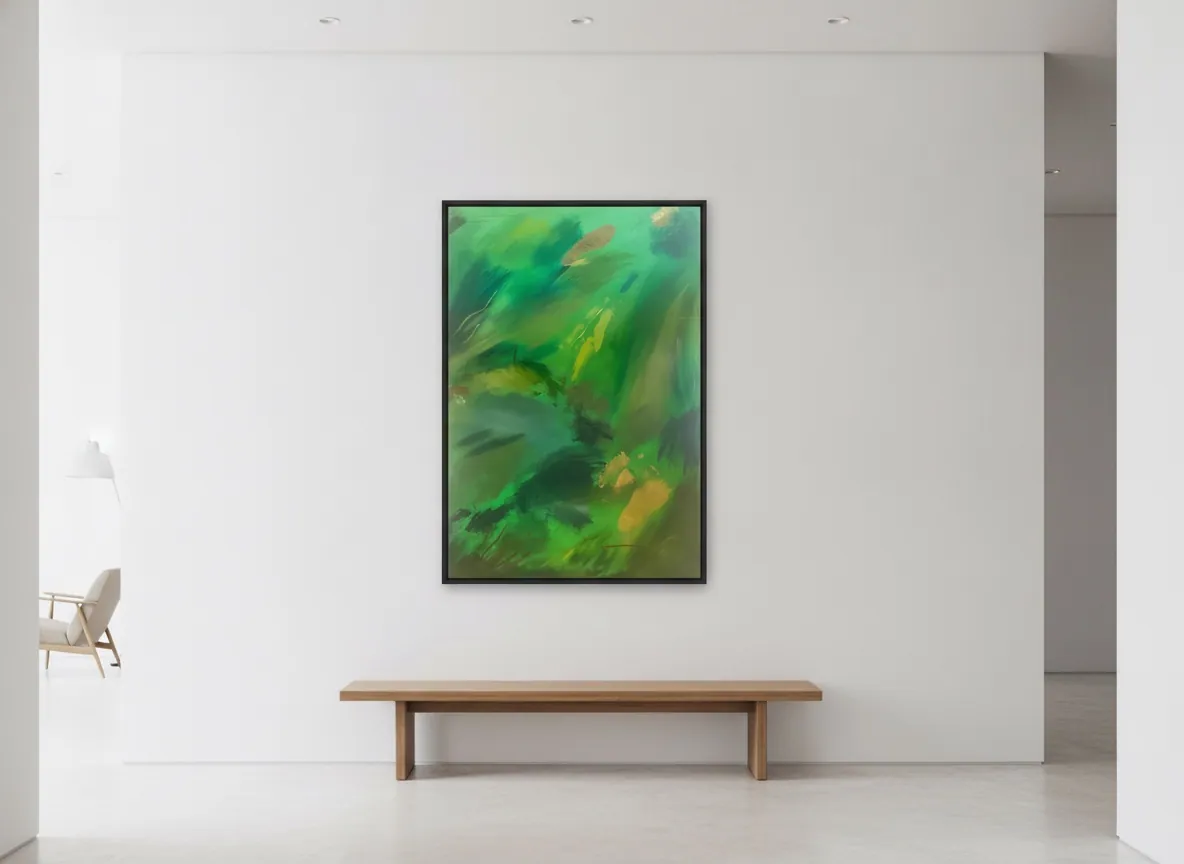
It depends on what a room can actually offer. Vegetal Dawn, from the Terra & Ether series, layers botanical greens with fragments of gold leaf catching the light through the surface — so, like Golden Passage from Black & Gold, it belongs in whichever room in the house genuinely runs dry or air-conditioned, not simply the most visually striking wall in an open, humid living space. For a villa's most humid, least climate-controlled corners, a purely acrylic canvas with no metallic component at all is the safer match, since it leaves one less material variable to manage.
Thinking about a piece for a home in a humid tropical climate?
Tell the studio about the room — how it's ventilated, whether it runs air-conditioning, how close it is to an exterior wall — and we'll help you find a piece and a placement that actually holds up.
Sources
- Canadian Conservation Institute / Government of Canada — 2026-09-26
- Canadian Conservation Institute / Government of Canada — 2026-09-26
- Canadian Conservation Institute / Government of Canada — 2026-09-26
- Canadian Conservation Institute / Government of Canada — 2026-09-26
- Canadian Conservation Institute / Government of Canada — 2026-09-26
- Getty Conservation Institute — 2026-09-26
- Getty Conservation Institute — 2026-09-26
- Getty Conservation Institute — 2026-09-26
- Western Australian Museum — Collections Care Manual — 2026-09-26
Published on