Can you hang a painting in a wine cellar?
Yes, but the two environments want different conditions. Wine cellars are typically run at 55–75% relative humidity and 10–15°C, while conservation guidance for canvas paintings recommends a stable 40–60% RH. Hang the piece in the drier, better-ventilated part of the cellar — an entry wall or tasting area, not deep among the racks.
The RH and temperature mismatch between wine storage and painting conservation standards
Wine storage and painting conservation follow separate standards, and the two don't fully agree. Climate-controlled wine storage is generally kept at 55–75% relative humidity, with temperature held around 10–15°C (50–59°F) — the range most commonly cited for a cellar built to age wine over the long term.
Conservation guidance for paintings starts from a different number. The Canadian Conservation Institute's environmental guidelines for paintings state that "the safest RH for paintings on canvas or wood is a stable level between 40 and 60%," with a recommended temperature range of 16–25°C. Line the two ranges up and the only real overlap sits in the humidity band around 55–60% — below that, a cellar is running drier than its own usual target; above it, the cellar is wetter than what conservation guidance treats as safest for a canvas, and colder than the temperature range that same guidance recommends.
Humidity level isn't the only variable at play. The same CCI guidance treats swings in RH as a separate risk in its own right: "short-term fluctuations (daily) in RH can be very damaging to vulnerable objects that respond quickly to changes in RH." A cellar's humidifier or cooling system cycling on and off, or a door opening into a warmer hallway, can move RH from day to day even when the average sits inside a reasonable range — and that day-to-day movement is its own hazard, separate from whatever the average number happens to be.
Mould risk: where the top of a wine cellar's humidity range gets dangerous for a canvas
The upper end of typical wine cellar humidity is where the two standards conflict most directly. The CCI's guidance is specific about the threshold: "RH levels over 70–75% will encourage mould growth," and separately notes that "artworks are susceptible to fungal infestations when the humidity exceeds 70–75% RH." A cellar conditioned toward the top of the 55–75% range commonly cited for wine storage sits inside, or right at the edge of, that mould-risk band for anything painted on canvas.
This doesn't mean every wine cellar is dangerous for a painting. A cellar held at the lower end of that range, closer to 55–60% RH, stays inside the CCI's 40–60% safe range for paintings too. The risk shows up specifically when a cellar runs toward 70% or higher, or when local humidity spikes near a humidifier reservoir, an evaporative cooling unit, or a wall that picks up condensation from the temperature difference with the room next door.
Where to actually place a painting in or near a wine cellar
If a painting is going in or near a wine cellar, distance from the racking and from the humidification source matters more than the room label. An entryway, a tasting nook, or the wall opposite the bottle storage tends to run drier and see less direct exposure to whatever is keeping the bottles humid than the racks themselves do, since misting and evaporative units concentrate moisture close to where the wine sits.
Avoid exterior walls of the cellar, any wall adjacent to a cooling unit or humidifier reservoir, and any surface that has ever shown condensation — a cold wall next to a warmer room is exactly where moisture concentrates. A painting positioned near the cellar door, where air exchanges with the rest of the house, generally sees a milder and steadier RH than one deep inside a sealed, actively humidified room.
Humidity buffers, glazing, and framing choices that create a safer microclimate
Where the room itself can't be brought fully into the 40–60% band, the piece can be given its own microclimate. Framing behind glazing — particularly UV-filtering acrylic or glass, paired with a sealed backing board — slows how quickly the canvas responds to swings in room humidity, which matters given how much weight CCI's guidance puts on short-term fluctuation as a hazard separate from the average humidity level.
A sealed backing (a rigid board sealed to the frame rebate, rather than an open-backed canvas) reduces how directly the reverse of the canvas is exposed to cellar air. Where a collector wants tighter control, some framers add a buffering board inside the sealed package to slow moisture exchange further — though for a piece with real value or existing condition concerns, the safer route is a conservator's assessment rather than treating a framing choice as a substitute for one.
From the studio
From the atelier
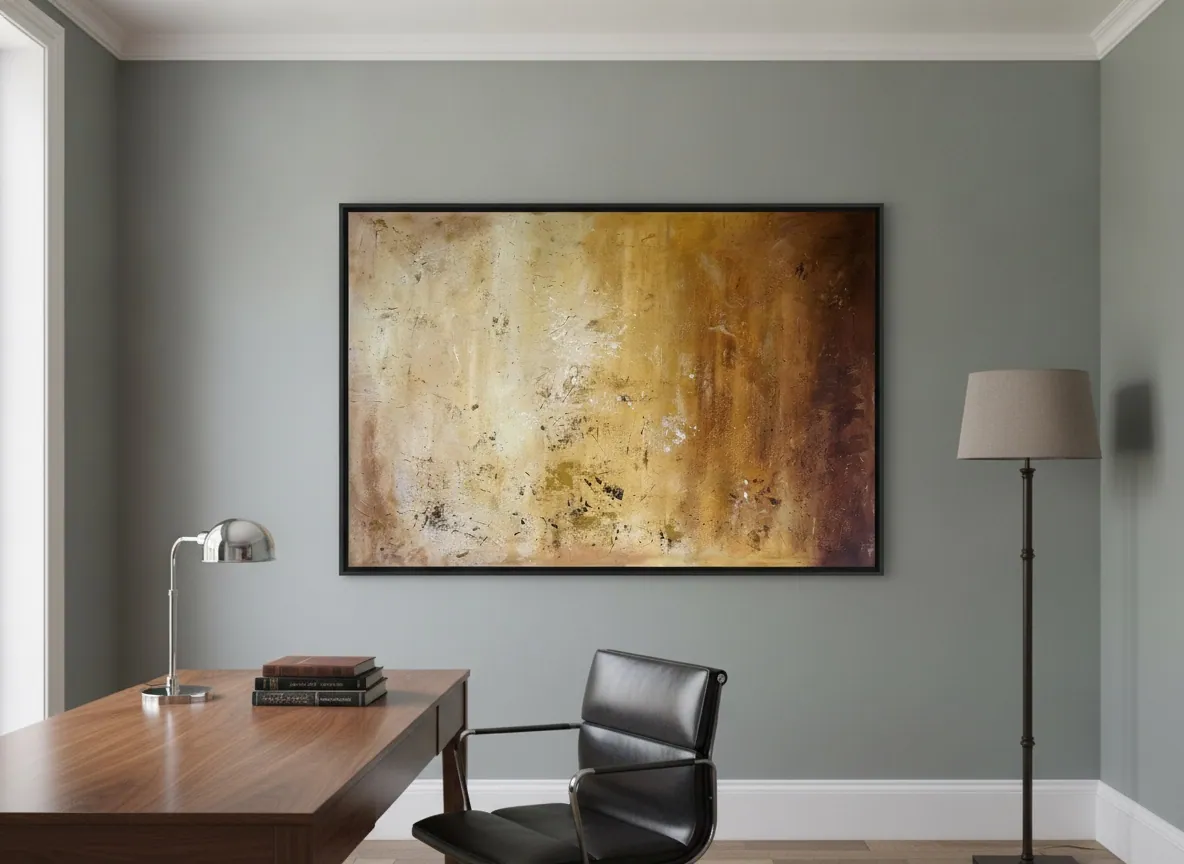
I get this question more often than the size of my studio would suggest, because Brasília has a lot of newer houses with a wine room built into the plan before anyone has decided what goes on the wall next to it. My honest answer, every time: I'd rather see a piece from Terra & Ether — a series built on earth tones, mineral texture, and warm metallic fragments — near a cellar than almost anything from Luminous Rebirth, because the palette already belongs there, and because I'm not asking a collector to fight the room's own humidity swings with a mismatched surface.
My work is acrylic-based mixed media on canvas, not oil, and I still tell people the same thing a conservator would tell them about any canvas: keep it out of the wettest, most enclosed part of the room. When a client tells me a piece is going near their cellar, I ask where the humidifier sits and which wall gets the most direct airflow from it before I say a specific spot works — not because the work is unusually delicate, but because any canvas deserves that five minutes of thought before it goes on a wall that was designed around bottles, not paint.
Frequently asked
Can you hang a painting in a wine cellar?
Yes, with some placement care. Wine cellars are typically conditioned to 55–75% relative humidity, while conservation guidance for canvas paintings recommends a stable 40–60% RH. The safest spot is the drier, better-ventilated part of the room — away from the humidifier and the racks themselves — rather than deep inside a sealed, heavily humidified section.
What humidity level is too high for a painting near a wine cellar?
Above roughly 70–75% RH. The Canadian Conservation Institute's guidance states that RH levels over 70–75% will encourage mould growth and that artworks become susceptible to fungal infestations past that point. Many wine cellars are conditioned toward the top of the 55–75% range commonly cited for wine storage, which can sit at or above that threshold; a cellar held at the lower end of that range, closer to 55–60% RH, stays inside the range conservation guidance treats as safe for canvas.
Does the temperature in a wine cellar matter as much as the humidity?
It's worth checking separately. Wine cellars are commonly run at 10–15°C (50–59°F), while conservation guidance for paintings recommends a temperature range of 16–25°C. A painting placed in the coldest part of a cellar sits outside that recommended range regardless of what the humidity reading shows.
Does humidity fluctuation matter more than the average humidity level?
They are two separate risks, not one ranked above the other. Conservation guidance treats short-term, day-to-day RH fluctuation as damaging to vulnerable objects on its own terms, apart from whether the average humidity sits inside a safe range. A cellar whose humidifier cycles swing several points a day can still be a risk even if its average RH looks acceptable on paper.
Can framing or glazing protect a painting hung near a wine cellar?
It can help create a buffer, though it isn't a substitute for placement. Glazing paired with a sealed backing board slows how quickly a canvas responds to changes in room humidity, and a sealed rather than open-backed frame reduces how directly the back of the canvas is exposed to cellar air. For a valuable or already fragile piece, a conservator's assessment is the safer route rather than relying on framing alone.
Is a mixed-media acrylic painting from Perfeito Studio safe in a wine cellar setting?
With the same care as any canvas, yes. The Terra & Ether series in particular, worked in earth tones and mineral texture, was made with warm, stone- and wood-adjacent interiors in mind. As with any painting on canvas, we'd recommend the drier, better-ventilated part of a cellar, or an adjoining room, rather than a wall deep inside heavily humidified racking.
Thinking about a piece for a room near your wine cellar?
Tell the studio about the room — how the cellar is humidified, which wall you're considering — and we'll help you work out if it's a safe, good-looking match.
Sources
Published on