Art for a yacht interior: what actually survives at sea
Salt air, humidity swings, and constant low-level vibration are the three real threats to a painting kept aboard a yacht — not sunlight, which is easy to control. The painting survives when it stays inside a stable, glazed, well-secured microclimate, not simply out of direct spray. Placement and framing matter more than the medium.
Humidity is the real threat, not sunlight
The Canadian Conservation Institute's guidelines for paintings on canvas put the safest relative humidity at a stable 40–60%, with 50% RH commonly used as the central target for consistency between institutions. On a yacht, the risk is rarely a single bad reading — it's the swing: air conditioning holding a saloon at a cool, dry level while a nearby door to the deck lets in warm, salt-laden air every time someone steps outside. Above roughly 75% RH, canvas paintings come under increased physical strain as the fabric and its wooden support expand at different rates, and sustained levels above 70–75% RH create conditions where mould can begin to grow. Below that range, in an over-dried, over-air-conditioned cabin, the opposite problem appears: paint and ground layers stiffen and become more prone to cracking. A yacht's HVAC system, built to keep people comfortable, was not designed with either limit in mind.
Salt air corrodes the frame before it reaches the canvas
Canvas and paint don't corrode — the metal around them does. The Canadian Conservation Institute's reference on relative-humidity damage singles out salt-contaminated iron and copper alloys as a fast-failing case: on marine and archaeological items, pitting and staining of nearby surfaces can develop within weeks once damp, salt-bearing air reaches an unprotected fitting. On a yacht, that means the D-rings, wire, hinges, and mounting screws holding a painting to a bulkhead are the actual point of failure, not the canvas itself. The fix is not exotic: specify marine-grade stainless steel or solid brass hardware — the same standard used for deck fittings — rather than the plated steel that ships with most retail frames, and keep the fittings behind a sealed backing board rather than exposed to cabin air circulation.
Acrylic tolerates motion and swings better than oil
A painting on a boat is never fully still — the hull works, engines idle, and a piece hung on a bulkhead absorbs some of that low-level vibration for years, not days. Paint chemistry matters here. Research published by Golden Artist Colors' Just Paint, drawing on coatings-research studies, notes that at normal indoor temperatures acrylic paint films remain considerably more flexible than oil films, which stiffen and grow more brittle as they age through oxidation. That flexibility gives an acrylic-based painting more tolerance for the small, constant flex of a moving structure. It isn't a blanket guarantee — the same research notes acrylic flexibility drops sharply in cold conditions, so a piece stored unheated below deck in winter loses part of that advantage — but for a work living in a climate-controlled saloon or cabin, acrylic and mixed-media paintings have a real physical edge over oil on this specific point.
Where on the boat a painting can actually survive
Given those two constraints — humidity swings and salt-laden air — the practical placement rule on a yacht is straightforward: an interior wall, away from any door or porthole that opens directly to the deck, and away from air-conditioning vents that create localized cold spots where condensation forms first. A saloon bulkhead or a corridor wall between climate-controlled cabins tends to hold a steadier microclimate than anywhere near an entrance, a galley (which adds its own humidity and grease aerosol), or an exterior-facing wall that picks up heat and cold from the hull. None of this requires a museum-grade retrofit — it requires choosing the wall that already has the most stable air on the boat, which is rarely the most dramatic one.
Framing, glazing, and mounting matter more on a vessel
Two framing choices do more for a painting at sea than any humidifier. First, UV-filtering acrylic glazing: beyond blocking light damage, CCI guidance notes that glazing buffers a painting from short-term relative-humidity fluctuations, especially when the frame includes a sealed backing board — exactly the kind of daily swing a yacht produces every time a door opens. Second, mounting: the same CCI guidance on painting storage and display recommends against placing artworks in locations subject to vibration, which on a vessel means securing a piece with hardware rated for the hull's actual movement rather than the picture hooks used in a static apartment — and never simply leaning a framed piece against a wall in transit, which is exactly when it is most exposed to knocks and slippage.
From the studio
From the studio
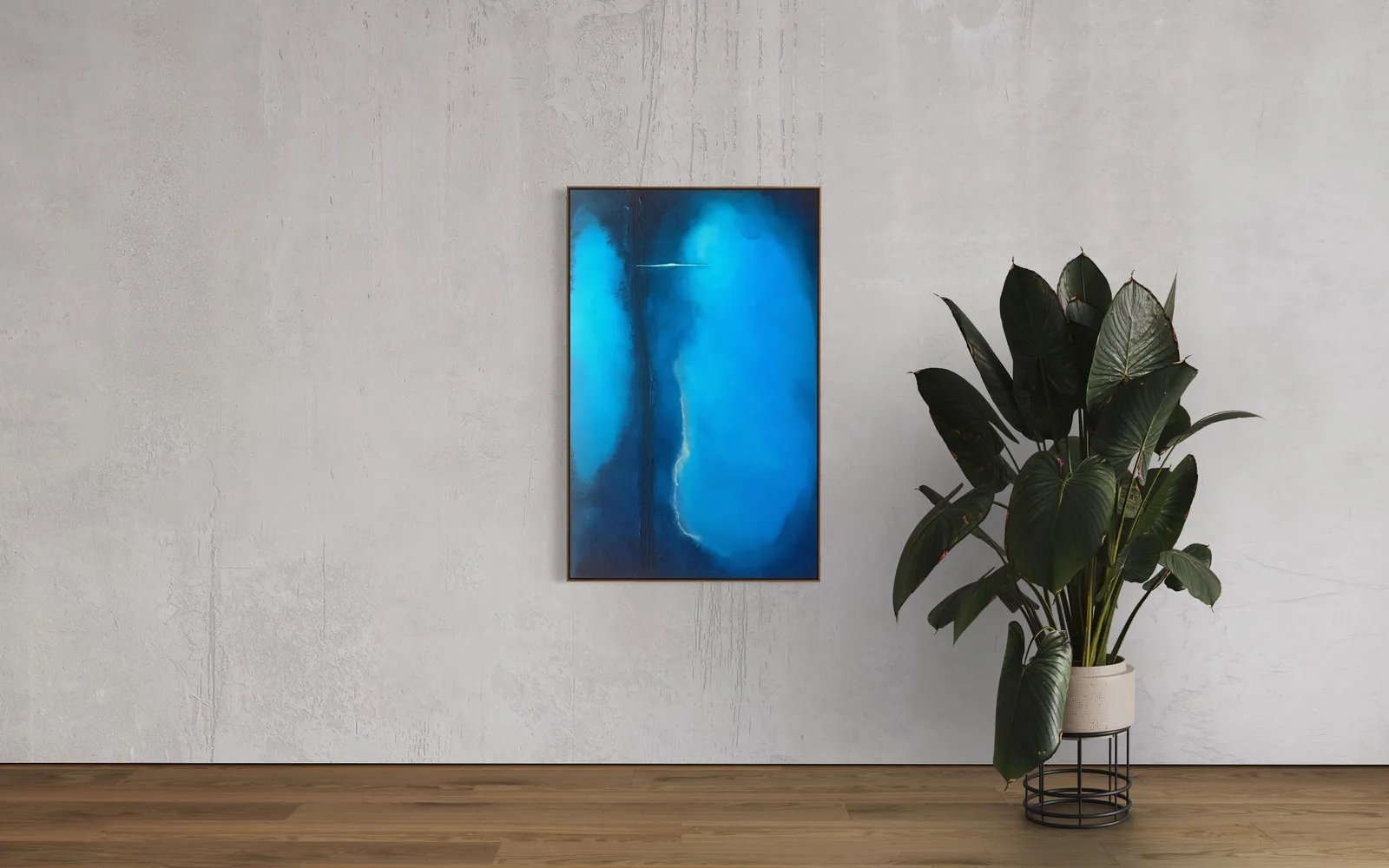
When a client tells me a piece is going on a boat, I ask the same three questions I'd ask an architect client about any wall: what does the light do there across a day, what's actually behind the wall, and how much does the space move. A boat just answers the third question more honestly than a house does — everything on it moves, all the time, and the air changes the moment a door opens. I work in acrylic and mixed media — gold leaf, sculpted texture, layered pigment — partly because that build tolerates a less controlled environment better than a thin oil glaze would, and partly because the texture reads well in the low, shifting light you get inside a cabin. If someone tells me a piece is headed to a vessel, I choose the backing and recommend the glazing accordingly before it ever leaves the studio. It's a question I'd rather answer once, in the frame, than have a collector solve later with a dehumidifier.
Frequently asked
Can any original painting go on a yacht, or only certain mediums?
Acrylic and mixed-media works tolerate the environment better than oil, mainly because acrylic paint films stay more flexible at normal indoor temperatures and the medium is less prone to the brittleness oil develops with age. The bigger variable is usually placement and framing, not the medium alone.
What humidity range should the room where the painting hangs stay in?
A stable 40 to 60% relative humidity is the standard conservation target for paintings on canvas, with 50% commonly used as the central value. The real danger on a boat is less a single bad reading than a daily swing between a cool, dry saloon and warm, salt-laden air from an open deck door.
Does salt air actually damage the canvas itself?
Not directly in most cases — the canvas and paint layer aren't what salt attacks first. The metal hardware holding the painting to the wall, such as D-rings, wire, screws, and hinges, is far more vulnerable and can start pitting within weeks once salt-laden damp air reaches it.
Should the painting be glazed with glass or acrylic?
Yes, on a boat more than almost anywhere else. UV-filtering glazing protects against light damage and also buffers the painting from short-term humidity swings, particularly when combined with a sealed backing board, which is exactly the kind of daily fluctuation a yacht's interior produces.
Where inside the boat should the piece actually be hung?
An interior wall away from any door or porthole that opens to the deck, and away from air-conditioning vents, which create localized cold spots where condensation forms first. A saloon bulkhead or a corridor between climate-controlled cabins is usually steadier than a wall near an entrance or the galley.
Does a painting need insurance specifically for a yacht?
Marine transit and a yacht's operating environment differ enough from a house that it's worth confirming with an insurer whether a standard fine-art policy covers the vessel or whether it needs a marine rider. That's a question for the policy provider, not something the studio can answer generically.
Placing a piece aboard? Send the boat's layout.
Alyne works in acrylic and mixed media partly because it holds up better in a less controlled environment — send a photo of the wall, the humidity range if you know it, and she'll advise on framing and placement before anything ships. Pieces in the current collection run roughly R$2,400 to R$8,800 (very approximately US$450–1,600, depending on the exchange rate on the day).
Sources
- Canadian Conservation Institute (Government of Canada) — CCI Notes 10/4 — 2026-09-02
- Canadian Conservation Institute (Government of Canada) — CCI Notes 10/4 — 2026-09-02
- Canadian Conservation Institute (Government of Canada) — CCI Notes 10/4 — 2026-09-02
- Canadian Conservation Institute (Government of Canada) — Agents of Deterioration: Incorrect Relative Humidity — 2026-09-02
- Canadian Conservation Institute (Government of Canada) — CCI Notes 10/3 — 2026-09-02
- Just Paint / Golden Artist Colors, Inc. (Frank N. Jones, Coatings Research Institute, Eastern Michigan University) — 2026-09-02
Published on