Art for an aesthetic or cosmetic clinic
An aesthetic or cosmetic clinic reception calls for art that reads as refined and unhurried, not clinical or loud: a piece with a contained, luminous palette or a restrained gold-leaf finish tends to anchor a premium reception better than an expansive, high-saturation gesture, which competes with signage and bright clinical lighting instead of supporting the brand.
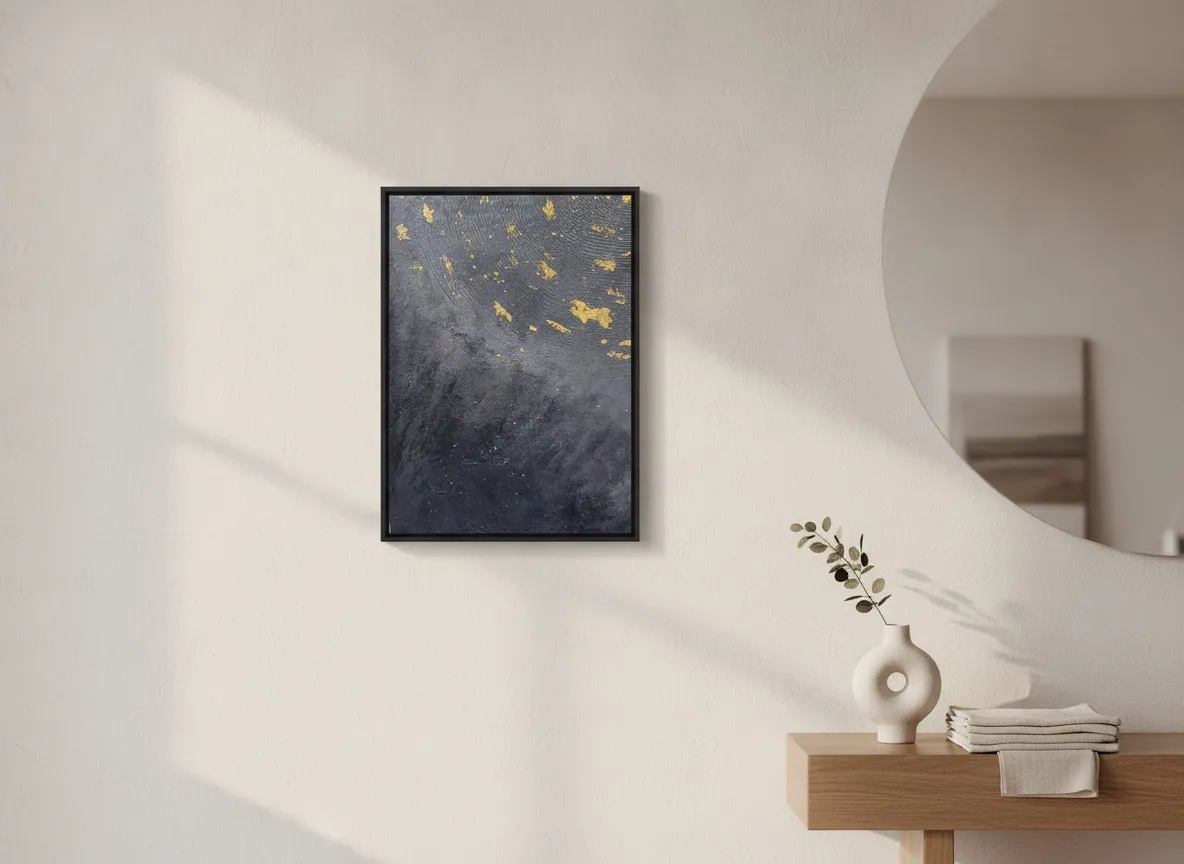
Reception, waiting area, and treatment room ask for different things
Art in an aesthetic clinic doesn't do one job — it does a different job in every room. In the reception, it's the first read of the brand: the moment a new patient decides, in seconds, whether the space feels considered, serious, and invested in. That's where the most expressive piece belongs, the one the clinic can use as its visual signature.
In the waiting area, the brief changes. The work is seen for longer, from a fixed, usually seated vantage point — which calls for a composition that holds up under repeated looking without tiring the eye, and without competing with reception screens, signage totems, or product displays that are already fighting for attention on the same wall.
In the treatment room itself, the logic is different again: an easy-to-clean surface, a discreet format, and no pronounced sculpted texture near equipment or a treatment bed. Many clinics choose not to hang anything there at all, or use a small, neutral piece — the right call depends on the room's own protocol, not on taste.
Gold leaf, luminous palettes, and the line between refined and overdone
Gold leaf over sculpted texture paste — as in Celestial Plan or Golden Passage, from the Black & Gold series — tends to read well in aesthetic-clinic receptions because it speaks the same visual language these brands already use: matte metals, warm neutrals, a polished finish that never feels cold. The risk isn't using gold, it's repeating it in every room: as a single accent on the anchor piece in reception, it works as signature; spread across several rooms, it turns into ornament and loses force.
In support spaces, a more luminous, contained palette — the register that defines the Luminous Rebirth series — does a different job: it isn't there to demand attention, it's there to avoid fighting the cold white light typical of clinical environments, or the white coats, pale furniture, and mirrors that already take up most of the wall in these rooms.
Anchor piece in reception, supporting pieces in the rooms that follow
The curation that tends to work best in an aesthetic clinic has a clear hierarchy: one larger, more present piece in the reception, and smaller works — from the same series or a complementary palette — in the waiting and consultation rooms. That avoids the common mistake of buying one work per room with no shared logic, and gives the whole space a coherent visual language.
In the current collection, the Luminous Rebirth series has five available works between roughly R$ 3,700 and R$ 5,900 (a USD reference is available on inquiry, always confirmed at checkout) — among them Celestial Drift, Veil of Light, Solar Rain, and Prism Garden — and the Black & Gold series has two, Golden Passage (R$ 3,500) and Celestial Plan (R$ 2,700). A common combination: the larger, more present piece in reception, and a medium-format work from the same palette in a waiting or consultation room.
Letting the art support the clinic's brand instead of competing with it
An aesthetic clinic usually arrives with a defined brand palette already in place — signage color, light temperature, wall finish — before any decision about art gets made. The most common mistake isn't choosing the wrong piece, it's choosing without accounting for that palette: a beautiful work that pulls toward a tone the brand doesn't use ends up fighting the rest of the room instead of reinforcing it.
In practice, that means sending photos of the reception and the rooms, with the real lighting on, before confirming any piece — that's how you confirm whether a work adds to the clinic's identity or competes with it. Large mirrors, common in aesthetic treatment rooms, also reduce the free wall available; it's worth measuring before settling on a format.
For a buyer outside Brazil, acquisition runs the same way it does for any other Perfeito Studio work: direct with the artist's studio, in BRL, with a signed Certificate of Authenticity, an Archive ID, and shipping quoted per destination — covered in more detail on the studio's available works page.
From the studio
Why I point toward Luminous Rebirth and Black & Gold here, not Heart of Chaos
Before I was a painter, I was an architect, and when the brief is an aesthetic clinic I read the space differently than I would for an ordinary medical office. For a general practice's consultation or waiting room, I almost always point toward a contained palette — Matter & Silence or Terra & Ether — because sobriety and not competing with clinical signage is the priority there. An aesthetic clinic is a different brief: the brand itself already sells refinement and attention to appearance, so the art can — and usually should — carry more light and more finish, without turning into a gallery piece that competes with the space.
That's why, for an aesthetic-clinic reception, my first suggestion is usually something from Luminous Rebirth for the luminosity of the palette, or a Black & Gold piece when the brand already uses matte metal or gold in its identity. I don't point toward Heart of Chaos for this kind of environment — it's the most expansive, most saturated series in the collection, and it tends to fight the white light and mirrors these rooms usually have. I always ask for a photo of the wall with the real lighting on before confirming a recommendation; the clinic's palette decides more than any preference of mine.
Frequently asked
Does gold-leaf art suit an aesthetic clinic, or does it look excessive?
It suits it, with one condition: use it as a single accent, not repeated in every room. Black & Gold pieces, like Golden Passage and Celestial Plan, carry gold leaf over sculpted texture paste, a finish that reads well against the matte metal and warm neutrals common in aesthetic-clinic branding. The risk isn't gold itself, it's multiplying it: one anchor piece in reception works as a signature; gold in every room turns into ornament and loses its force.
Should the art reflect the clinic's premium positioning?
Yes, and it's usually the first thing a new patient reads before speaking to anyone. A refined, well-resolved piece signals the same care the clinic wants associated with its treatments. A decorative print that could hang in any waiting room does the opposite — it flattens a premium position down to a generic one, however good the treatment itself is.
What colors work in a bright, all-white clinic?
A luminous, contained palette tends to work better than a highly saturated one, which competes with white walls, cold clinical lighting, and mirrors. The Luminous Rebirth series was built around that register — light, layered transparency, soft chromatic movement — with five available works between roughly R$ 3,700 and R$ 5,900. A Black & Gold piece, with its warmer, more contained tone, is the other register that reads well in the same setting.
What size fits a small reception?
There's no single number — it depends on the wall available once furniture, a reception desk, and any mirror are accounted for. As a general reference in the current collection, mid-size works run from about 50 × 70 cm (Celestial Plan) up to 100 × 150 cm (Vibrant Awakening) for a larger anchor wall. The studio reviews photos of the actual wall, with the real lighting on, before recommending a specific format.
Original art or a print for a cosmetic practice?
That depends on what the clinic wants the piece to signal. A signed original — with a Certificate of Authenticity and its own Archive ID — is a physically different object from a decorative print produced in series: it isn't the same piece hanging in dozens of other receptions. Whether that distinction matters to a given practice is a positioning decision, not a factual one — but it's a real, verifiable difference, not a marketing claim.
Can a clinic outside Brazil acquire a piece and have it shipped?
Yes. Perfeito Studio works directly with buyers abroad the same way it does domestically — pricing is set and confirmed in BRL, with an approximate reference at current rates on request, never fixed in USD or EUR. Shipping is quoted per destination, and every acquisition includes a signed Certificate of Authenticity and an internal Archive ID, so the piece's documentation travels with it.
Choosing art for your aesthetic clinic
Send photos of the reception and the treatment rooms, with the real lighting on, and the studio recommends works that reinforce the clinic's identity without competing with it — shipping quoted for any destination.
Published on