Art for a private members club: heavy footfall, low light and security
A private members club combines heavy footfall, low light and long unsupervised hours — a private home rarely does. The safer setup: a concealed, tool-locked fixing, light kept in the 50–150 lux gallery range used for oil paintings, and a robust mixed-media or gold-leaf canvas rather than anything on paper.
Security fixings: what actually keeps a painting from being lifted off the wall
In a members' club, a painting is unsupervised for most of its life — open bar hours, private events, cleaning crews after close. The fixing that holds it matters as much as the wall it hangs on. Museum and gallery hardware suppliers point to systems like the Ryman Hanger, standard in institutional settings, which uses a concealed locking mechanism that "can only be disengaged with a specialised tool" — the frame sits close to the wall, with no visible screw or catch a passing hand could work loose. For heavier frames or frames with deep rebates, a Link Hanger is the equivalent recommendation: a robust, similarly discreet support.
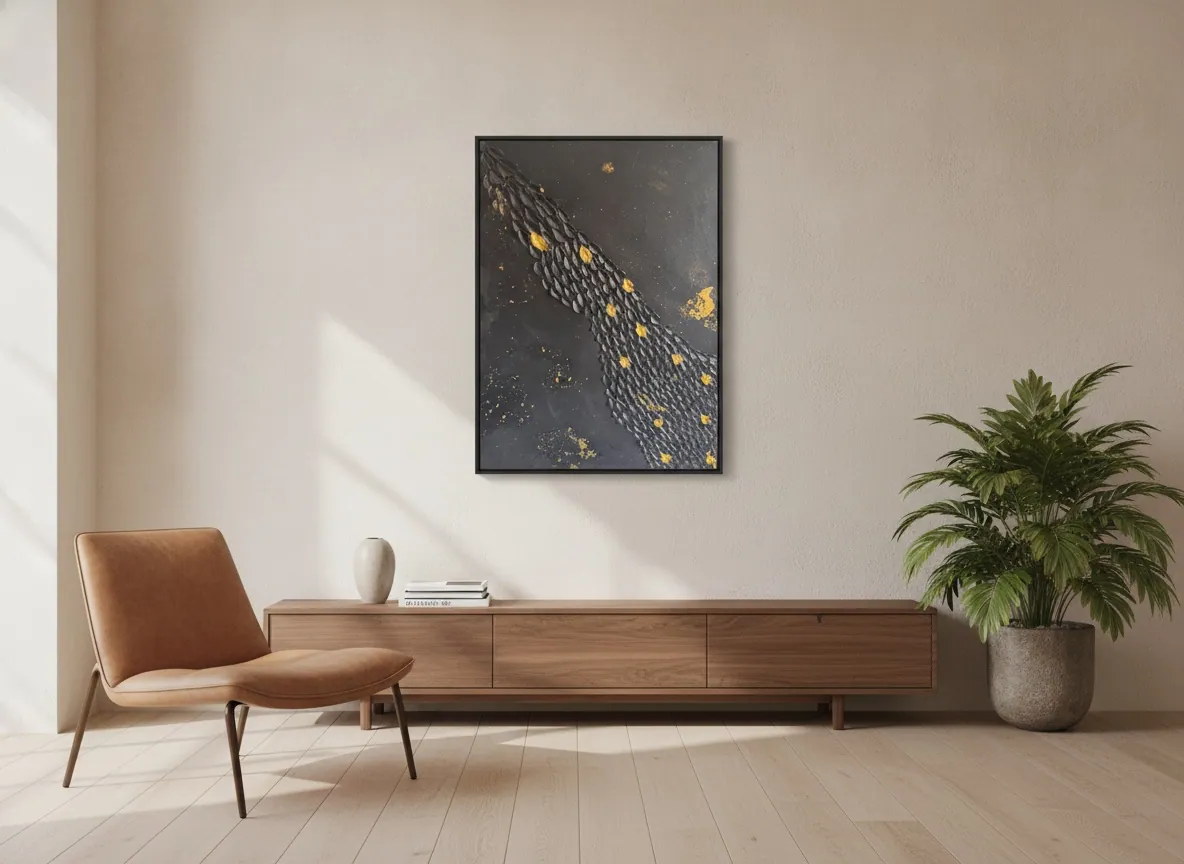
None of this needs to look institutional. A concealed, tool-locked fixing is invisible from the floor — it reads as a normal hang, and only the installer knows a screwdriver won't do the job. For a piece like Golden Passage, whose 60 × 80 cm canvas and black steel frame are built for exactly this kind of wall-mounted permanence, the fixing is a one-time decision made at installation, not something a venue manager should have to think about again.
Low light and colour: why a dim room needs directional light, not more of it
Members' clubs are lit for mood, not for reading — which is the opposite of what a painting needs to stay legible. Conservation guidance for painting display puts around 50 lux as the level at which the average eye reads colour reasonably well, rising to about 150 lux where detail in darker tones is needed — the same range oil paintings are rated for in institutional display, as opposed to the roughly 50-lux ceiling set for paper, photographs and textiles. Most club ambient lighting sits well under that, especially in the evening.
The fix is not to brighten the whole room. A single accent fixture — a picture light or an angled ceiling spot — aimed at the canvas brings just that surface into the 50–150 lux range while the rest of the space stays dim. This matters more on a dark-ground, metallic piece than on a pale one: on gold-and-black work, the gold leaf only activates when it catches direct light at an angle. In flat, ambient-only lighting, a piece like Golden Passage reads as a dark rectangle, and the texture and gold fragments that are the point of the composition disappear.
Heavy footfall and durability: why the surface and the substrate matter more here
A private home might see a painting from across the room, occasionally, at a safe distance. A club sees hundreds of shoulders, elbows and passing trays a week, closer to the wall than any residential hang. The practical response is substrate choice: conservation guidance places oil paintings, wood and leather in a materially different, more resilient category than works on paper, photographs and textiles — the latter are restricted to short, rotating display precisely because the material itself is fragile. A robust canvas built up in mixed media, texture paste and gold leaf, then sealed, belongs with the sturdier category — it is the kind of surface that tolerates a public room without a vitrine, not the kind that needs one.
Placement does the rest of the work a fixing can't. Keeping the lower edge above the natural arc of a raised glass or a passing bag, and clear of doorways and the direct line of a service route, removes most of the accidental contact risk before it starts — a rule that also protects a correctly fixed heavy painting from the slow damage that vibration and knocks in a busy room cause over time.
Scale for a lounge: sizing a painting against furniture, low light and a moving crowd
A lounge or club room is furnished for people, not for a painting — sofas, a bar, low tables, and a crowd that is rarely still. A piece sized for a quiet study or a bedroom wall tends to get visually absorbed in that environment: from across a low-lit room, a small canvas reads as a dark patch rather than a composition. The same problem a retail floor with heavy footfall solves with a bolder, more legible piece applies here — scale needs to compete with furniture and bodies in motion, not disappear behind them.
In practice, that means favouring one strong canvas at a scale that reads from the seating area over a cluster of smaller works — a grouping only works if every piece is well lit, and most clubs cannot commit that much accent lighting to a single wall. The Black & Gold series was built for this kind of room: dark grounds that recede into a dim interior at rest, and gold that reads as a focal point the moment light hits it — built for a space that people move through, not one they sit and study.
From the studio
Why I keep the gold sparing in Golden Passage
When collectors ask me about hanging Golden Passage in a busier, more social room than a living room, I tell them the same thing I kept in mind while I was painting it: the gold in this piece was never meant to flood the surface. It sits as small fragments of revelation across a dark field, and that restraint is exactly what makes it work under a single accent light instead of a fully lit wall — a painting built to be bright everywhere doesn't survive a dim room nearly as well.
I built the black field with texture paste before any gold went on, so the surface catches shadow even without colour doing the work. In a club or lounge, where the light is often moving — someone walks past a spot, a door opens — that texture keeps the piece legible in a way a flat black surface wouldn't. It's the same reason I keep gold leaf sparing across the whole Black & Gold series: less gold, placed with intent, reads better in low and changing light than more gold spread thin.
Frequently asked
What is the safest way to hang a painting in a members' club or lounge?
A concealed, tool-locked hanging fixing — the type used in museums and galleries — rather than a standard D-ring and wire. It holds the weight the same way a normal hang does, but removing the painting requires a specific tool, not just lifting it off a hook, which is enough to deter casual theft or an accidental knock sending it to the floor.
How bright should the lighting be on a painting in a dim club or lounge?
Conservation guidance for oil paintings on display puts the useful range at roughly 50 to 150 lux, measured at the surface of the painting, not the room. In a low-lit lounge, that means a single accent light aimed at the canvas rather than raising the ambient light of the whole room.
Does a painting need to be behind glass or in a case in a busy public room?
Not if the substrate is right. A robust canvas in oil or mixed media, properly sealed, tolerates open display far better than anything on paper — which is why paper-based work is the category conservation guidance restricts to short, rotating display rather than permanent hanging in a public room.
What size painting works in a club or lounge without getting lost among the furniture?
One piece large enough to read clearly from the seating area, rather than several smaller works split across a wall. In low light and with a room full of people, a single well-lit canvas holds attention; a cluster of small pieces usually can't all get enough accent light to stay legible.
Does a dark, gold-leaf painting work better or worse in low light than a pale one?
Better, if it gets a direct accent light. A dark ground with gold fragments — like the Black & Gold series — is built around contrast: in flat ambient light it can look like little more than a dark rectangle, but under an angled light source the gold activates and the piece reads clearly, even from across a dim room.
Should the painting be placed away from where people walk or gather?
Yes. Keeping the lower edge above the height of a raised glass or a passing bag, and clear of doorways and service routes, prevents most of the accidental contact a high-footfall room produces — it matters more here than in a private home, where a painting is rarely brushed against.
Planning art for a club, lounge or members' space?
Tell us the room — lighting, footfall, wall type — and we'll help you choose the right piece and fixing from the Black & Gold series or the wider collection.
Sources
- Absolute Museum & Gallery Products — "Security in Museums and Art Galleries" — 2026-09-26
- Canadian Conservation Institute — CCI Notes 10/4, Environmental Display Guidelines for Paintings — 2026-09-26
- Conservation Center for Art & Historic Artifacts (CCAHA) — "Light Exposure for Artifacts on Exhibition" — 2026-09-26
Published on