Art for a luxury boutique: display lighting, footfall and a wall that changes every season
A luxury boutique gets more from one strong original placed where customers pause — the till, a fitting-room corridor, a wall near the entrance — than from art scattered across the floor. Retail lighting runs brighter and more variable than gallery lighting, so the piece needs a spot that avoids glare and a plan to rotate it.
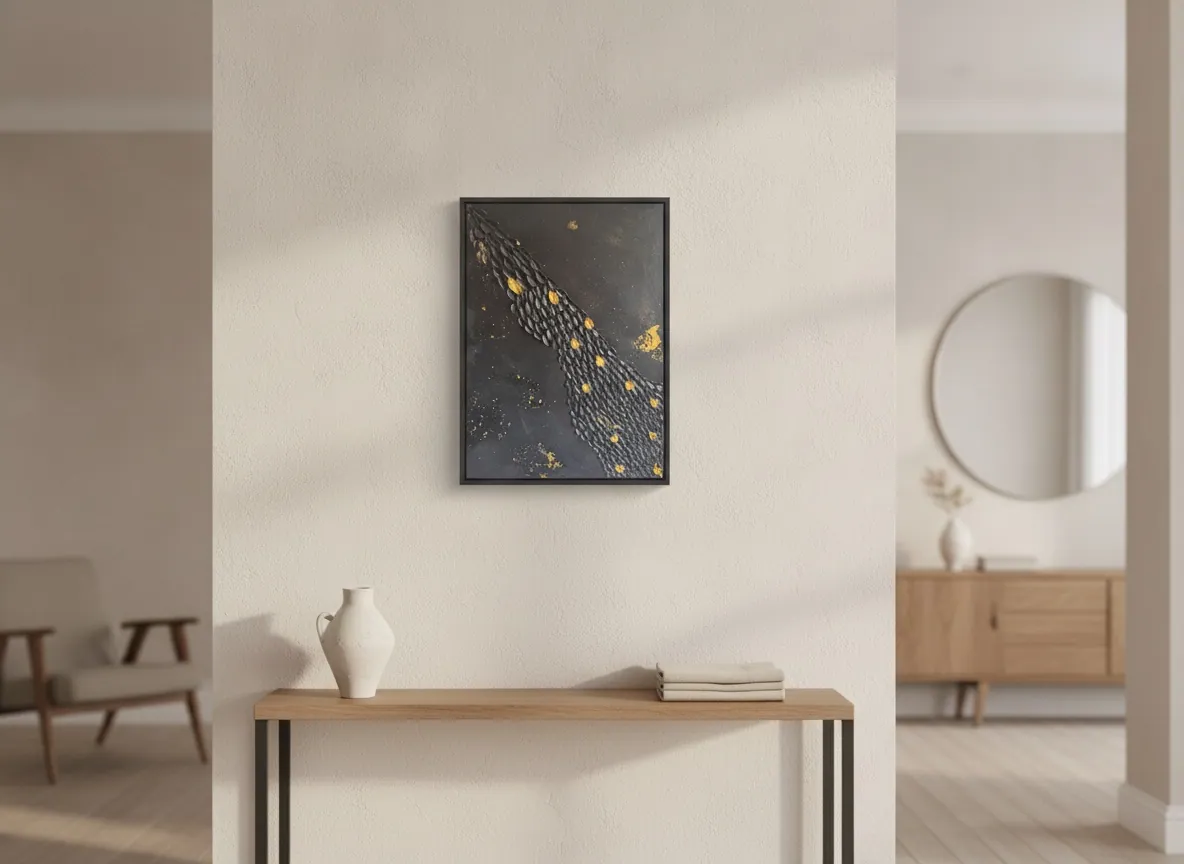
Where one painting earns its place on a boutique floor
A flagship or boutique interior already has a job for every wall — shelving, mirrors, a till, a rail of product — so the wall given to art should be one the customer's eye reaches without competing with merchandise. In practice that means a handful of pause points: behind or beside the till, where a transaction gives a few seconds of dwell time; the corridor leading to fitting rooms, which is walked slowly and often alone; and a back wall visible on axis from the entrance, which sets the tone of the store before a customer has touched anything.
One work of real presence at one of those points reads as considered. Several smaller pieces spread across a sales floor tend to read as filler, and they compete with the visual merchandising the store actually depends on to sell. A single painting, scaled to the wall and lit on purpose, does more for a luxury interior than a gallery wall of smaller work squeezed between fixtures.
Display lighting: what changes when art shares a wall with merchandise
Retail lighting is built to sell product, not to present a single work in isolation, so it tends to run brighter overall and far less uniform than a gallery's — a mix of ambient light across the floor and stronger accent light aimed at specific fixtures, mannequins, and display walls. That contrast is normal in a well-lit store and is not automatically a problem for a painting, but it does mean the artwork's lighting can't simply borrow the settings used for a garment rail. The exact footcandle or lux levels a store runs vary by brand and by lighting designer, so this is a conversation to have with whoever plans the store's lighting, not a fixed number to import from a museum spec sheet.
Reflective surfaces need a different angle than flat canvas. A piece like Golden Passage carries gold leaf fragments across a black ground, and gold leaf answers direct, head-on spotlighting with glare rather than warmth — the same way a mirror or a glass vitrine does. A fixture angled to graze the surface, rather than hit it straight on, lets the gold catch light as intended instead of bouncing it back at the viewer. This is the kind of detail worth flagging to the lighting designer before the track is fixed, not after.
Protecting the surface under retail-level light, day after day
Light damage to a painting is cumulative — conservation guidance treats the total dose a surface receives as the product of light intensity and the number of hours of exposure, so a lower level held for long hours can add up to the same wear as a brighter level held briefly. That is why the Canadian Conservation Institute's traditional guidance for oil and acrylic paintings caps display lighting at roughly 150 lux in a museum setting: moderately light-sensitive materials, held to a level well below what most retail floors run for merchandising.
A boutique is not a museum, and no one expects retail-level caution on a sales floor built to move product under bright light. But if a painting is meant to stay on that wall for years rather than one season, it is worth keeping it out of a fixture's direct hot spot, away from window sun, and reviewing the actual lighting levels at that specific wall with the store's lighting designer — a five-minute conversation that costs nothing and extends the life of a piece the store has already paid for.
Budget and scale: pricing a statement piece for a boutique wall
Perfeito Studio's available originals currently span roughly R$2,400 to R$8,800 (Brazilian reais; any currency conversion at time of inquiry is only ever approximate), depending on size and series. Golden Passage, the Black & Gold piece pictured above, is priced at R$3,500 for a 60 x 80 cm (23.6 x 31.5 in) canvas — a scale that reads clearly from till distance or along a fitting-room corridor without asking for a double-height wall.
A flagship with a taller or more generous entry wall can look toward the larger end of the range or a large-format piece from Heart of Chaos or Terra & Ether, where scale itself does the work of a statement. Either way, because each piece is a one-of-a-kind original — no editions, no reproductions — the selection is made from what the studio currently has finished, not commissioned sight unseen for a specific footprint.
A wall that changes every season, without commissioning new work
Retail interiors reset on a cycle a private home never does — new windows, new campaign, sometimes a new palette, every few months. Because Perfeito Studio does not produce editions or repeat a composition, refreshing the art wall means rotating between a small set of owned or newly acquired originals rather than reprinting the same file in a new frame. A store that acquires two or three pieces across a year, from different series, can rotate them through the till wall and the entrance wall as the rest of the interior turns over, so the art keeps pace with the merchandising calendar instead of sitting static for years.
This works best when it is planned in advance with the studio — which pieces exist now, which are likely to be available for the next seasonal turn, and how a rotation is staged so the wall is never simply empty between changes.
From the studio
From the studio: light as a material, not just illumination
I trained as an architect before I trained as a painter, and a store's lighting plan still reads to me the way a building section does — where light lands, and what a fixture does to a surface, not only to the room around it. When a piece with gold leaf or a high-gloss finish is going into a commercial interior, I ask about the lighting layout before I recommend a work, because the same painting can look considered under a grazing accent light and look cheap under a spotlight aimed straight on. It is a five-minute question, and it changes how the piece performs in that specific room far more than the painting itself does.
Frequently asked
Should a boutique display an original painting or a print?
An original reads as considered in a way a print does not, and it is what supports a luxury positioning — no two stores in a chain would show the identical piece. Perfeito Studio does not produce editions or reproductions, so every work placed in a store is a unique canvas, which also means it cannot simply be reordered if a second location wants the same look; a related piece from the same series is the way to echo the look across locations.
How bright should the lighting on the artwork be compared with the merchandise?
There is no single number that fits every store, because retail lighting plans vary by brand, ceiling height, and fixture type. What matters more than a target lux figure is the angle: accent light aimed straight at a reflective surface like gold leaf creates glare, while light that grazes the surface at an angle lets it read as intended. This is worth raising with the store's own lighting designer before the fixtures are set, rather than assuming the gallery or merchandise settings will suit the painting.
Will boutique-level lighting damage an original painting over time?
Light exposure to a painting is cumulative — conservation guidance measures it as light intensity multiplied by hours of exposure, and museums traditionally cap oil and acrylic paintings around 150 lux for exactly that reason. Retail floors commonly run brighter than that for merchandising purposes, which is not unusual or wrong for a sales floor, but it does mean a painting meant to hang for years benefits from being kept out of a fixture's direct hot spot and away from window sun.
Where in the store should the piece go — window, till, or fitting-room corridor?
The till and the fitting-room corridor are usually the better choices: both hold a customer's attention for a few unhurried seconds, away from direct sun and away from the traffic and product density of a window display. A back wall visible on axis from the entrance also works well, since it sets the tone of the store before a customer engages with any product. A shop window exposes the work to direct sunlight and weather-adjacent conditions, which is harder on an original canvas over time.
What does a statement original cost for a boutique?
Perfeito Studio's available works currently range from about R$2,400 to R$8,800 (Brazilian reais; any currency conversion is only approximate), depending on size and series. A mid-scale piece suited to a till wall or fitting-room corridor, such as Golden Passage at R$3,500 for 60 x 80 cm, sits toward the lower half of that range; a larger entrance-wall statement piece sits toward the top.
Can the same piece move between the boutique's seasonal window and its permanent wall?
It can, but a window is a harsher environment — direct sunlight, temperature swings near the glass, and higher handling risk during seasonal resets — so a piece meant to last is better kept on an interior wall and reserved for the window only briefly, if at all. For a rotating display, it is more practical to plan two or three owned originals in advance and move them between walls rather than repeatedly relocating a single valuable canvas into direct light.
Curating art for a retail or flagship space?
Tell us about the wall, the lighting, and the footprint, and we'll put together a curated selection from the available collection.
Sources
Published on