Can I hang a heavy painting on drywall?
Yes, with the right anchor. A heavy-duty toggle anchor in standard 1/2 in. drywall carries a manufacturer-rated safe working load of roughly 60 lb per anchor (59–66 lb, depending on bolt size, after the standard 4:1 safety margin) — enough for most framed paintings. For heavier or very large pieces, anchoring into the stud gives more room.
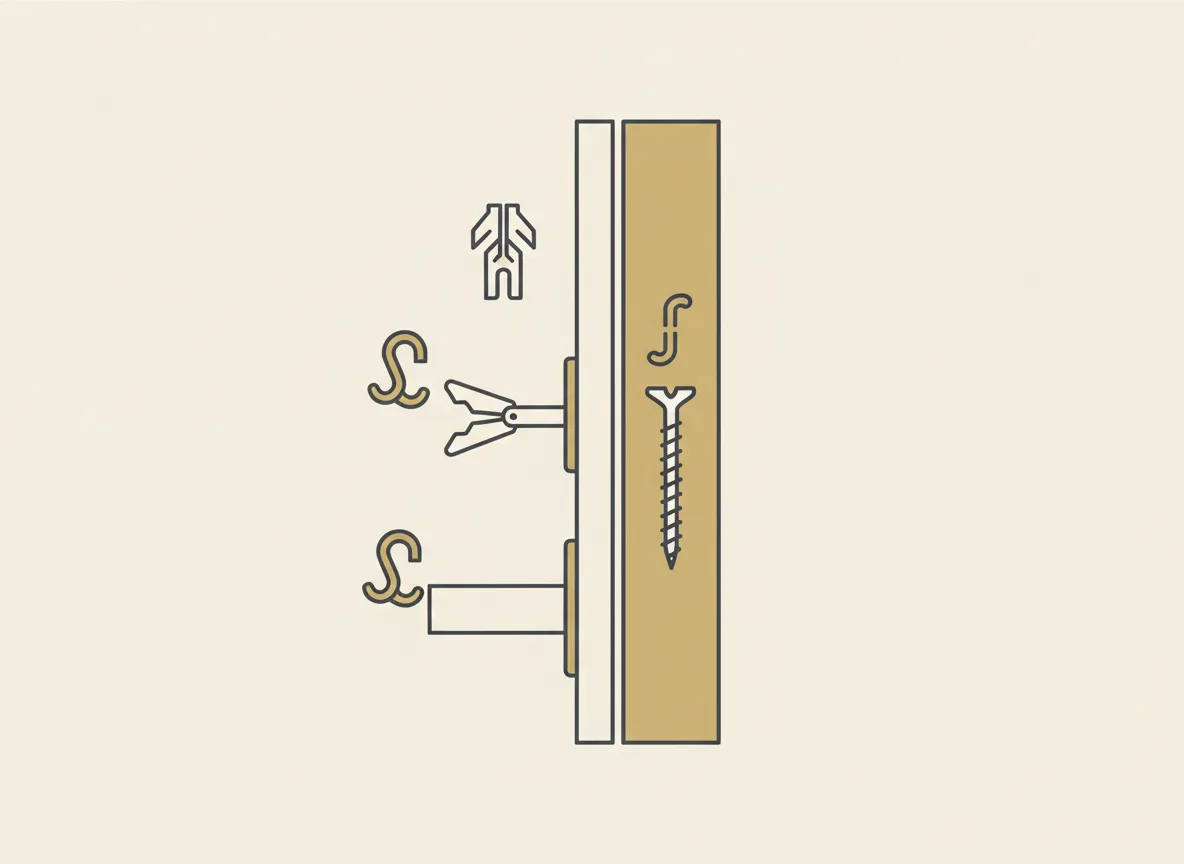
How much weight can a drywall anchor actually hold?
It depends entirely on the anchor, not the drywall itself. Standard plastic expansion anchors are rated for roughly 5 to 25 lb, self-drilling threaded anchors for 25 to 75 lb, and molly bolts for 25 to 55 lb — fine for a small print, not for a substantial original painting.
The anchor built for this job is the heavy-duty strap-style toggle bolt (sold under names like SnapToggle). Its manufacturer's own published test data shows an ultimate tensile pull-out of 238 lb for the 3/16-24 bolt size and 265 lb for the 1/4-20 size, both in standard 1/2 in. drywall. The same spec sheet recommends a 4:1 safety factor for real-world use, which works out to a safe working load of roughly 59 lb and 66 lb per anchor. Two anchors on a wire or two D-rings comfortably clears 100 lb of combined margin.
The stud is still the stronger option
A screw driven into solid stud framing isn't rated by the same drywall-failure math — the wood, not a thin gypsum panel, is doing the holding. A typical wood screw driven into a stud is estimated to hold in the range of 80 to 100 lb, with a standard #8 screw alone carrying roughly 90 lb of shear strength once it has enough penetration into the wood. The caveat that matters: that figure is for a single, properly seated screw — it isn't a reason to hang a heavy piece from one point, and it drops sharply in softer woods or with shallow penetration.
In practice, this means: if a stud lines up with where the piece needs to hang, use it. If it doesn't, a heavy-duty toggle anchor in the drywall is the next best thing — not a compromise.
Finding the stud behind the drywall
The common electronic stud finder works by capacitance sensing: it emits a weak electrical field through the wall and measures how the material holds a charge. Empty wall cavity reads one way; solid wood or metal framing reads differently and denser, so the capacitance reading changes sharply as the sensor crosses from hollow space onto a stud. Simple "edge-finding" models just beep at that crossing point; more advanced ones use multiple sensors to estimate the stud's center directly.
Studs sit at a regular, repeating interval behind the wall — once one edge is found, sweeping a short distance to either side usually turns up the next. A stud finder is worth the small cost before committing to any drywall-only anchor for a piece of real weight.
Matching the hardware to the piece
A pull-out rating in pounds assumes the piece hangs flat and close to the wall, pulling straight out. A deep floater frame, a shadow-box mount, or anything that stands proud of the surface adds leverage the rating doesn't account for — testing by Bob Vila's team notes that just 20 lb on an 8 in. shelf translates into roughly 160 inch-pounds of torque on the anchor. The practical takeaway: the deeper or more projecting the mount, the more margin to build in beyond the anchor's flat pull-out number.
For most original paintings — which hang flat against the wall on a wire or D-rings — this isn't a concern. It matters more for heavier sculptural or dimensional pieces.
From the studio
The atelier's view
Every piece that leaves the studio ships unframed, with the gallery edges finished and ready to hang — no glass, no external frame adding weight. Even our large-scale works, stretched acrylic and mixed media on canvas up to 120 × 200 cm, are lighter than their footprint suggests; the material that adds real weight is texture paste, sculpted relief, or metallic fragment work in the Terra & Ether and Matter & Silence series, not the canvas itself. For those pieces, and for any acquisition shipped internationally, we default to recommending two mounting points on the wire rather than one, and we always ask whether the wall is drywall or a stud can be reached before advising on hardware. Installation guidance — hanging height, hardware, lighting — is part of what comes with every acquisition, and it's a conversation worth having before the piece arrives, not after.
Frequently asked
What type of anchor works best for hanging a heavy painting on drywall?
A heavy-duty strap-style toggle bolt (sold under names like SnapToggle) is built for this. Manufacturer test data puts its ultimate pull-out strength at 238 to 265 lb in standard 1/2 in. drywall depending on bolt size, well above lighter plastic or self-drilling anchors.
How much weight can drywall safely hold with the right anchors?
Applying the manufacturer's own recommended 4:1 safety factor to a heavy-duty toggle anchor works out to roughly 59 to 66 lb of safe working load per anchor in 1/2 in. drywall. Using two anchors, as most paintings do with a wire or two D-rings, adds meaningful margin beyond that.
Is it better to mount into a stud than into the drywall panel itself?
Yes, when a stud lines up with the hanging point. A properly seated screw into solid stud framing is generally estimated at 80 to 100 lb of holding capacity for a single screw, because the load is carried by solid wood rather than a thin drywall panel. It isn't a reason to rely on only one screw, but it does give more margin than any drywall-only anchor.
How do I find a stud behind a drywall wall?
An electronic stud finder is the reliable way. Most work by capacitance sensing — they read a change in the wall's electrical properties as they move from hollow cavity onto denser stud material, and beep or light up at that transition. Studs repeat at a regular interval, so finding one edge makes the next easy to locate.
Should a very heavy painting go on a different type of wall instead?
There's no fixed cutoff, but once a piece approaches the top of what a single heavy-duty anchor or stud screw is rated for, the safer move is to spread the load across two stud points, use a mounting rail anchored into framing, or bring in a professional installer — rather than push one anchor to its limit.
Sources
- TOGGLER / Mechanical Plastics Corp. — 2026-08-19
- Bob Vila — 2026-08-19
- Bob Vila — 2026-08-19
- Engineer Fix — 2026-08-19
- Power Tool Base — 2026-08-19
Hanging a large piece and not sure about the wall?
Tell us the wall type and where the piece is going — the studio can walk through hardware and hanging height before it ships.
Talk to the studio on WhatsApp
Published on