Art for a diplomatic residence or embassy: what works?
Art for a diplomatic residence or embassy works best when it is abstract and free of national, religious, or political symbolism — content that reads as neutral to any visiting delegation, regardless of the piece's country of origin. Beyond content, what matters is scale suited to a formal reception room and a complete paper trail for institutional records.
Why content, not just quality, is the first filter
A painting bound for a private living room only has to suit the people who live there. A painting bound for a diplomatic residence or embassy has to read the same way to every delegation that walks past it — a different country's ambassador, a visiting minister, a local business contact — none of whom share a single cultural frame. That audience is the reason abstraction is the safer default in these spaces: a non-figurative composition built from color, texture, and form carries no flag, no religious symbol, no historical reference that could be misread by any one of those visitors.
The U.S. Department of State's own Art in Embassies program, running since 1963, works from a version of this same logic at institutional scale: its curators build each residence's exhibition in collaboration with the ambassador, taking into account the host country's artistic traditions and cultural mores rather than imposing a fixed program across every posting. The specific curatorial choices differ post to post, but the underlying discipline is the same one a residence manager applies to any single acquisition — read the room's actual audience before the content, not after.
Brasília's diplomatic market is unusually concentrated
Brasília was purpose-built to host a diplomatic corps, and it shows: more than 130 countries maintain a resident embassy in the city, clustered largely along the Setor de Embaixadas Norte and Sul. That concentration means a meaningful share of the formal interiors in Brasília — chanceries, ambassadors' residences, the reception rooms of consulates and bilateral chambers of commerce — are furnished for exactly this kind of audience, not a private one.
For a piece originating in Brazil, that context cuts two ways. It gives a work of contemporary Brazilian art a natural claim to the wall — something made in the country the mission is posted to, rather than shipped in from elsewhere. It also raises the bar on the content question above: a piece hanging in a residence in the country it was made in is, if anything, under closer scrutiny for neutrality than one hanging somewhere unrelated to it.
Scale and placement for a formal reception room
Reception rooms in residences and chanceries tend to run larger and more formal than a private living room — high ceilings, longer sightlines, furniture arranged for standing conversation rather than seating around a piece. A single large-scale, restrained composition generally reads better in that setting than a cluster of smaller works, which can start to look like a private collection rather than a considered acquisition for a shared space.
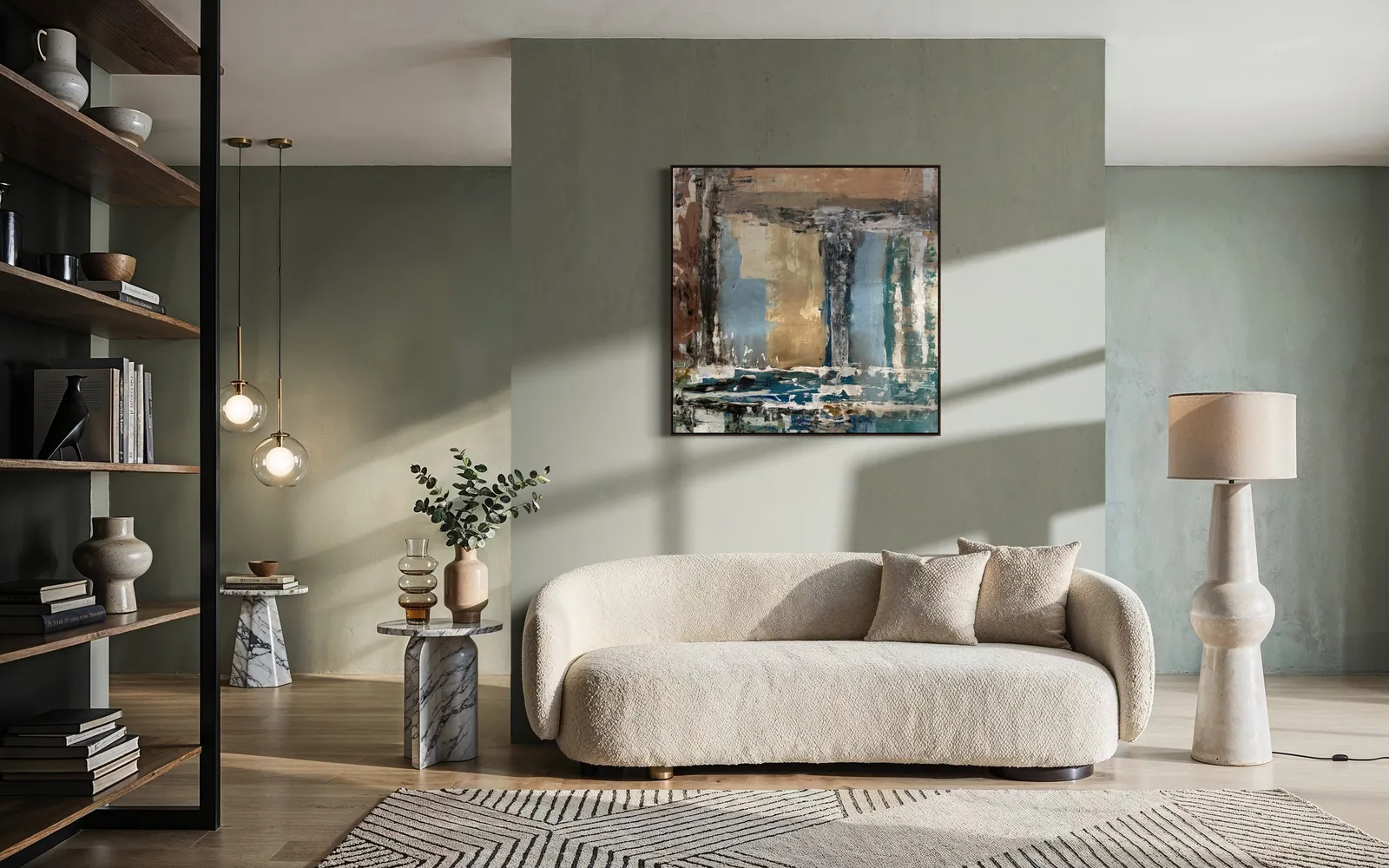
Within the studio's own catalogue, Patina Field, from the Terra & Ether series, is built around exactly this register: tonal, architectural, and restrained rather than gestural — a piece meant to settle a room instead of animating it. That quality — settling a space rather than demanding attention within it — is generally what a formal reception area calls for, more than a piece designed to be the first thing a visitor notices.
The paperwork an institutional acquisition needs
A residence or chancery acquiring art for its own inventory — as opposed to an individual buying for a home — is closer to the family-office case than to an ordinary retail purchase: it needs a signed certificate of authenticity, the studio's invoice, and, if the piece will later be shipped abroad as part of a diplomatic relocation, the paperwork that move requires. The studio's own guide to documentation for institutional buyers covers what a certificate, invoice, and appraisal need to contain and why each is kept current rather than filed once. For the logistics of an international move specifically, the studio's guide to shipping original art internationally from Brazil and its companion piece on buying Brazilian art before leaving Brasília cover what travels with the piece and what does not require export authorization.
From the studio
The studio's view
Alyne Perfeito trained as an architect before she trained as a painter, and it shows in how she talks about a formal room: she reads sightlines and traffic before she reads color. A reception room, in her account, is not a wall waiting to be filled — it is a space people pass through while talking to someone else, which is exactly why a restrained, tonal piece tends to outperform a loud one there. Terra & Ether, the series Patina Field belongs to, was built with that kind of room in mind: pigment applied and then scraped back until the surface reports wear rather than gesture, closer to the register of an old wall than a statement piece. It is not a series designed to be noticed first. It is designed to still be the right choice a year into daily use, which is the actual test a shared institutional space applies that a private room does not.
Frequently asked
Does art for a diplomatic residence need to avoid strong political or religious references?
Yes, as a practical default rather than a formal rule. A residence or embassy is seen by visitors from many different countries and backgrounds, so content that reads clearly as neutral to all of them — abstract composition built from color, texture, and form, with no flag, religious symbol, or explicit political reference — carries far less risk of being misread than figurative or symbolic work would.
Is Brazilian abstract art an appropriate choice for a foreign embassy in Brasília?
It generally is, and the city's own diplomatic density makes the case stronger: more than 130 countries maintain a resident embassy in Brasília, so acquiring contemporary art made in the host country is a common and well-precedented choice for a residence's formal spaces, provided the piece itself is content-neutral in the way described above.
Can the studio ship a piece directly to an embassy or diplomatic residence?
A painting bought directly from the studio typically travels the same way any personal or institutional acquisition does — as part of a relocation or diplomatic shipment, documented by the studio's invoice and Certificate of Authenticity. The studio's guide to shipping original art internationally from Brazil covers the logistics in detail; a customs broker or the mission's own logistics team should confirm requirements for the specific destination.
Does documentation matter more for an institutional or diplomatic purchase than a personal one?
It matters more in practice, because an institutional buyer needs the piece on record for reasons a private buyer usually does not — inventory, insurance at the mission level, and eventual transfer when a posting changes. The certificate of authenticity, invoice, and an appraisal that stays current are the same three documents a family office is expected to keep, and for the same reasons.
What size of artwork suits a formal reception room in a residence?
A single larger-scale, restrained piece usually reads better than several smaller works in a formal reception room, since these rooms tend to have longer sightlines and are used for standing conversation rather than close viewing. A tonal, architectural composition that settles the room tends to outperform a busier or more gestural piece in this specific setting.
Considering a piece for a residence or chancery wall
Talk directly with the studio about scale, placement, and the documentation an institutional acquisition needs.
Published on