Art for a family office: what to hang, and what has to be documented
A family office holding art needs four records per piece: a signed certificate of authenticity, a condition report, a provenance file, and a current appraisal — the same paper trail insurers and estate advisors expect for any long-held asset. Missing files make a work harder to insure, transfer, or verify.
The four records every acquired work should carry
Documentation follows a piece, not a wall. When an entity — a family office, a holding company, a foundation — acquires a work, four records should exist for it from day one and stay current for as long as the work is held.
The certificate of authenticity is issued by the studio at the point of sale: it names the artist, title, series, year, medium, dimensions, and the work's internal Archive ID, and it is signed. The invoice or fiscal receipt establishes the transaction itself — price, date, parties — and becomes the first entry in the piece's provenance file.
The condition report works differently: it is not issued once and filed away. It records the physical state of the work at a given moment — surface, edges, any existing wear — so a later inspection has something concrete to compare against, rather than memory or a photograph taken for another purpose.
The appraisal sits closest to the insurance and financial side. It states a current value, the method used, and the appraiser's qualifications, and it needs revisiting — the number on a five-year-old appraisal is not the number an insurer will honor without question today.
Why the paperwork outlasts the wall it hangs on
Chubb's own guidance for collectors describes an appraisal as doing more than one job: it substantiates that a work exists, describes its condition, and sets a value that keeps the piece insured at current replacement cost rather than the price paid years earlier. The same document does double duty if a work is later sold, donated, or passed through an estate, where insurers and tax authorities look for different numbers — replacement value for a claim, fair market value for a sale or transfer.
Provenance works the same way from the ownership side. Insurer AXA XL describes provenance as the recorded history of a work's ownership — receipts, prior appraisals, any auction or exhibition catalog it appeared in — and notes that this history helps establish that a piece can be legitimately transferred and was not, at some point, lost or misattributed. Gaps in that history are common and not automatically disqualifying, but an entity that cannot produce any ownership record for a work it holds is in a weaker position than one that can.
For a piece bought directly from a working studio, this file starts clean: invoice, certificate, and Archive ID all originate from the same acquisition, with no prior chain to reconstruct.
Condition reports are a habit, not a formality
Conservation professionals treat documentation as a working record, not paperwork completed once and forgotten. Conservation OnLine — the reference platform associated with the American Institute for Conservation's own standards — frames the absence of documentation in practical terms: without it, an institution cannot say with confidence when a piece was last examined, account for its condition, or in some cases confirm ownership at all. The same logic applies at the scale of a single work in a private or corporate collection.
In practice, this means a condition report is most useful when created early — close to acquisition — and revisited at intervals, or whenever the work is moved, reframed, cleaned, or relocated to a different space. A reception or office wall introduces its own variables: foot traffic, HVAC vents, direct light through glass partitions — all worth noting the first time the work is condition-checked in that room.
Appraisal frequency: what the market for the artist decides
How often an appraisal needs updating depends on how the market for that artist's work behaves, not on a fixed calendar. AXA XL's guidance for collectors draws a clear line: collections weighted toward Old Masters or Impressionist-era work, where prices move slowly, are typically reappraised every four to six years; collections that include contemporary work by artists earlier in their career are reappraised more often — as frequently as every other year — because pricing for that segment can shift faster.
This describes how appraisers approach different market segments in general, not a projection for any specific artist or piece. It is offered here as context for how a family office might schedule the appraisal line item, not as a statement about what any particular work will be worth.
What changes, and what doesn't, for a work in a reception or office
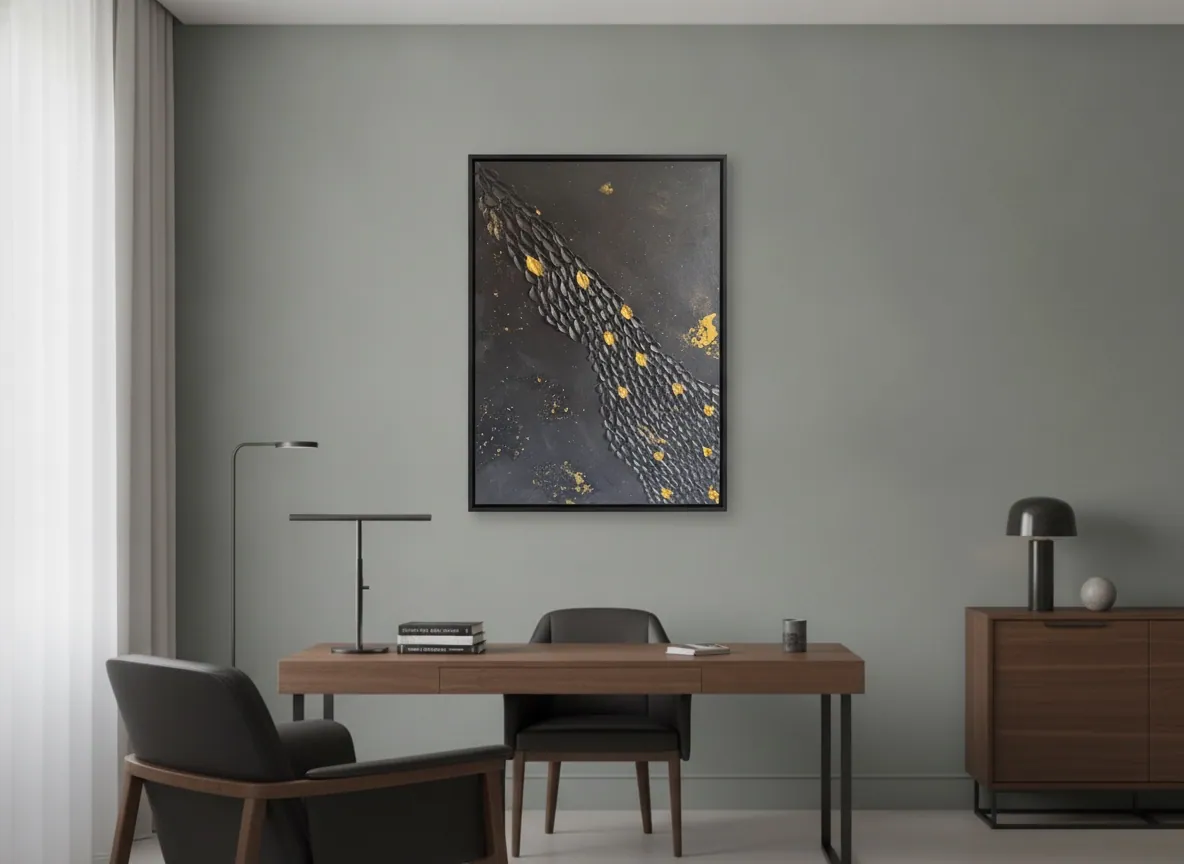
A painting placed in a family office reception is doing two jobs at once: it is decoration, chosen the way any piece for a considered interior is chosen, and it is an asset on somebody's books. The first job is aesthetic — scale, palette, how the work reads from the entry point, how it holds a wall without competing with a desk or a seating group nearby. Golden Passage, from the studio's Black & Gold series, was built for exactly that kind of restrained, formal room: a black ground, a diagonal current of sculpted texture, and gold leaf used sparingly rather than as the main event.
The second job doesn't change because the room is shared rather than private. The same four records apply, the same person or role in the office should be responsible for keeping them current, and the file should travel with the piece if it is reassigned to another office, sold, or included in an estate. What does change is who else might need access to that file — a facilities manager, an insurance broker, a new partner joining the firm — which is a reason to keep it centralized rather than in one person's inbox.
This article is informational and does not constitute tax, legal, or financial advice. Appraisal cadence, valuation method, and the tax treatment of art held by an entity depend on jurisdiction and structure — consult your own advisor.
From the studio
The studio's eye
I built Golden Passage at a domestic scale — 60 by 80 centimeters — but I composed it to hold a formal wall. That comes directly from training as an architect before training as a painter: reading a room's proportions, its sightlines from the entrance, how a piece behaves next to a desk or a run of joinery, is the same exercise whether the surface in question is a floor plan or a canvas. In this piece, I built the diagonal band of sculpted texture and the restrained use of gold leaf to hold their own at a distance — the kind of distance a visitor covers walking into a reception before they're close enough to see the surface in detail.
I register every piece that leaves my studio the same way before it ships: photographed, assigned its Archive ID, logged against the series it belongs to. That habit exists for my own archive first — it isn't a service I invented for this article. It happens to be the same discipline a family office needs to apply to what it hangs.
Frequently asked
What documents does a family office need for an artwork it owns?
Four records, at minimum: a signed certificate of authenticity naming the artist, title, year, medium and dimensions; a condition report describing the work's physical state at acquisition and updated periodically; a provenance file with receipts, invoices and any prior ownership records; and a current appraisal for insurance and, where relevant, estate purposes. Each should be kept as a permanent file tied to the piece, not folded into a general expense record.
Who is responsible for keeping this documentation — the office or the seller?
Both play a part. The seller, in this case the studio, issues the certificate, invoice and technical sheet at the point of sale. The buying entity is responsible for maintaining the condition report over time, keeping the appraisal current, and filing everything so it survives a change in staff, insurer, or ownership structure.
How often should an owned artwork be reappraised?
It depends on the market for the artist. According to AXA XL, collections weighted toward contemporary work, especially by artists earlier in their career, are often reappraised as frequently as every other year, since prices for that segment can move faster than for established, historical work. This describes general industry practice, not a projection for any specific piece.
Does documentation reduce the tax owed on art an entity holds?
That depends entirely on the jurisdiction, the entity structure, and how the asset is classified — it is not something this article can answer in general terms, and Perfeito Studio does not give tax advice. What documentation does, everywhere, is give the entity's own accountant or advisor the paper trail needed to answer that question correctly. Consult your own tax or legal advisor for anything jurisdiction-specific.
Is a condition report only necessary if the work will be shipped or loaned?
No. Conservators treat it as a baseline record, created early and revisited over time, so that any later change — a scuff, a shift at a corner, fading near a light source, a hairline crack in texture paste — can be measured against a documented starting point, rather than relying on memory or a photograph taken for an unrelated purpose.
Can Perfeito Studio help with documentation for a work already acquired?
Yes. Every work sold by the studio already carries a certificate of authenticity, a technical sheet, and an internal Archive ID assigned at the point of sale. If any of that documentation needs to be reissued, or a work's provenance record needs confirming for an insurer, an accountant, or an incoming partner, reach the studio directly on WhatsApp and it is handled personally, not through a support queue.
Documentation for a work already on your wall
If a piece from Perfeito Studio needs its certificate reissued, or you have a documentation question for a work you're considering, the studio replies directly on WhatsApp.
Sources
- Chubb — 2026-08-28
- AXA XL — 2026-08-28
- AXA XL — 2026-08-28
- Conservation OnLine (COOL) — 2026-08-28
Published on