Journal · Exhibitions & museums
What to see at the National Gallery, London
The National Gallery's collection turns on a small set of works: The Arnolfini Portrait (van Eyck), The Ambassadors (Holbein), Sunflowers (Van Gogh), and Whistlejacket (Stubbs). Together they trace European painting from fifteenth-century Flanders through the English eighteenth century to French Post-Impressionism -- the fastest way to understand what the collection actually holds.
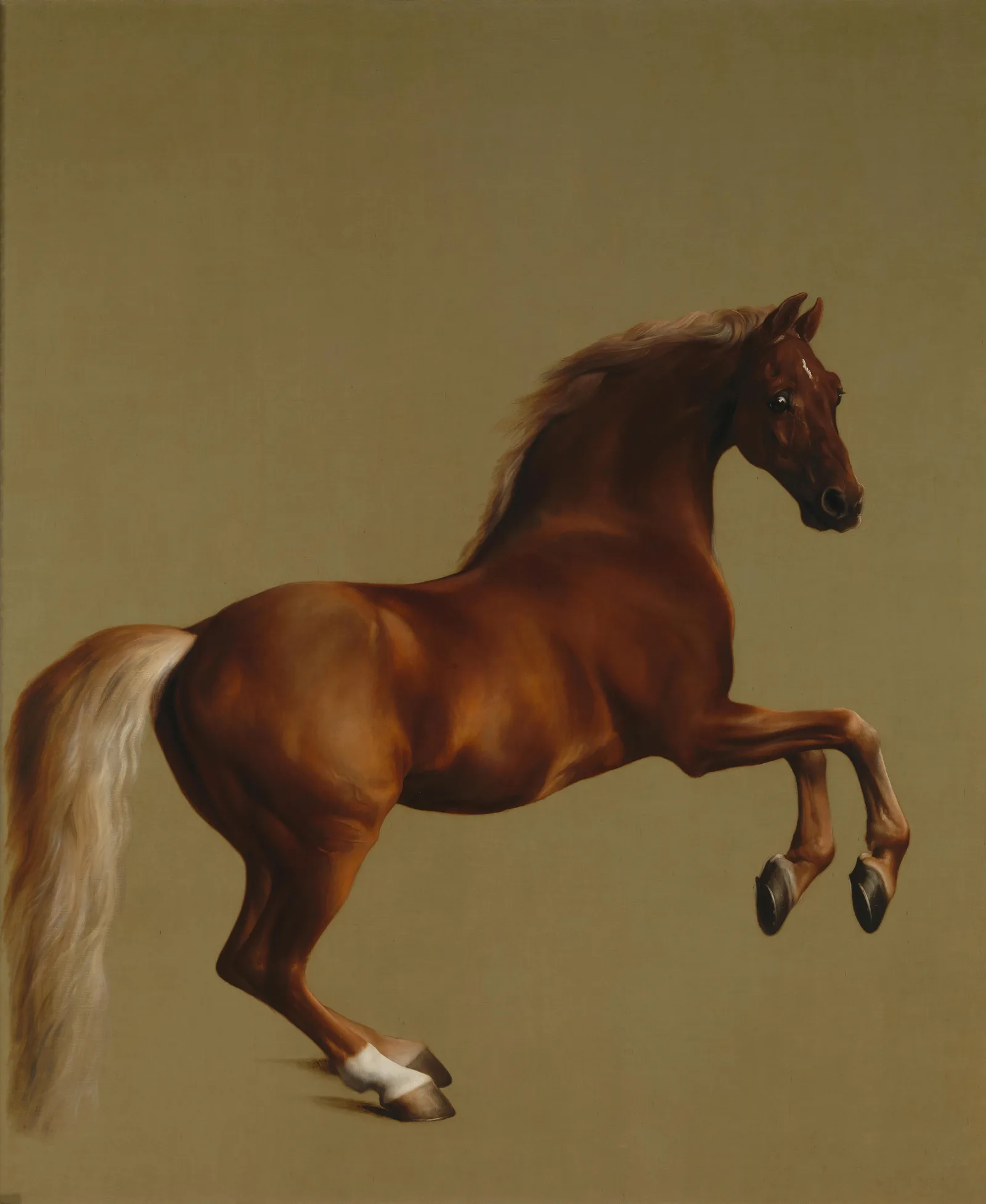
The works that define the collection, and what to look at
The Arnolfini Portrait (1434), Jan van Eyck's double portrait of Giovanni di Nicolao Arnolfini and, probably, his wife, rewards a slow look at the small convex mirror on the back wall: it reflects the whole room in miniature, including two figures standing where the viewer would stand, painted at a scale easy to miss on a first pass. The oil glazes throughout -- the dog's fur, the brass chandelier, the folds of green wool -- are part of why this small panel is treated as a turning point in what oil paint could do as early as the 1430s. The Ambassadors (1533), Hans Holbein the Younger's double portrait of two French diplomats, hides a distorted skull stretched diagonally across the floor between the two men -- an anamorphic shape that only resolves into a recognizable skull when the painting is viewed from the side, a technical trick built directly into a formal state portrait.
Sunflowers (1888), one of five versions Van Gogh painted, is worth looking at for the range packed into a single color: background, vase, and petals are all variations on yellow, separated mostly by outline and by the thick, directional brushwork Van Gogh used to describe each petal on its own. Whistlejacket (about 1762), George Stubbs's life-size portrait of a racehorse rearing against a plain background, strips away every convention of the equestrian portrait -- no rider, no saddle, no landscape -- leaving a single animal painted with the anatomical precision Stubbs built up from years of dissecting horses for his own reference drawings.
Turner, and why he matters to anyone who paints
J. M. W. Turner has two paintings in the National Gallery that matter for different reasons. The Fighting Temeraire (1839) shows a decommissioned warship being towed by a small steam tug to be broken up for scrap, the old ship rendered pale and almost translucent against a sunset built from thick, layered strokes of orange and red -- the drama sits entirely in the contrast between a solid, fading past and an atmosphere that will not hold still. Rain, Steam and Speed (1844) pushes further: a train crosses a bridge through a haze of rain and steam so dense that the locomotive itself barely holds its shape, dissolving into the same weather it is moving through.
Turner matters to anyone who paints because he treats atmosphere as the actual subject, decades before anyone had a word for abstraction. The edges in these two paintings are not contours around objects; they are the point where light stops behaving predictably. That is a different problem than drawing a ship or a train accurately, and it is the problem every painter eventually runs into: at what point does a form stop being a thing and become only light and paint.
The collection as a chronological line of Western painting
The National Gallery's collection is arranged, wing by wing, in roughly the order the paintings were made -- from the early Renaissance and Early Netherlandish panels that open the collection through to the paintings that close it around 1900, after which the story continues at Tate. The Virgin of the Rocks, Leonardo da Vinci's altarpiece begun in 1483, and Venus and Mars, Sandro Botticelli's panel from around 1485, sit early in that line, both painted while oil technique was still being absorbed from Netherlandish painters like van Eyck. The Supper at Emmaus (1601), Caravaggio's staging of the moment two disciples recognize the resurrected Christ, marks the Baroque swing toward theatrical light and shadow roughly a century later.
By the time the line reaches The Hay Wain (1821), John Constable's view of a cart crossing a millpond on the River Stour, and Bathers at Asnières (1884), Georges Seurat's large, meticulously built riverside scene made from small related brushstrokes rather than the loose touch of Impressionism, the story has moved from English landscape painted on location to a studio picture that plans its brushwork like an engineering problem. Walking the collection from its earliest rooms to its last means walking roughly six centuries of European painting without changing buildings.
What most visitors walk past
Venus and Mars is small and quiet compared with the rooms around it, which is exactly why it gets walked past: the panel rewards a close look at the four satyrs surrounding the sleeping god of war, one of them blowing a conch shell directly into Mars's ear without waking him, a detail that carries the painting's argument -- love has disarmed war so completely that war cannot even be roused -- more than the two reclining figures do on their own. Bathers at Asnières has the opposite problem: it is enormous, but visitors moving quickly toward the Van Gogh room often give it only a glance, missing that Seurat built the entire riverside scene from small, planned strokes rather than the spontaneous brushwork most Impressionist paintings favor at a similar scale.
The earliest rooms suffer the same fate for a different reason: visitors heading straight for Turner or Van Gogh skip past the fifteenth-century panels near the start of the collection, where The Arnolfini Portrait hangs among other Early Netherlandish and early Italian paintings that established the technical foundations -- oil glazing, sustained naturalism, close observation of surface and light -- that every later painting in the building depends on.
From the studio
From the studio
I have never stood in front of these paintings, but I know exactly where I would slow down: The Arnolfini Portrait. Van Eyck built that surface in thin, patient glazes, layer over layer, until the paint stopped looking like paint at all -- which is the opposite of how I work. I paint in layers too, but mine are thick, built up with acrylic and mixed media until the surface has real texture you can see from across a room. His patience produces stillness; mine is closer to accumulation. Standing in front of that panel would be useful precisely because it is not how I paint -- it would show me, by contrast, what my own layering is actually doing.
Turner is the more honest ancestor of what I do. Large-format abstraction starts from the same impulse he had in Rain, Steam and Speed: atmosphere is the subject, not the thing sitting inside it. When I build a canvas in layers of acrylic, I am deciding, the way Turner was deciding with paint on a bridge and a train, at what point a mark stops describing a shape and starts describing only light and weight. He got there with a locomotive dissolving into rain. I get there with color fields built up over weeks in a studio in Brasília. The vocabulary is the same even when nothing else is.
Frequently asked
National Gallery or Tate?
<p>The National Gallery holds Western European painting from roughly the thirteenth century to about 1900 -- <em>The Arnolfini Portrait</em>, <em>Sunflowers</em>, and Turner's late work all fall inside that range. Tate Britain and Tate Modern pick up British art and international modern and contemporary art from around 1900 onward. If the painting in question predates 1900, it is very likely at the National Gallery; if it is twentieth-century or later, it is almost certainly at Tate.</p>
Is admission to the National Gallery free?
<p>Yes. General admission to the National Gallery's permanent collection has been free since the Gallery was founded in 1824, and it remains free today -- only some temporary exhibitions are ticketed separately.</p>
What are the must-see works at the National Gallery?
<p>Most first-time visitors go looking for <strong>Sunflowers</strong> (Van Gogh), <strong>The Arnolfini Portrait</strong> (van Eyck), <strong>The Fighting Temeraire</strong> (Turner), and <strong>The Ambassadors</strong> (Holbein) -- four works that, between them, span roughly four centuries of the collection.</p>
Is The Fighting Temeraire really at the National Gallery?
<p>Yes. Turner's <em>The Fighting Temeraire</em> is in the National Gallery's collection, where it has been since 1856. Many of Turner's paintings entered Tate Britain through the artist's own bequest, which causes confusion, but this specific canvas belongs to the National Gallery, not Tate.</p>
Does the National Gallery have a painting by Leonardo da Vinci?
<p>Yes. <em>The Virgin of the Rocks</em>, begun in 1483, is in the National Gallery's collection. Leonardo painted two versions of the composition; the other is in the Louvre, Paris -- a common point of confusion between the two paintings.</p>
Sources
- National Gallery, London — 2026-07-26
- National Gallery, London — 2026-07-26
- National Gallery, London — 2026-07-26
- National Gallery, London — 2026-07-26
- National Gallery, London — 2026-07-26
- National Gallery, London — 2026-07-26
- National Gallery, London — 2026-07-26
- National Gallery, London — 2026-07-26
- National Gallery, London — 2026-07-26
- National Gallery, London — 2026-07-26
- National Gallery, London — 2026-07-26
- National Gallery, London — 2026-07-26
Planning the visit to the National Gallery?
If any of these works shaped how you look at painting, the studio is happy to talk through the pieces in the Perfeito Studio collection.
Talk to the studio on WhatsApp
Published on