Journal · Exhibitions & museums
What to see at Tate Modern, London
The essential visit is built around four works: the Rothko Room, Matisse's The Snail, and Picasso's The Three Dancers and Weeping Woman -- housed inside Herzog & de Meuron's conversion of a former power station on the Thames, alongside Dali's Metamorphosis of Narcissus.
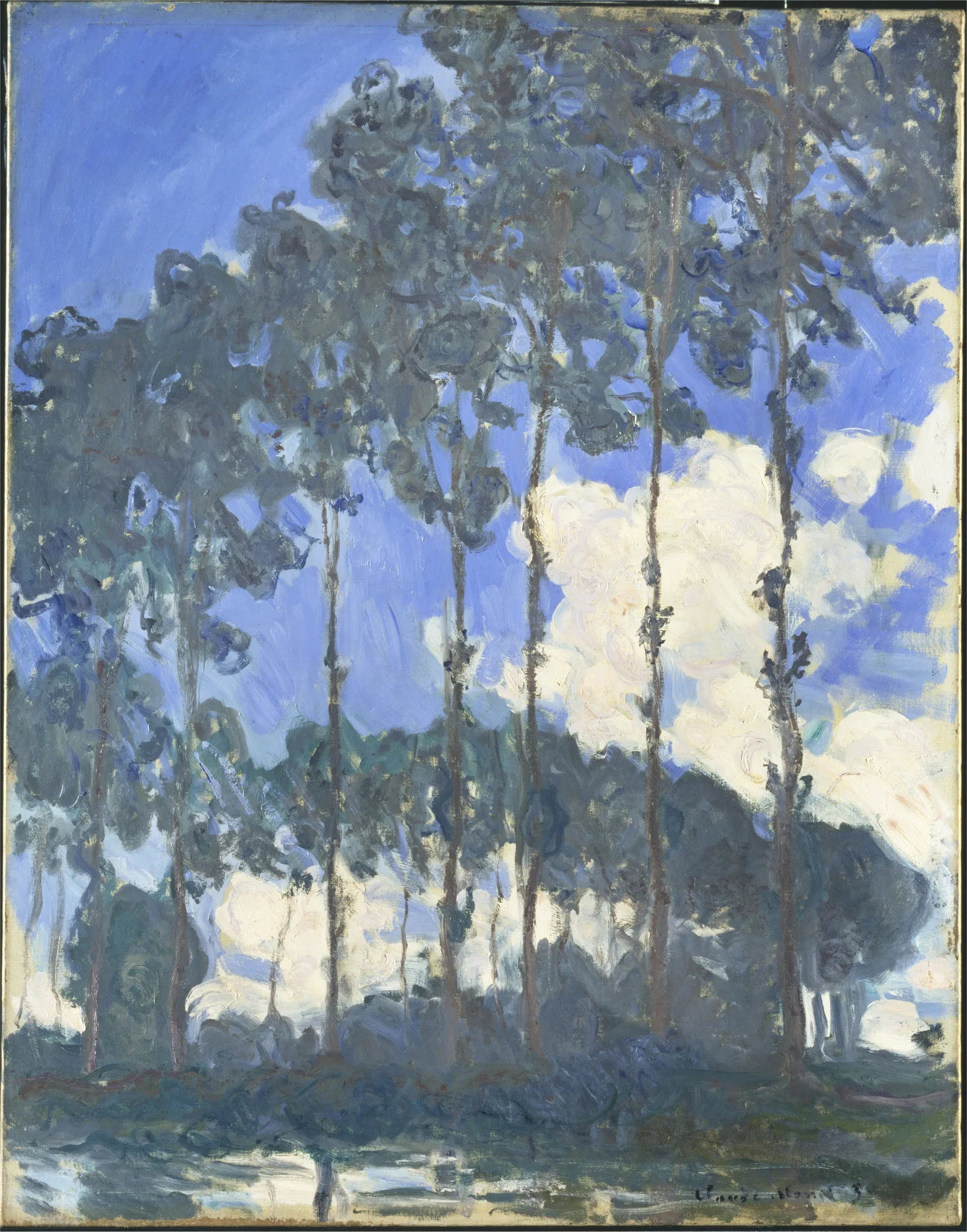
The works that define the collection
Matisse's The Snail (1953) is one of the largest and last of his cut-outs, made in the Hôtel Régina in Nice near the end of his life by pasting sheets of gouache-painted paper, cut with shears, onto a base nearly three metres square. Look at how the colour works in pairs -- red against green, orange against blue, yellow against mauve -- spiralling outward from the centre; Matisse said he drew the snail from nature, then purified the image in his mind until only the shell's logic remained. Picasso's The Three Dancers (1925) stayed in his own possession for forty years before Tate acquired it in 1965, a hard-won purchase led by the trustee and Picasso's friend Roland Penrose. The jagged, splintering forms read as pure energy at a glance, but Picasso later linked the painting to the death of a friend -- look for how the two outer figures fracture into angles while the central one keeps something closer to a human silhouette.
Weeping Woman (1937) was painted in the same year, and in the same emotional register, as Picasso's response to the bombing of Guernica; the handkerchief and hands break into small cubist facets, grief rendered as fracture rather than expression. Metamorphosis of Narcissus (1937), by Salvador Dalí, sets a kneeling youth on the left against a mirrored, fossil-like hand on the right, holding an egg from which a narcissus flower grows -- Dalí's paranoiac-critical method applied to the myth of a man who could not look away from his own reflection. Dalí carried this exact canvas to London in 1938 to show Sigmund Freud; it entered Tate's collection in 1979.
The Rothko Room, as an experience
In the late 1950s, Mark Rothko was commissioned to paint a series of murals for the Four Seasons restaurant in New York's Seagram Building -- the most prestigious public commission ever offered to an Abstract Expressionist painter. Rothko came to feel that a fashionable restaurant was the wrong home for the work and withdrew from the commission. A decade later he presented nine of the resulting paintings to the Tate Gallery, where they have been on display ever since. The palette shifted, compared with his earlier canvases, toward maroon, dark red, and black -- darker in mood, and painted for a room, not a wall.
The point of the Rothko Room is not to read nine separate pictures but to stand inside them. The canvases are large enough, and hung close enough to eye level, that the edges leave the visitor's field of vision -- colour becomes an environment rather than an object across the room. Surface matters as much as hue: passages of matte and faintly glossy paint sit next to each other in ways that photograph as flat but read, in the room, as depth and temperature. This is the strongest argument on this list for seeing a painting in person rather than in reproduction -- no image file carries the shift in the paint's own surface as the light in the room changes.
The building: a power station and the Turbine Hall
Tate Modern occupies the former Bankside Power Station, designed by Sir Giles Gilbert Scott and built in two phases between 1947 and 1963; the station closed in 1981 and stood disused until an international competition, launched by Tate in the mid-1990s, was won by the Swiss architects Herzog & de Meuron. Their approach was to do as little as possible to Scott's structure: unfinished brick walls, exposed steel, and the narrow vertical windows of the original building were kept rather than replaced, and the museum opened inside the converted station in 2000.
The station's old turbine housing became the Turbine Hall -- a single vast volume that now serves as the building's main entrance and its most distinctive architectural feature. Since Tate Modern opened, the hall has hosted a rotating series of large-scale commissions, each one a new work made by a different contemporary artist in response to the space's scale rather than a fixed installation. The very first of these commissions, in 2000, was Louise Bourgeois's giant spider sculpture Maman, now part of Tate's collection -- the commission that set the format the Turbine Hall has followed ever since, with a new work by a different artist rotating through the space over time.
Tate Modern vs Tate Britain
Tate is not one museum but a family of four, and the two London sites are easy to conflate because they share a name. Tate Modern, at Bankside on the south bank of the Thames, holds international modern and contemporary art from roughly 1900 onward -- Matisse, Picasso, Rothko, Dalí, and Bourgeois all belong here. Tate Britain, in a separate building upriver at Millbank, holds British art across five centuries, including the largest collection of J.M.W. Turner's work anywhere in the world. A boat service connects the two sites along the river, which makes the confusion worse rather than better: if the visit is built around Rothko, Matisse, or Picasso, that is Tate Modern; if it is built around Turner, Constable, or Hogarth, that is Tate Britain.
From the studio
From the studio
I have never stood in the Rothko Room myself, but I know exactly what it would teach me, because it is the same lesson I chase in my own studio at a much smaller scale: paint has a surface, and surface only exists at the distance of a body in a room. My own canvases build up in layers over weeks -- matte passages set against passages left to catch light differently -- and that relationship between matte and sheen is the first thing a reproduction flattens out. A photograph of a Rothko can carry the colour. It cannot carry the fact that the maroon shifts temperature as you walk past it, because that shift only happens at the scale of a body moving through a room, not a screen.
The building interests me for a different reason, closer to my training as an architect than to painting. Herzog & de Meuron's decision to leave Bankside Power Station's industrial volume mostly intact, rather than disguise it as a conventional gallery, means the visitor's body is recalibrated before they see a single painting -- the scale of the Turbine Hall resets what counts as large, so that by the time you reach the Rothko Room, you arrive already primed to stand inside a painting rather than look at it from across a room. That sequencing, from raw industrial volume into contemplative gallery space, is the same question I ask about any room a piece of mine is going to hang in: not just what the canvas shows, but what the body has just walked through to get there.
Frequently asked
Tate Modern or Tate Britain?
<p>They are different buildings with different collections. <strong>Tate Modern</strong>, at Bankside, holds international modern and contemporary art -- Matisse, Picasso, Rothko, Dalí. <strong>Tate Britain</strong>, at Millbank, holds British art across five centuries, including the largest Turner collection in the world. If your list is Rothko, Matisse, and Picasso, you want Tate Modern.</p>
Is Tate Modern free to visit?
<p>General admission to the collection displays is free, and no timed ticket is required to enter the building -- this is standard across the UK's national museums. Major temporary exhibitions are ticketed separately from the free collection.</p>
What is the Rothko Room?
<p>It is the display of nine Seagram Murals that Mark Rothko presented to the Tate Gallery a decade after withdrawing from the commission that produced them. The paintings have been shown together at Tate ever since, in a room designed for the viewer to stand inside the colour rather than view it from a distance.</p>
Where is Tate Modern?
<p>Tate Modern sits at Bankside, on the south bank of the River Thames, inside the converted former Bankside Power Station. A riverboat service also connects it to Tate Britain, further upriver at Millbank.</p>
What is the Turbine Hall commission?
<p>It is Tate Modern's ongoing series of large-scale, site-specific works made for the vast former turbine housing of the power station -- a new commission by a different contemporary artist, responding to the hall's scale rather than a fixed permanent installation. The series began in 2000 with Louise Bourgeois's giant spider sculpture, <em>Maman</em>.</p>
Sources
- Mark Rothko -- Display at Tate Modern (In the Studio: The Seagram Murals)
- 'The Snail', Henri Matisse, 1953 | Tate
- 'The Three Dancers', Pablo Picasso, 1925 | Tate
- 'Weeping Woman', Pablo Picasso, 1937 | Tate
- 'Metamorphosis of Narcissus', Salvador Dalí, 1937 | Tate
- Tate acquires Louise Bourgeois's giant spider, Maman -- Press Release | Tate
- History of Tate Modern | Tate
- Constructing Tate Modern | Tate
- Tate Modern | Tate
- Tate Britain | Tate
- Frequently asked questions (ticketing) | Tate
- 'Poplars on the Epte', Claude Monet, 1891 | Tate
Planning the visit to Tate Modern?
If the Rothko Room or these works shaped how you look at painting, the studio is happy to talk through the pieces in the Perfeito Studio collection.
Talk to the studio on WhatsApp
Published on