Journal · Exhibitions & museums
What to see at MoMA, New York
MoMA's collection turns on a small set of works: The Starry Night (Van Gogh), Les Demoiselles d'Avignon (Picasso), Campbell's Soup Cans (Warhol), and One: Number 31, 1950 (Pollock). Together they trace modern art from Post-Impressionism through Cubism to Pop and Abstract Expressionism -- the fastest way to understand what the museum actually holds.
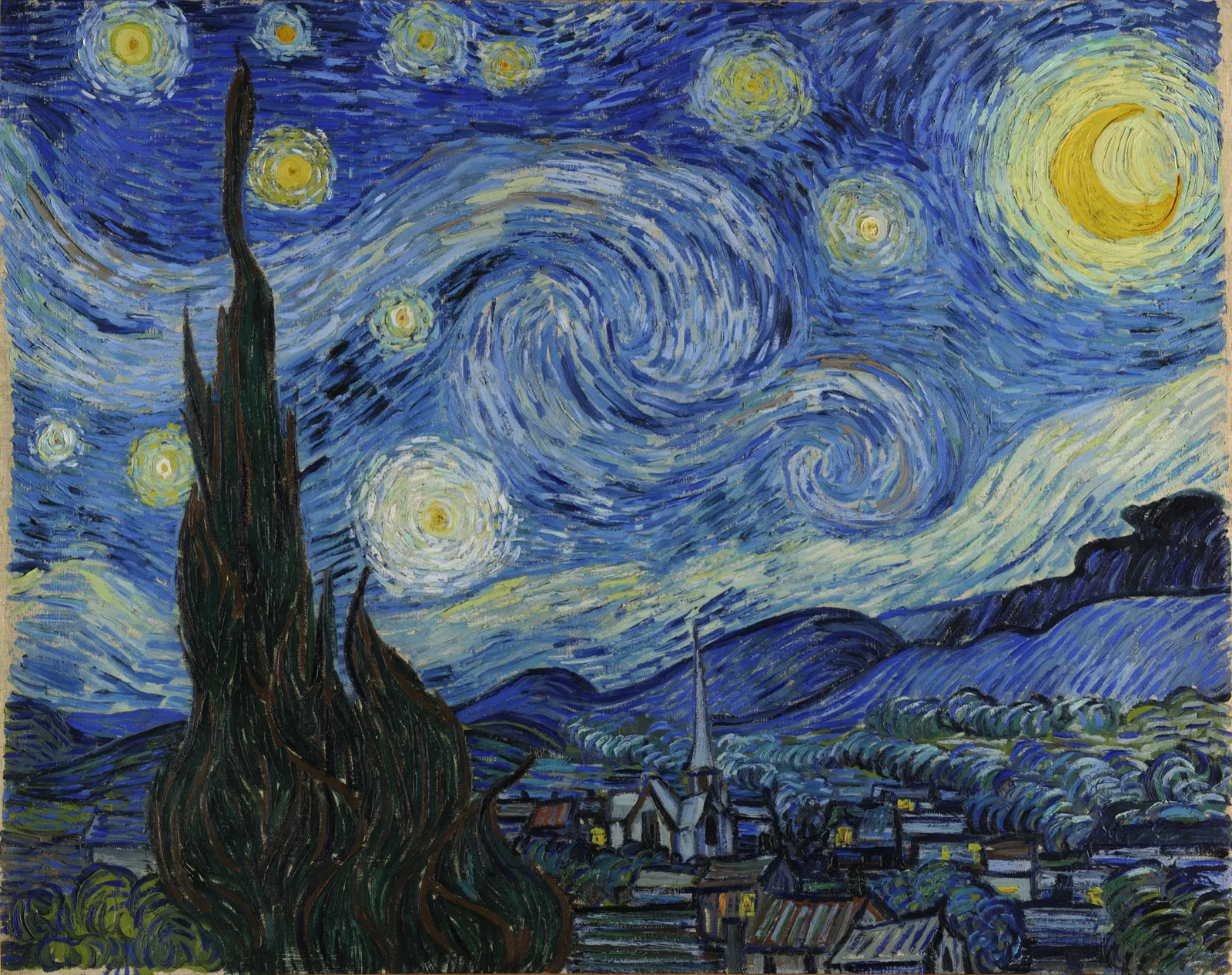
The works that define the collection, and what to look at
The Starry Night (1889), painted by Van Gogh during his year at the asylum in Saint-Rémy, has been in MoMA's collection since 1941. Look at the sky before the village: the brushwork runs in thick, directional strokes laid almost like rope, while the houses below stay flat and calm -- the whole painting is built on that contrast between a sky in motion and a village standing still. Les Demoiselles d'Avignon (1907), Picasso's break from centuries of pictorial space, rewards a slow look at the two figures on the right, painted later than the other three, where faces splinter into angular, mask-like planes -- the clearest evidence in the painting of Picasso changing his own approach mid-canvas.
Campbell's Soup Cans (1962), Warhol's thirty-two canvases, gain from being read as a set rather than thirty-two separate paintings: each flavor is a small variation on an identical template, a repetition that turns a supermarket shelf into a question about originality itself. One: Number 31, 1950, Pollock's largest canvas at MoMA, is worth walking the full width of -- at over seventeen feet across, it was made by pouring paint over a canvas laid on the studio floor, and the layered skeins of black, white, and aluminum paint hold up to close inspection as well as a step back.
How the collection is organized: painting, sculpture, photography, design, film
MoMA collects across six curatorial departments -- painting and sculpture, drawings, prints and illustrated books, photography, architecture and design, and film -- and the works that draw the largest crowds are concentrated in painting and sculpture, arranged loosely by period rather than by artist. Early modernism runs from Cézanne and Van Gogh through Picasso's Cubist break; the museum's Surrealist holdings include Dalí's The Persistence of Memory (1931), with its limp watches set against a real stretch of Catalonian coastline; American painting between the wars includes Wyeth's Christina's World (1948), a single figure in a field rendered with the same tempera precision the artist used across his career. Mid-century abstraction -- Pollock, plus Mondrian's late New York painting Broadway Boogie Woogie (1942-43) -- leads into Pop art and Warhol.
Two departments surprise first-time visitors precisely because they exist at all inside an art museum: architecture and design, and film. Design has been a MoMA curatorial department since 1932, one of the first of its kind at any museum in the world, collecting everyday industrial objects alongside furniture, graphic design, and architectural drawings. Film runs a full public screening program from its own archive. Neither competes for attention with the paintings, which is exactly why they are easy to skip on a first visit.
What to see if you only have two hours
With limited time, follow the century in order rather than chasing individual rooms. Start with Les Demoiselles d'Avignon and The Starry Night, the two works that most visitors come specifically to see -- seeing them early avoids the density that builds around both as the museum fills up later in the day. From there, move to Matisse's Dance (I) (1909), a large compositional study for a mural commission, its simplified figures a useful contrast to the tighter brushwork of the two paintings before it.
Close with Pop and postwar abstraction: Campbell's Soup Cans, Warhol's Gold Marilyn Monroe (1962) -- a silkscreened portrait set against a solid gold field, made soon after Marilyn Monroe's death -- and One: Number 31, 1950. That sequence, four stops instead of a dozen, covers roughly seventy years of the collection's core story in about two hours without doubling back across the building.
What most visitors walk past
Jasper Johns's Flag (1954-55) is easy to walk past because it reads, at a glance, like an actual flag rather than a painting -- the value is entirely in the close look, where encaustic wax over collaged newspaper builds a surface far rougher and more physical than the flat image it appears to be from across the room. Mondrian's Broadway Boogie Woogie suffers the opposite problem: it looks decorative from a distance and gets treated as a design object rather than the culmination of a decades-long argument the artist was having with his own earlier grid paintings.
The bigger miss is structural. Visitors who treat MoMA as a painting museum skip the architecture and design galleries entirely, along with the film program -- the collection that most clearly separates MoMA from any other major museum in the city. An hour spent there covers ground no other institution on this list offers, and it is usually the emptiest part of the building.
From the studio
From the studio
I have never seen these paintings in person, but I know exactly what I would do standing in front of them: get close enough to lose the image and see only the surface. In The Starry Night, that means the ridges of paint in the sky, laid on thick enough to catch real shadow, next to the flat, almost matte houses below -- the same decision I make on every canvas, choosing where paint gets to stand up off the surface and where it stays quiet. Pollock's One: Number 31 asks the same question at a different scale: layers of poured paint that only resolve into a single surface once you step back far enough to lose the individual pours. Scale, edge, and where the paint sits in relation to the canvas -- that is the whole vocabulary, whether the painting is eleven feet wide or the ones I finish in my own studio in Brasília.
The design and architecture collection interests me for a different reason, closer to my training as an architect than to painting. A museum choosing to collect an object built for use -- a chair, a tool, a piece of graphic design -- alongside a painting is making an argument that form and function are not separate questions, which is exactly how I think about a piece leaving my studio: not only what the canvas shows, but the wall it will hang on, the light it will catch at a given hour, and the room a collector has to walk through to reach it.
Frequently asked
How long do I need to see MoMA's highlights?
<p>Budget around two hours for the core works -- <em>Les Demoiselles d'Avignon</em>, <em>The Starry Night</em>, <em>Dance (I)</em>, <em>Campbell's Soup Cans</em>, and <em>One: Number 31, 1950</em> -- followed by an extra hour if you want to add the architecture and design galleries, which most visitors skip entirely.</p>
Is The Starry Night really at MoMA?
<p>Yes. Van Gogh's <em>The Starry Night</em> has been in MoMA's collection since 1941. It is commonly confused with the Musée d'Orsay in Paris, which holds other major Van Gogh paintings but not this one -- <em>The Starry Night</em> is in New York, not Paris.</p>
What are the must-see works at MoMA?
<p>The works most first-time visitors name are <strong>The Starry Night</strong> (Van Gogh), <strong>Les Demoiselles d'Avignon</strong> (Picasso), <strong>Campbell's Soup Cans</strong> (Warhol), and <strong>One: Number 31, 1950</strong> (Pollock), spanning roughly seventy years of the collection's core story.</p>
Does MoMA have Picasso's Les Demoiselles d'Avignon?
<p>Yes, it is one of the paintings most associated with the museum's collection, acquired through the Lillie P. Bliss Bequest and widely considered a founding work of Cubism.</p>
Does MoMA only show paintings?
<p>No. Alongside painting and sculpture, MoMA has dedicated departments for photography, architecture and design, and film, with its own screening program -- the design collection, in particular, is unusual for a museum this focused on painting, and is one of the parts of the building most visitors skip.</p>
Planning the visit to MoMA?
If any of these works shaped how you look at painting, the studio is happy to talk through the pieces in the Perfeito Studio collection.
Sources
- Vincent van Gogh. The Starry Night. 1889 -- MoMA
- Pablo Picasso. Les Demoiselles d'Avignon. 1907 -- MoMA
- Andy Warhol. Campbell's Soup Cans. 1962 -- MoMA
- Jackson Pollock. One: Number 31, 1950. 1950 -- MoMA
- Salvador Dalí. The Persistence of Memory. 1931 -- MoMA
- Andrew Wyeth. Christina's World. 1948 -- MoMA
- Piet Mondrian. Broadway Boogie Woogie. 1942-43 -- MoMA
- Henri Matisse. Dance (I). 1909 -- MoMA
- Andy Warhol. Gold Marilyn Monroe. 1962 -- MoMA
- Jasper Johns. Flag. 1954-55 -- MoMA
Published on