Journal · Technique & materials
Why is abstract art considered art?
Abstract art is considered legitimate because critics and museums stopped requiring a recognizable subject as the test for artistic value. Formalist criticism argues that color, composition, texture, and gesture are themselves sufficient content; painters made a deliberate break from representation to prove it; and major institutions then validated the category, starting with MoMA's 1936 exhibition Cubism and Abstract Art.
The formalist argument: form itself can be the content
The strongest argument for abstract art's legitimacy does not try to explain what a painting is "of." It argues that a painting does not need to be of anything to count as art, because its form — color, composition, texture, gesture — is content in its own right. Tate traces this position back to critic Clive Bell, who in his 1914 book Art "formulated the notion of significant form – that form itself can convey feeling," and defines formalism itself as "the critical position that the most important aspect of a work of art is its form" rather than its narrative or its relationship to the visible world. Under that standard, a formalist critic "would focus exclusively on the qualities of colour, brushwork, form, line and composition" — exactly the vocabulary used to describe a painting that shows nothing recognizable.
The idea predates full abstraction by two decades. The painter Maurice Denis put the same claim in a single, often-quoted sentence that Tate cites as foundational to this way of judging a picture: "Remember, that a picture, before it is a picture of a battle horse, a nude woman, or some story, is essentially a flat surface covered in colours arranged in a certain order." Denis wrote that in 1890, still working in a representational tradition — but the sentence already gives abstraction its later justification: the arrangement of color on a flat surface is the painting, whether or not it also depicts something.
The historical break: when painters stopped depicting the world
Abstraction did not arrive gradually as a style choice — several painters describe it as a deliberate break. Kazimir Malevich, explaining the 1913 origin of his Black Square, wrote plainly: "In the year 1913, trying desperately to free art from the dead weight of the real world, I took refuge in the form of the square." That is a break stated as intent, not discovered by accident: the square replaces a depicted object because Malevich wanted painting to stop referring to the physical world at all.
The question of who got there first is more contested than the popular story suggests. Tate notes that "Kandinsky claimed, wrongly as it turns out, that he produced the first abstract painting in 1911" — and Hilma af Klint's case is why that claim doesn't hold. Af Klint "painted her first series of abstract paintings" in 1906, part of a body of work now "considered to be among the first major abstract works in Western art history," and, as Wikipedia's summary of the scholarship puts it, "a considerable body of her work predates the first purely abstract compositions by Kandinsky, Malevich, and Mondrian." The break from representation, in other words, happened in more than one studio, for more than one reason, before any museum had a name for it.
Institutional and critical validation across the 20th century
A break made by individual painters becomes an accepted category of art once major institutions treat it as one worth studying historically — not just exhibiting as novelty. The turning point most often cited is MoMA's 1936 exhibition Cubism and Abstract Art, curated by the museum's founding director, Alfred Barr. TheArtStory describes it as "a groundbreaking 1936 display of 400 objects that occupied all five floors of the museum," spanning painting, sculpture, architecture, photography, and design. Barr didn't just hang the work — he charted it: his now-famous diagram of movements and influences, printed on the catalogue's dust jacket, became, in TheArtStory's words, "an important touchstone for understanding the development of modern art," and Wikipedia's entry on the museum still calls it "Barr's influential 'Cubism and Abstract Art'" among MoMA's landmark shows of that era.
What made the exhibition validating rather than merely popular was its framing: Barr presented abstraction as the logical endpoint of a historical problem, not a stylistic fad — the argument, as TheArtStory summarizes it, that twentieth-century painters faced diminishing returns from "the imitation of natural appearance" after centuries of representational painting had already explored it. Treating abstraction as the subject of art-historical inquiry, with a chart and a chronology instead of a shrug, is what a specialized field of criticism did over the following decades: giving formless-looking paintings the same kind of scholarly attention previously reserved for depicted subjects.
So what actually makes an abstract painting count as art?
Put together, the case does not rest on one argument alone. The formalist position removes the requirement that a painting depict something before it can be judged. The historical record shows painters — af Klint, Malevich, Kandinsky, each independently — treating the removal of subject matter as a deliberate, stated choice rather than a failure to paint something recognizable. And museums and critics then built the apparatus — exhibitions, chronologies, published criticism — that a field of art history needs to take a category seriously.
None of this settles whether any single abstract painting is good. It settles the narrower, prior question: whether a painting with no representational subject can be art at all. The three arguments above converge on the same answer — yes, because being classified as art was never contingent on depiction in the first place, only on the arrangement Denis described a picture as being, before it is anything else.
From the studio
In the studio: texture that isn't standing in for anything
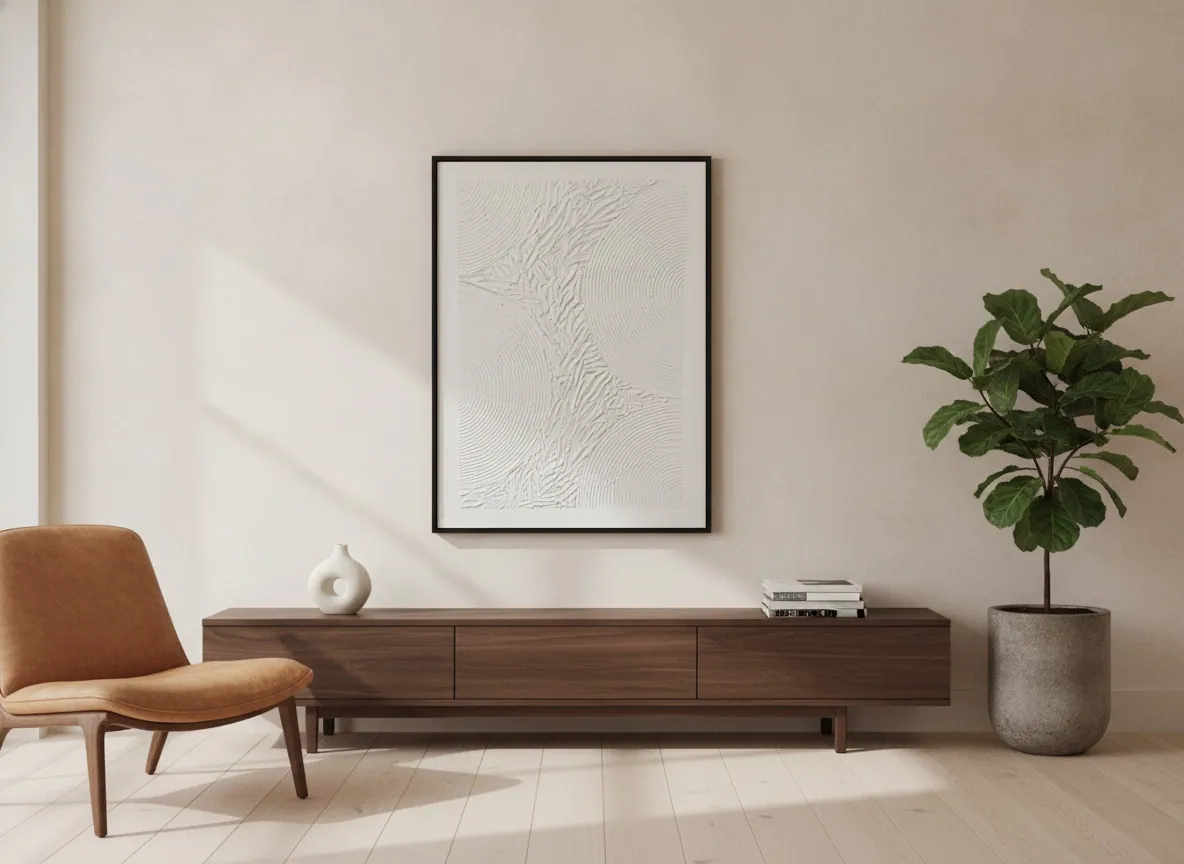
Matter & Silence is the series where this argument is easiest to see in the work itself. Echo of Silence has no image to decode — no horizon, no figure, nothing it is secretly "of." What it has is a sculpted, concentric relief built directly into the surface: the texture is the composition, not a decoration applied to one. When a collector asks what a piece like this "means," my honest answer is that the question assumes a hidden picture that isn't there. What is there is a specific, considered arrangement of relief, light, and monochrome surface — and whether that arrangement holds up in a room, under real light, changing through the day, is a more useful test than asking what it depicts.
Frequently asked
Is abstract art really art, or is it just decoration?
It is art by the same standard formalism applies to any painting: the quality of its form — color, composition, texture, gesture — rather than whether it depicts something recognizable. Tate defines formalism as the critical position that a work's form is its most important aspect, not its narrative or relationship to the visible world. Decoration and art can share a wall, but a painting is judged as art when it rewards close attention to how it is made, not just whether it matches a room.
Who painted the first abstract painting?
There is no single settled answer. Kandinsky is often credited with painting the first fully abstract work in 1911, but Tate notes this claim is "wrongly" made, since Hilma af Klint painted her first series of abstract works in 1906 — work now considered among the first major abstract paintings in Western art history, predating Kandinsky, Malevich, and Mondrian's own abstract breakthroughs. Several painters arrived at abstraction independently in the same period.
What is formalism in art criticism?
Formalism is the critical position, associated with critic Clive Bell and his concept of "significant form" (1914), that a work's most important quality is its form — color, brushwork, line, composition — rather than its subject matter or story. A formalist critic evaluates an abstract painting the same way as a representational one: by the arrangement itself, not by what it shows.
When did museums start treating abstract art seriously?
A widely cited turning point is MoMA's 1936 exhibition Cubism and Abstract Art, curated by founding director Alfred Barr: nearly 400 works across painting, sculpture, architecture, and design, framed with a historical chart tracing abstraction's development. Presenting abstraction as a subject for art-historical study, with a chronology and criticism, rather than as a passing novelty, is what moved it from individual painters' choice into an accepted category museums and critics engage with.
Does an abstract painting need to mean something to be legitimate?
No — legitimacy and meaning are separate questions. Whether a specific abstract painting has to carry a fixed message is genuinely disputed among artists themselves, as our companion piece on that question covers. Whether abstraction as a category counts as art at all is a different, earlier question, answered by the formalist argument that form is sufficient content, regardless of whether any given painter intended a message underneath it.
See how texture alone carries a composition
Echo of Silence (Matter & Silence) has no depicted subject — the sculpted relief is the entire content. Ask the studio about this piece or others in the series.
Published on