Journal · Technique & materials
Why does a textured painting look different in a photo than in person?
A textured painting looks different in a photo than in person because a photograph freezes one light angle and one viewing angle, while a painting's physical relief casts shadows that shift as the light and the viewer move. Raking light — light striking the surface at a low angle — reveals texture that flat, front-on lighting compresses away.
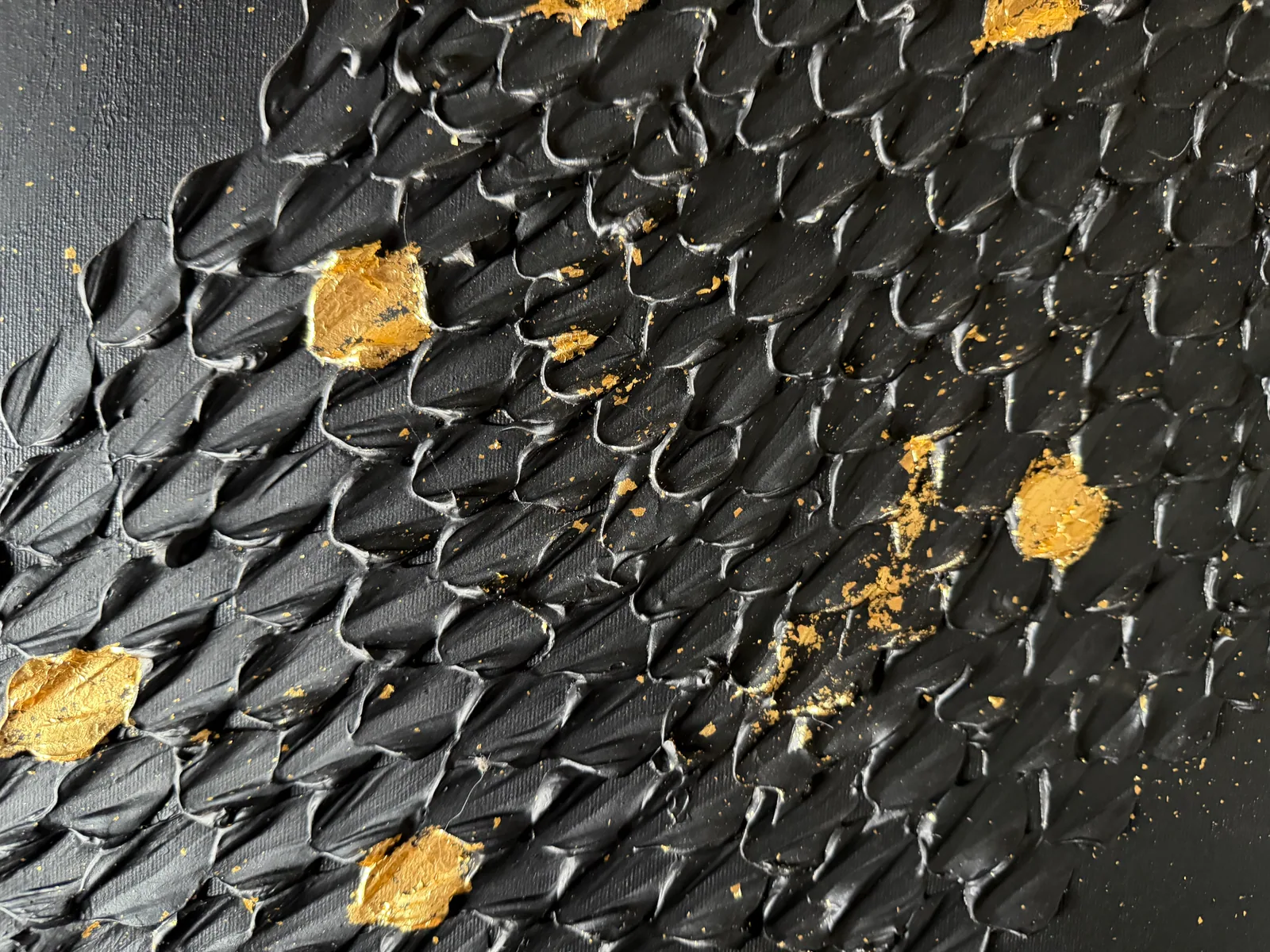
Why a photo and the painting are answering two different questions
A photograph of a textured painting is the record of one specific moment: one light source, at one angle, striking the surface for the fraction of a second the shutter is open. A physical painting with real, raised relief — ridges of texture paste, sculpted brushwork, layers of paint standing off the canvas — is not one static thing to be photographed once. Its surface changes appearance depending on where the light comes from and where the viewer is standing, because raised paint casts a shadow and flat paint does not.
Front-on, even lighting — the kind most product and catalogue photography aims for, because it renders color accurately and avoids glare — is close to the least revealing lighting condition for physical relief. It illuminates the peaks and the valleys of a textured surface almost equally, which is exactly what makes color read true, and exactly what makes the topography of the paint disappear. A photo shot this way is not a failure of photography; it is photography doing its job of showing color, at the cost of showing depth.
What raking light is, and why conservators rely on it
Raking light is light striking a surface at a low, almost parallel angle rather than head-on. Conservators use it as a standard examination technique specifically because it does close to the opposite of front lighting: it illuminates the side of every ridge facing the light and casts a shadow on the side facing away, so even small variation in surface height becomes visible as a pattern of highlight and shadow.
Museums use raking light to study exactly the kind of surface a heavily textured painting has — brushwork, the layering of paint, and the topography left by a palette knife or a built-up texture paste — because it can reveal detail that stays invisible under a room's normal, even illumination. It is the same principle at work whenever a window's low afternoon light rakes across a textured canvas at home: the same painting, the same paint, and a completely different amount of visible relief.
The part a single photograph structurally can't do
Standing in front of a physical painting, a viewer's own movement constantly changes the angle between their eye, the light source, and the paint's relief. Take one step to the side, or come back at a different hour with the light lower in the sky, and the same ridge of texture paste that was almost invisible a minute ago throws a visible shadow, or a small fragment of gold leaf that was dark suddenly catches the light and flares. None of this is the painting changing — it's the same fixed relief being lit from a different angle each time, a range of appearances a single photograph, by definition, can only sample once.
This is also why the more "accurate" a texture photograph tries to be, the flatter it can end up looking. Removing reflections and glare with careful lighting or a polarizing filter produces a color-true image, but the same reflections being removed are often what were reading, to the eye, as the surface's own depth — so a technically cleaner photo can look less dimensional than a messier one, because glare and perceived dimensionality can come from the same physical cause.
What to ask for when judging a textured piece from photos alone
Because no single photo can show what a textured surface does under changing light, the practical fix used in art photography is close to the one conservators already rely on: photograph the surface again, deliberately, under light coming from the side rather than the front — a window, an open doorway, or an angled lamp — so the relief casts the shadows a frontal shot suppresses.
For a piece with real sculpted texture, like Golden Passage, that means asking for more than the one hero image used on a gallery page: a detail shot under raking light, ideally from more than one angle, and a short video panning across the surface if one is available. None of that fully replaces standing in front of the canvas — but it closes most of the gap between "a photo of the composition" and what the paint actually does.
From the studio
The atelier's view: Golden Passage under changing light
On a catalogue photo, Golden Passage reads as a diagonal band of sculpted forms crossing a black field, with small flashes of gold. That's the composition, and it's true — but it's not the whole surface. The forms in that diagonal band are built with texture paste before any color goes on, so they stand physically off the canvas, and the gold leaf sits in fragments across that relief rather than painted flat on top of it.
When we document this piece in the studio, the same thing happens every time: under even, front-on light, the diagonal reads mostly as shape and color. Angle a light in from the side, or wait for the room's late-afternoon light to come in low, and the sculpted forms suddenly have depth — a ridge that was barely implied a moment ago is now casting a real shadow, and gold that looked like a flat highlight starts to flare as the angle changes. It's the clearest example in the collection of why we tell people to ask for more than one photograph before deciding on a heavily textured piece.
Frequently asked
What is raking light, and why does it matter for a textured painting?
Raking light is light hitting a surface at a low, almost sideways angle instead of head-on. Because it lights one side of every ridge and casts a shadow on the other, it makes even small variations in surface height visible — which is why conservators use it to examine brushwork and paint layering, and why it's the lighting condition that shows a textured or impasto painting's relief most clearly.
Why does a heavily textured painting look flatter in a photo than it does in the room?
A photo captures one light angle and one viewing angle at the moment the shutter opens. A physical painting with raised paint or texture paste changes appearance as the light and the viewer's position change, because the relief casts a shadow that shifts. Even lighting, the kind most product photography uses to render color accurately, is close to the least revealing angle for physical texture — so an accurate color photo and a flattened-looking texture often come from the same lighting choice.
Can better studio photography fully solve this?
It helps, but it can't fully replace seeing the piece in person. Photographing under raking, angled light instead of front-on light — and taking more than one shot, from more than one angle — shows far more of the relief than a single hero photo. But the range of appearances a textured surface has under continuously changing light is something a fixed photograph, however well lit, can only sample rather than fully capture.
What should I ask for if I'm considering a heavily textured painting I've only seen in one photo?
Ask for a detail photo taken under raking or side light rather than front-on light, ideally from more than one angle, and a short video panning across the surface if one is available. For a piece like Golden Passage, where the relief is built with texture paste and gold leaf sits across it, this shows how the surface actually behaves under light far better than the single image used on a gallery page.
Does this only apply to impasto or texture-paste paintings, or to flat paintings too?
It applies almost entirely to paintings with real physical relief — impasto, texture paste, gold leaf applied over a sculpted surface, or heavy palette-knife work. A painting with a smooth, flat paint film doesn't have ridges to cast a shadow, so a photo and the painting in person read much closer to each other. The gap described here is specifically a function of physical height variation on the canvas.
Want to see the texture in Golden Passage before deciding?
We can send detail photographs taken under raking light, from more than one angle, and a short video if useful — so the relief and the gold leaf read the way they do in the room, not just in a single frontal shot.
Sources
- Wikipedia — 2026-09-26
- Cincinnati Art Museum — 2026-09-26
- Milton Contact — 2026-09-26
- Will Kemp Art School — 2026-09-26
Published on