Journal · Technique & materials
What is canvas weight (gsm) and why it matters
Canvas weight is the density of woven fabric, measured in grams per square meter (gsm) or ounces per square yard. Heavier canvas is sturdier and better suited to large or heavily worked paintings, while lighter canvas suits smaller, more detailed work — a separate quality factor from the cotton-versus-linen choice.
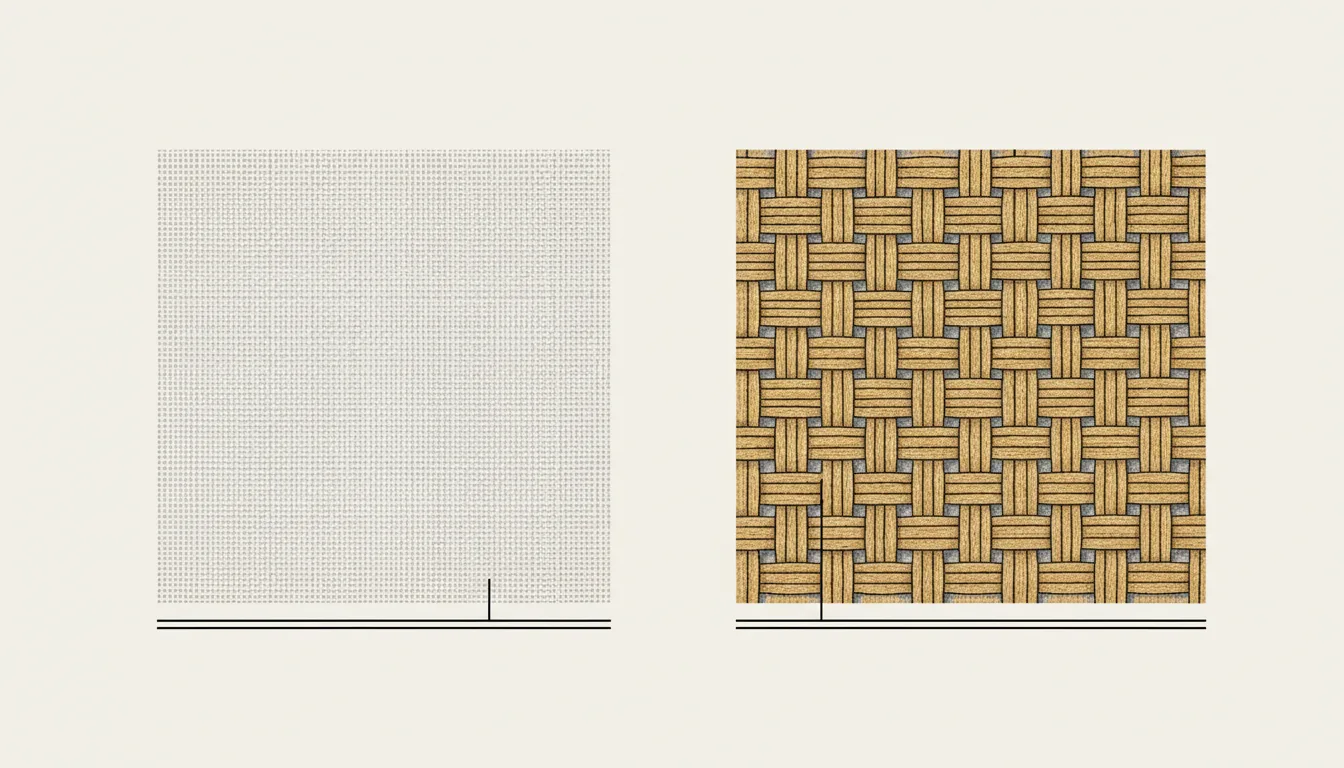
What canvas weight actually measures
Canvas weight is a measurement of fiber density — how much woven fabric sits in a given area, not how thick or textured the surface looks. Outside the United States it is usually expressed in grams per square meter (gsm); American art-supply catalogs typically use ounces per square yard (oz/yd²) instead, where roughly 1 oz/yd² equals 33.9 gsm. Higher numbers mean more fiber packed into the same square of cloth, which is what gives a heavier canvas its added body and resistance to flexing.
Weight is a separate axis from the cotton-versus-linen choice: both materials are milled in a range of weights, from light rolls meant for small studies to heavy-duty rolls meant to be stretched over a large frame. A cotton canvas and a linen canvas can carry the same weight number and still behave differently once paint goes on, because fiber type and weave also play a role — weight tells you how much fabric there is, not what it's made of.
Typical weight ranges for artist canvas
Art-supply technical guidance generally splits artist canvas into two working bands. Lightweight canvas, roughly 7 to 10 oz/yd², is easier to stretch and transport and suits lighter paint applications or detailed, smaller-scale work. Heavyweight canvas, roughly 12 to 15 oz/yd² and above, gives a stronger, sturdier surface that resists tearing and holds up under heavy layers of paint, mixed media, or large-scale work.
These are working bands rather than one fixed industry standard — different mills draw the line in slightly different places — but the direction is consistent across sources: as the number goes up, so does the canvas's capacity to carry weight without stretching, bowing, or tearing.
Why weight matters more as a painting gets larger
The larger the canvas, the more its own weight — and the weight of everything painted onto it — pulls against the stretcher bars and the fabric itself. Canvas manufacturer Fredrix states the relationship plainly in its own buying guidance: “the larger the size of the painting the heavier the weight of canvas needed,” recommending 10 oz. or 12 oz. cotton, or about 10 oz. linen, for canvas sizes 48 inches (122 cm) and larger.
Below that weight, a large expanse of stretched fabric has more surface area free to flex, and gravity and humidity both work on it over years, not days — a lightweight canvas that looks perfectly taut on the day it's stretched can develop a visible sag or ripple once it's hanging on a wall carrying its own paint film indefinitely.
Is heavier canvas always the better choice
No — heavier is the safer default for scale and load, not a universal upgrade. Lightweight canvas remains the right tool for smaller formats, fine detail work, and pieces where the priority is ease of stretching, lower material cost, or portability rather than carrying a heavy paint film. Pushing a very heavy, stiff canvas onto a small, delicately worked piece adds cost and handling difficulty without a corresponding benefit.
Heavier canvas earns its place specifically where the painting demands it: large dimensions, thick or built-up paint, or mixed-media elements with real physical weight — texture paste, layered acrylic, metallic fragments, gold leaf. The right weight is the one matched to what the piece actually asks the fabric to carry, not the highest number available.
How weight affects what the canvas can carry
Weight and load-bearing capacity move together. Art-supply guidance is consistent that a heavier-weight canvas holds up better under heavy paint, mixed media, or large-scale work, while a lighter canvas is easier to handle but more likely to strain under the same load. That capacity matters as much during preparation as during painting: a canvas carrying several coats of gesso, a built-up ground, or a textured, sculptural surface needs enough underlying density to stay flat and stable through all of it, not just through the final layer of paint.
Material adds a second variable on top of weight. Winsor & Newton notes that linen “holds up to a heavy painting hand and does not become slack as easily as cotton canvas,” while cotton, even in a heavier weight, is “considered too flexible for very large paintings.” Weight and fiber type work together, not as substitutes for each other.
From the studio
In the studio: what the canvas has to carry before the paint does
Genesis of Flame is the largest canvas I've built so far — 120 by 200 centimeters, layered with acrylic, metallic pigment, and both high-gloss and matte finish. A support that size has to carry real weight before a single pass of color goes on: the fabric needs enough density not to bow under its own stretch, let alone under three or four heavily loaded layers. I don't think in gsm numbers while I'm working, but I feel it immediately when a canvas is too light for the scale — the surface gives under the brush instead of pushing back. On the gold leaf pieces, like Quartz Seam, the concern runs the other way: enough tooth and structure in the weave to hold the leaf and texture paste flat, without so much flex that the gilding cracks months after it leaves the studio.
Frequently asked
What does canvas weight (gsm) mean?
Canvas weight describes how much fabric sits in a given area — measured in grams per square meter (gsm) in most of the world, or ounces per square yard (oz/yd²) in US art-supply catalogs, where 1 oz/yd² equals roughly 33.9 gsm. It measures fiber density, not thickness alone: a higher number means more fiber packed into the same square of cloth. Weight is independent of material — cotton and linen canvas both come milled in a range of weights, from light to heavy.
Does a heavier canvas last longer than a lighter one?
Generally, yes, within the same material. Heavier-weight canvas resists tearing and holds up better under heavy paint layers, mixed media, or large-scale work, according to art-supply technical guidance, while lighter canvas is easier to stretch but more likely to strain under heavy paint over time. Fiber matters too: linen holds up to a heavy painting hand and does not go slack as easily as cotton, independent of the weight number. Weight and material both contribute to how a canvas ages.
Is heavier canvas always better for large-format paintings?
Heavier is the safer default for large paintings, but not automatically the better choice for every piece. Canvas manufacturer Fredrix recommends 10 to 12 oz. cotton, or about 10 oz. linen, for paintings 48 inches (122 cm) and larger, since a large expanse of lightweight fabric is more prone to sagging under its own stretch. But lighter canvas remains the right choice for smaller formats, fine detail work, or pieces where cost and portability matter more than load-bearing strength.
How does canvas weight affect how paint or gesso sits on the surface?
Weight and surface behavior are related but not identical. What the sources are clear about is capacity: heavier-weight canvas holds up better under heavy paint layers, mixed media, or repeated coats of gesso, while lighter canvas is easier to stretch but can strain under the same load over time. In the studio, the practical sign is simple — a canvas that gives or bows under a loaded brush or a thick pass of texture paste is under-built for the work going onto it, regardless of what the weight label says.
What canvas weight is typical for large contemporary paintings?
For paintings around 48 inches (122 cm) and up, Fredrix — a canvas manufacturer used across the professional US market — specifies 10 to 12 oz. cotton or roughly 10 oz. linen as the recommended range, which converts to roughly 339-407 gsm using the standard oz-to-gsm factor. Below that weight, fabric stretched at this scale is more likely to sag or ripple once it is loaded with paint and hanging under its own tension.
Sources
- Szoneier Fabrics — 2026-08-06
- Fredrix Artist Canvas — 2026-08-06
- Alabama Art Supply — 2026-08-06
- Winsor & Newton — 2026-08-06
See the studio's large-format works in person, digitally
Genesis of Flame and the other large canvases in the collection are built on heavyweight support to carry their layered acrylic, metallic pigment, and texture. Ask the studio for detail photographs before deciding on scale.
Talk to the studio on WhatsApp
Published on