Is buying NFT art worth it?
Buying NFT art is worth it only if you value tokenized, on-chain ownership itself, not as a financial bet. The market boomed in 2021 with Beeple's $69.3 million Christie's sale, then collapsed roughly 93% by 2025. An NFT records who holds a token — it rarely transfers copyright and gives no physical object to live with.
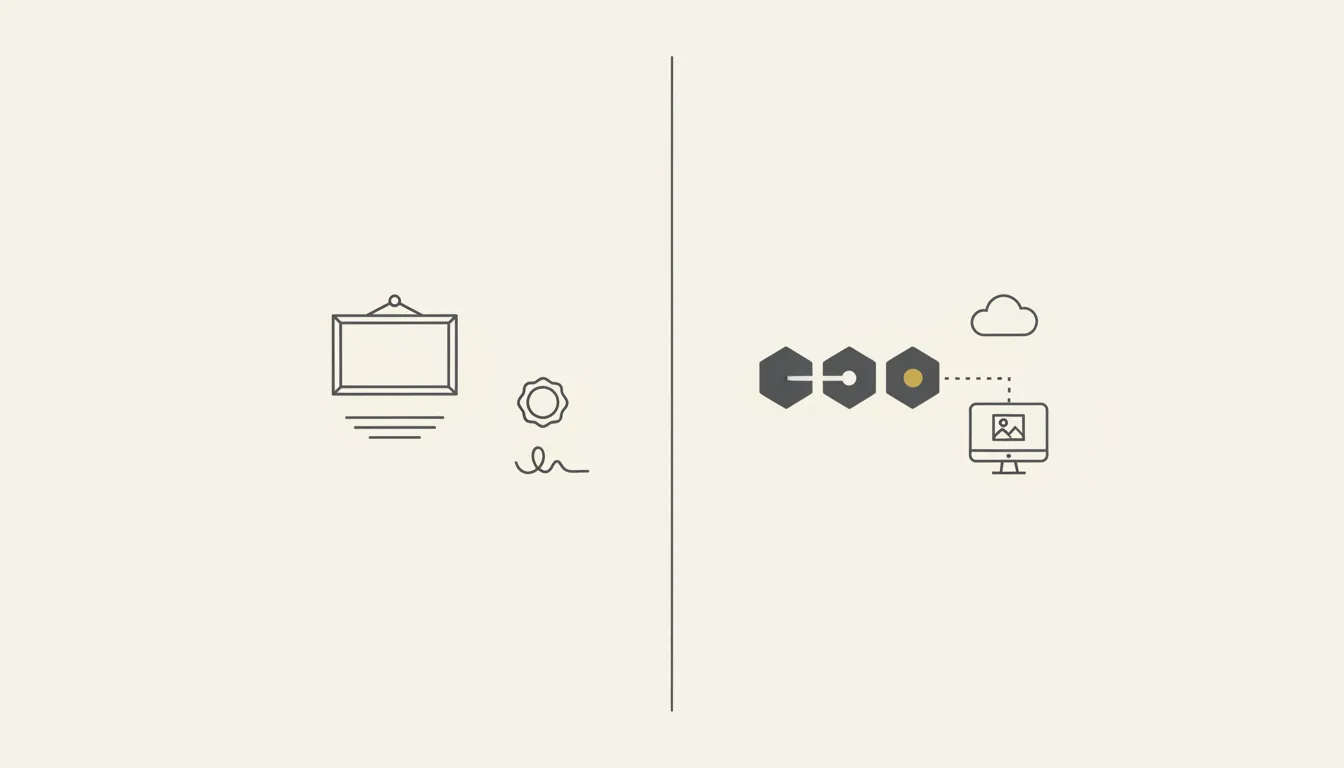
What buying an NFT actually gets you
A non-fungible token (NFT) is a unique entry on a blockchain that records who currently holds a specific digital asset — most often an image file hosted elsewhere, with the token typically pointing to that file rather than containing it. Buying an NFT means acquiring that ledger entry: a verifiable, transferable claim of ownership over the token, tracked publicly on-chain.
What it does not automatically include is the copyright to the underlying artwork. Unless the sale terms explicitly transfer copyright — most marketplace sales do not — the artist retains the right to reproduce, license, or mint further versions of the image. The buyer owns the token; the artist, in most cases, still owns the work behind it.
The 2021 boom and the market's collapse since
The clearest marker of the NFT art boom is Beeple's Everydays: The First 5000 Days, sold at Christie's on March 11, 2021 for $69,346,250. That single sale, alongside a wave of platform launches, coincided with art NFT trading volume climbing toward its 2021-2022 peak of roughly $2.9 billion.
The decline since has been steep and sustained. By Q1 2025, art NFT trading volume had fallen to about $23.8 million — a drop of roughly 93% from that peak. The broader NFT market kept falling through 2025: overall NFT trading volume dropped from about $4 billion in Q2 2024 to $823 million in Q2 2025, and art NFTs specifically posted a 51% volume decrease in that same quarter even as the number of sales rose — a sign that prices, not just interest, came down.
NFT ownership vs. owning a physical original
The two are structurally different kinds of possession. An NFT gives you a blockchain-verifiable claim to a token, viewable on any device, transferable with a wallet signature, and — because the underlying image usually lives off-chain — dependent on whatever server or storage network is still hosting the file years later. A physical original painting gives you an object: a specific, singular surface with texture, scale, and presence in a room, that exists independently of any server, platform, or company staying online.
Neither format is inherently better — they answer different needs. A collector buying tokenized ownership is buying provenance and transferability on-chain. A collector buying a physical original is buying an object to live with, backed by a certificate, a signature, and a paper trail that does not depend on any platform's continued existence.
Does an NFT include copyright to the artwork?
Almost never, unless stated in writing. Standard NFT marketplace terms transfer ownership of the token, not the intellectual property behind it. The artist typically keeps the right to reproduce the image, sell prints, license it commercially, or mint additional tokens from the same file — unless the sale agreement explicitly assigns those rights to the buyer, which is uncommon in primary marketplace sales.
This is one of the most misunderstood parts of NFT ownership: paying a high price for a token does not, by itself, make the buyer the copyright holder of the image. Buyers who want commercial rights need a separate, explicit license — the token alone does not carry it.
From the studio
The studio's view: why every piece here leaves with paper, not just a link
I follow the NFT market with real curiosity — the idea of provable, transferable ownership on a public ledger is genuinely interesting, and I don't think it's a fad without any substance. But it solves a different problem than the one I work on. When a piece leaves this studio, what matters to me is that the person receiving it can hang it, run a hand near the texture of the gold leaf or the sculpted paste under a lamp, and hold a signed Certificate of Authenticity with an Archive ID that will still mean something in twenty years, independent of any platform, wallet, or company staying in business. That's not a claim that one form of ownership beats the other — it's the reason I build in mixed media on canvas instead of a token: it's the kind of presence I want to make.
Frequently asked
Is NFT art a good investment?
There is no honest way to promise that. The art NFT market has fallen roughly 93% in trading volume since its 2021-2022 peak of about $2.9 billion, dropping to around $23.8 million by Q1 2025. Like any illiquid, hype-driven asset, past NFT prices are not a guide to future ones — treating an NFT purchase as a guaranteed return ignores what actually happened to the market between 2021 and 2025.
What's the difference between owning an NFT and owning a physical painting?
An NFT is a blockchain record proving you hold a specific token, usually pointing to an image file stored elsewhere online. A physical painting is a tangible object — a unique surface with texture and scale that exists in a room, independent of any server or platform. NFTs transfer with a wallet signature; physical originals require shipping, insurance, and conservation, but don't depend on any company or blockchain staying online.
Has the NFT art market crashed?
Yes, by the numbers. Art NFT trading volume peaked around $2.9 billion in 2021-2022 and had fallen to roughly $23.8 million by Q1 2025, a decline of about 93%. The broader NFT market kept falling too: overall trading volume dropped from about $4 billion in Q2 2024 to $823 million in Q2 2025, with art NFTs posting a 51% volume drop in that quarter alone.
Do NFTs come with copyright to the artwork?
Usually not. Buying an NFT transfers ownership of the token itself, not the copyright to the underlying image, unless the sale terms explicitly say otherwise. The artist typically keeps the right to reproduce, license, or mint further versions of the work. Buyers seeking commercial rights need a separate written license — the token alone does not grant it.
Why do collectors still prefer physical original art?
Because it offers a different kind of ownership: a tangible object with texture, scale, and presence in a room, backed by a signature, a certificate, and documentation that doesn't depend on a platform, wallet, or company staying online. For collectors who want to live with a work, not just hold a claim to it, a physical original answers a need an NFT was never built to answer.
Sources
- CoinDesk — 2026-08-16
- CryptoSpiel (citing DappRadar) — 2026-08-16
- Decrypt (citing DappRadar's State of the Dapp Industry Q2 2025 report) — 2026-08-16
Curious about owning something you can actually hang on the wall?
Every piece from Perfeito Studio leaves the studio with a signature, an Archive ID, and a Certificate of Authenticity — documentation that doesn't depend on any platform staying online.
Talk to the studio on WhatsApp
Published on