What insurance covers a painting during international transit?
International transit for a painting is normally covered by a nail-to-nail (wall-to-wall) cargo insurance policy bought specifically for that shipment, not by a carrier's standard liability. A carrier's built-in liability is usually a flat rate per weight, far below an artwork's value. Under most Incoterms the buyer arranges and pays for this insurance once risk transfers; under CIF and CIP, the seller does.
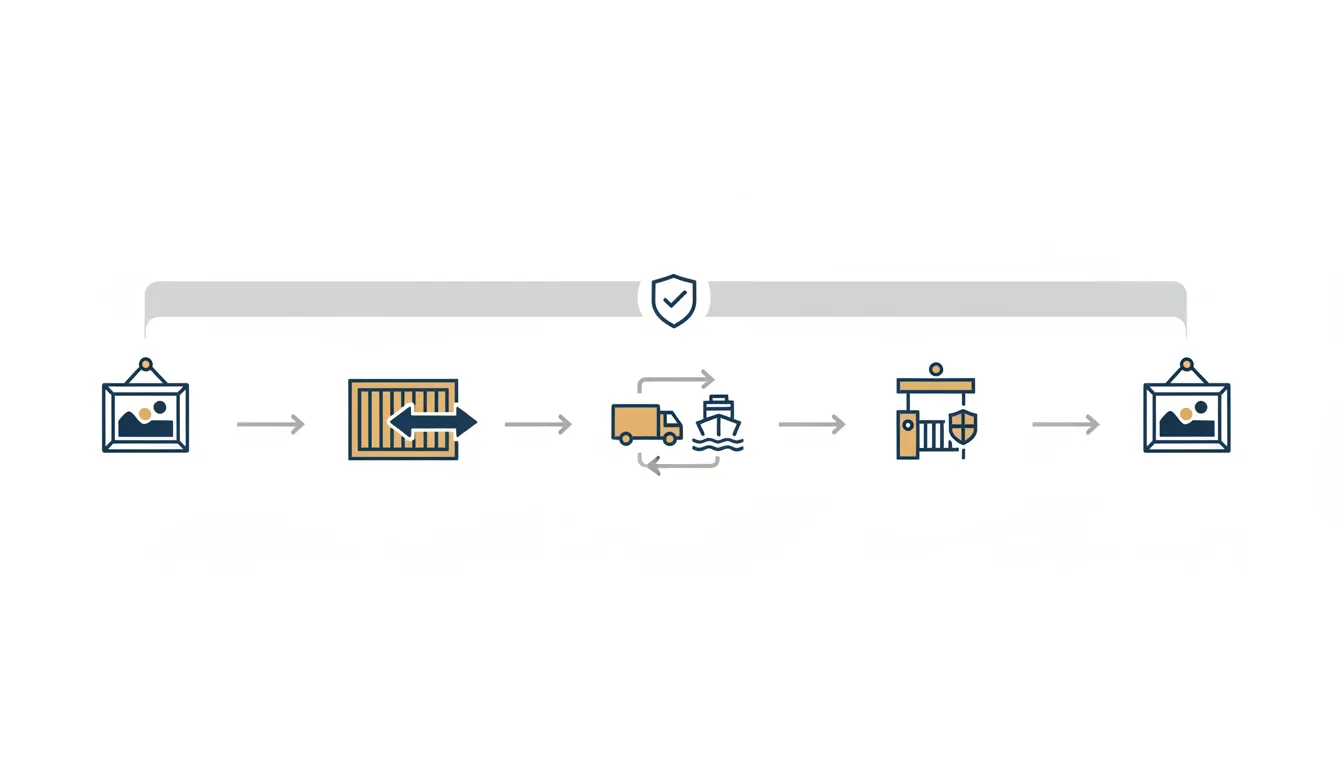
Nail-to-nail: the coverage that actually matches the risk
Fine-art transit insurance is typically written as "nail-to-nail" or "wall-to-wall" coverage — protection that begins the moment the piece is taken off the wall at origin and continues through crating, loading, the carrier leg, customs handling, uncrating, and reinstallation at the destination wall. Collectors, dealers, and artists shipping their own work all buy this type of policy specifically because ordinary transportation is where most fine-art claims originate: multiple handling points, unattended vehicles during stops, improper stacking, and warehouse holding periods (weekends especially) all add risk that a general property policy was never built to price.
Why the carrier's own liability isn't insurance
A shipping carrier's standard liability is not the same thing as cargo insurance, and conflating the two is the single most common gap. Carrier liability is usually a flat reimbursement tied to weight rather than declared value — a well-known illustration is a claim paying out on the order of sixty cents per pound, which for a light, high-value painting can mean a payout that is a rounding error against what the piece is actually worth. International carriage also sits outside the reach of a single domestic liability rule, which is precisely why a dedicated, valuation-based transit policy exists as a separate purchase from whatever liability the shipping line or airline already carries.
Who has to buy it: the buyer, the seller, or both
Responsibility for cargo insurance on an international shipment is generally decided by the Incoterms written into the sale — the International Chamber of Commerce's standard rules for dividing risk between buyer and seller. For most terms (including EXW, FCA, FOB and CPT), risk transfers to the buyer at a defined point, and the buyer is the one expected to insure the shipment from there. Only under the CIF and CIP terms is the seller obligated to buy insurance on the buyer's behalf, and even then the default minimum coverage under those terms can be narrower than either party assumes — worth specifying in the sale, not left to the default. Whoever ends up holding the risk during the transit leg is, in practice, the party who needs the policy in hand before the crate leaves the building.
Buying directly from an independent artist, without a gallery or shipping department
A gallery or auction house shipping department typically handles this insurance conversation as a matter of course. Buying directly from an artist's studio removes that intermediary, which means the insurance question has to be asked explicitly rather than assumed. At Perfeito Studio, professional packaging is included with every shipment and transit insurance is available; shipping itself — domestic or international — is quoted per destination and paid by the buyer, together with any import duties or taxes the destination country applies. Confirm the specific insurance terms, coverage amount, and who is named on the policy with the studio before the piece leaves Brasília — this is a detail to settle in writing per shipment, not a standing policy to assume.
From the studio
From the studio
Packing a painting for a flight it will never see me unpack is a different problem than hanging one in a room I can walk through — and it is the part of shipping abroad that collectors underestimate most. As an architect as much as a painter, I think about a piece's transit the same way I think about load paths in a structure: where the actual stress falls, not where it looks like it should. A crate that protects a canvas sitting still in a warehouse is not automatically the same crate that protects it through three handling changes and a customs inspection. I build the packaging around the real journey the piece is about to make, and I say plainly when transit insurance is something the buyer needs to arrange rather than something already baked into the price.
Frequently asked
What insurance covers a painting during international transit?
A nail-to-nail (wall-to-wall) cargo insurance policy purchased specifically for the shipment, covering the painting from the moment it leaves the wall at origin through packing, the carrier leg, customs handling, and reinstallation at destination. This is separate from, and normally far more protective than, the shipping carrier's own built-in liability.
What should a foreign buyer know before acting on this?
Confirm three things before the piece ships: whether insurance is being arranged and by whom, what value it is insured for (matching the invoice), and who is responsible for import duties and taxes at the destination. None of this should be assumed from habit — ask the seller or shipper in writing, per shipment.
Does this differ for a US buyer vs a European buyer?
The underlying principle — buy nail-to-nail cargo insurance rather than rely on carrier liability — is the same everywhere. What differs is the customs and import-duty regime each country applies on arrival, and which international carriage convention governs the leg (air or sea), so the paperwork and duty calculation will differ even when the insurance logic doesn't.
Who handles this in practice — the artist, a shipper, or the buyer?
It depends on who is selling. A gallery or auction house typically arranges this through its own shipping department. Buying directly from an independent artist's studio removes that intermediary, so the insurance conversation has to happen explicitly between artist and buyer rather than being handled invisibly in the background.
What could go wrong if this step is skipped?
If the painting is damaged or lost in transit with no dedicated cargo insurance in place, the buyer is left with whatever the carrier's standard liability pays — commonly a flat, weight-based reimbursement that can be a small fraction of the artwork's actual value, regardless of how carefully it was packed.
Shipping abroad, and want the insurance question settled before you buy?
Ask about packaging and transit insurance for a specific piece and destination before it ships.
Sources
- Risk Strategies / Brown & Brown — 2026-09-27
- Flaster Greenberg (law firm) — 2026-09-27
- HD Asian Art — 2026-09-27
- Chubb — 2026-09-27
- Perfeito Studio (studio policy, internal source) — 2026-09-27
Published on