Is it worth buying a museum print reproduction?
What a museum print reproduction actually is
A “museum print” is a reproduction — a manufactured copy of an image that exists as a painting, drawing, or photograph somewhere else. Most of what museum shops and online print retailers sell today are giclée prints: pigment-based inkjet reproductions on archival paper or canvas, chosen over cheaper offset printing because the ink holds its color and the resolution can carry an image's tonal range without visible dot patterns.
Two things determine what you are actually paying for. First, whether the edition is open — printed on demand, with no cap on quantity — or limited, meaning a fixed, numbered run signed by the artist or licensed by the estate. In printmaking, an edition is understood as a series of identical impressions produced from the same printing surface or file; the size of a limited run is a licensing decision, not a physical constraint of the ink and paper. Second, who issued it — the museum's own licensing program, a third-party print publisher, or an unauthorized print-on-demand seller riding on a public-domain image.
None of this makes a giclée a bad object. It makes it a manufactured multiple: a well-produced copy of something that exists, as itself, somewhere else.
Does a print of a famous painting hold or gain value?
Prints and editions are a real and growing category inside the art market, not a fringe purchase. In the Art Basel & UBS Global Art Market Report 2026, prints and multiples accounted for 12% of dealer sales in 2025, inside a global art market that grew 4% year-on-year to an estimated US$59.6 billion. That is a market for a defined print category — signed, numbered editions traded through recognized publishers and dealers, with their own resale circuit — not for posters or unlicensed reproductions bought from a decor retailer.
Within that defined category, value tracks the same forces that drive any collectible multiple: the reputation of the artist or estate, the size and rarity of the edition, the print's condition, and whether the publisher and provenance are documented. A poster-style reproduction of a public-domain painting — sold without an edition number, a publisher's mark, or a certificate — sits outside that market. It functions as decoration, not as a traded asset, because there is no scarcity, no license, and nothing in it that a market can price beyond the paper and the frame.
An original painting is a different proposition again: there is exactly one, and its value is tied to the individual work and the artist's own trajectory, not to an edition size set by a publisher.
Why an original by a living artist can cost less than a print of a famous name
It is a common surprise: a numbered giclée of a canonical painting, produced by an established print publisher, can cost more than a full-size, hand-made original by a working contemporary artist. The reason is not quality — it's licensing and brand. A print of a recognized masterpiece carries the estate's or museum's licensing fee, the publisher's production and distribution costs, and the pricing power of a famous name, stacked on top of the physical print itself.
An original by an artist still building a market — signed, one-of-one, sold directly from the studio — carries none of that overhead. The price reflects materials, scale, and the artist's own current standing, not a licensing chain. At Perfeito Studio, original mixed-media paintings by Alyne Perfeito currently range from R$ 2,400 to R$ 8,800, each a unique, signed piece with a Certificate of Authenticity — a price built from the object itself, not from a name being licensed onto paper. International buyers can request an approximate USD reference on inquiry; the reference price is always the BRL figure.
What to check before buying a reproduction online
- Edition status. Open or limited? If limited, ask for the run size and your print's number — a seller who can't answer either question is not selling a documented limited edition.
- Publisher and license. Who produced the print, and under what license from the museum, artist, or estate? Legitimate publishers state this plainly.
- Materials. Pigment ink versus dye-based ink, and the actual paper or canvas stock — ask, don't assume the word “giclée” alone guarantees archival quality.
- Documentation. A certificate of authenticity or publisher's label, separate from the printed sheet itself.
- Actual printed dimensions. Reproductions are frequently misjudged in size online; confirm the real printed size, not just the image file's aspect ratio, before ordering.
None of this applies to an original: there is no edition to verify, because there is only the one piece — a simpler, not a riskier, transaction, provided the seller documents the work itself.
From the studio
Why I build surfaces a print cannot flatten
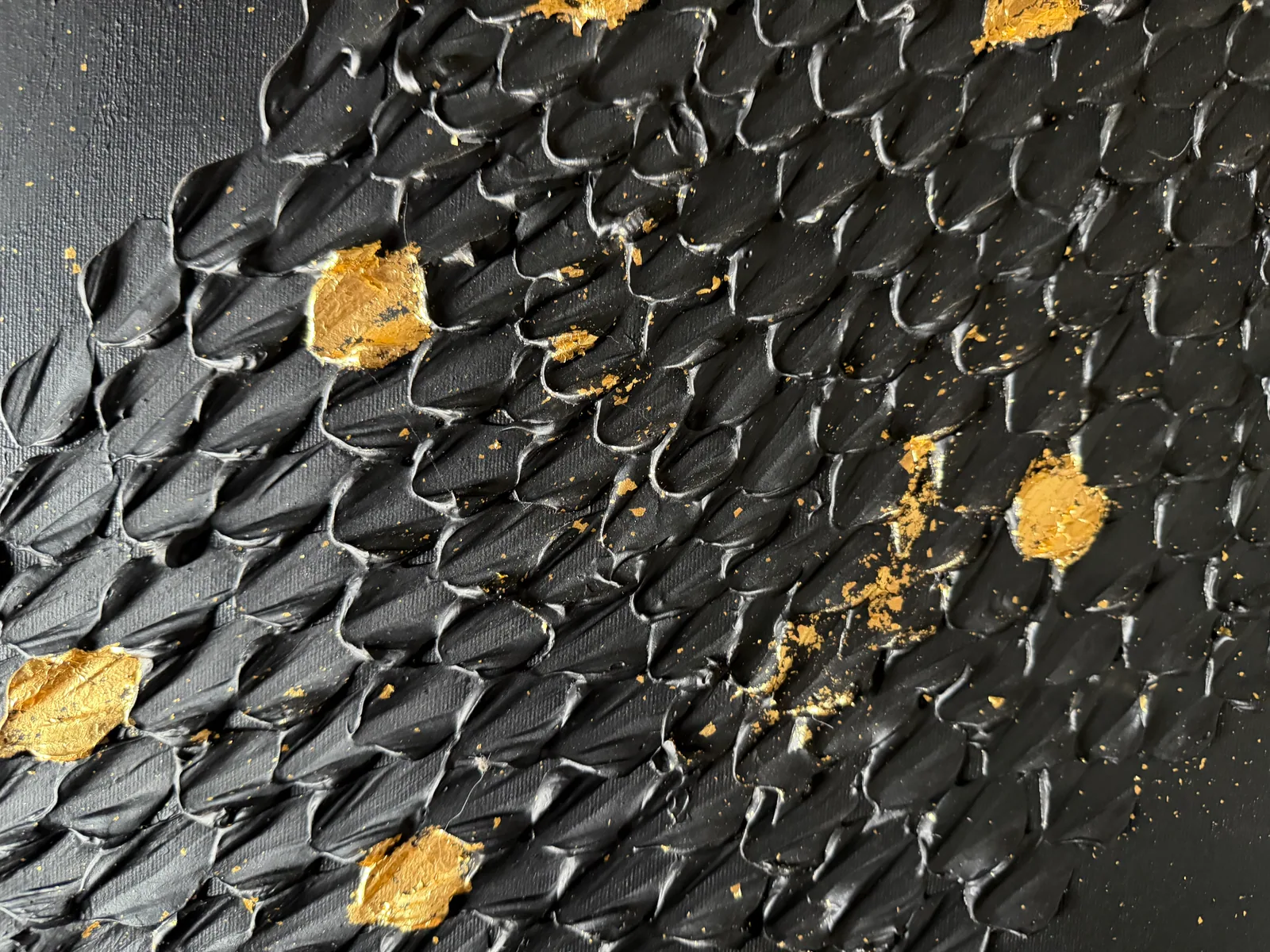
Golden Passage — the piece photographed above — carries raised texture paste under fragments of gold leaf; the surface changes as you move past it, catching light differently at different angles. That's not a decorative flourish, it's structural to how the work reads. I build several pieces this way, layering texture paste, sculpted relief and metallic pigment specifically because a flat reproduction can't hold what happens when light hits an uneven surface.
I don't say this to talk anyone out of buying a print — a giclée of a piece someone loves is a legitimate, honest purchase within its own category. I say it because when someone tells me they're deciding between a museum print and an original, the real question is usually about what they want on the wall: an image, or an object with a surface. Those are different things to own, and both are fine answers.
Frequently asked
What is the real difference between a museum print and an original painting?
A print is a manufactured reproduction of an image, however good the paper or ink, while an original is the one physical object the artist actually made, with the brushwork, texture and any raised material intact. A print can copy the image faithfully; it cannot copy the surface, and it exists as part of a fixed edition rather than as a single, irreplaceable piece.
Does a giclée print of a famous painting hold or gain value?
Only within the defined market for signed, numbered editions from recognized publishers, where prints and multiples made up 12% of dealer sales in 2025 according to the Art Basel & UBS Global Art Market Report 2026. An unlicensed or open-edition poster of a public-domain image sits outside that market entirely; it functions as decoration, not as a traded collectible, because it has no scarcity, publisher, or documented edition behind it.
Is a numbered/limited print reproduction worth more than an unlimited poster?
Generally yes, because scarcity and documentation are what give a reproduction any collectible standing at all. A numbered, signed, limited-run print from a recognized publisher has a defined edition size and a paper trail; an open-edition poster can be reprinted indefinitely with no publisher guarantee of rarity. Neither compares to an original, which has an edition of exactly one by definition.
Why do original contemporary paintings often cost less than a famous print edition?
Because a print of a famous name carries licensing fees paid to the museum or estate, plus a publisher's production and distribution costs, stacked on top of the paper itself. An original by an artist still building a market carries none of that overhead — its price reflects materials, scale and the artist's own current standing, sold directly, without a licensing chain in between.
What should I check before buying a reproduction online?
Ask whether the edition is open or limited, and if limited, request the run size and your print's number. Confirm who published it and under what license, what ink and paper or canvas were used, and whether documentation — a certificate or publisher's label — comes with it separate from the printed sheet. Also confirm the actual printed dimensions before ordering.
Considering an original instead of a print?
Tell us the piece or the surface that caught your eye and we'll walk you through materials, scale, and documentation.
Sources
- Art Basel & UBS, Global Art Market Report 2026 — 2026-08-04
- MyArtBroker, summarizing the Art Basel & UBS Global Art Market Report 2026 — 2026-08-04
- Tate, Art Terms glossary — 2026-08-04
Published on