How much does original art cost?
In this studio's current collection, an original mixed-media or acrylic painting costs between R$ 1,800 and R$ 6,600, priced mainly by size: a small format (~50×70 cm) starts near R$ 1,800, and a very large piece (120×200 cm) reaches R$ 6,600. That range moves with the exchange rate if converted to USD or EUR — and almost no independent artist publishes a real number at all.
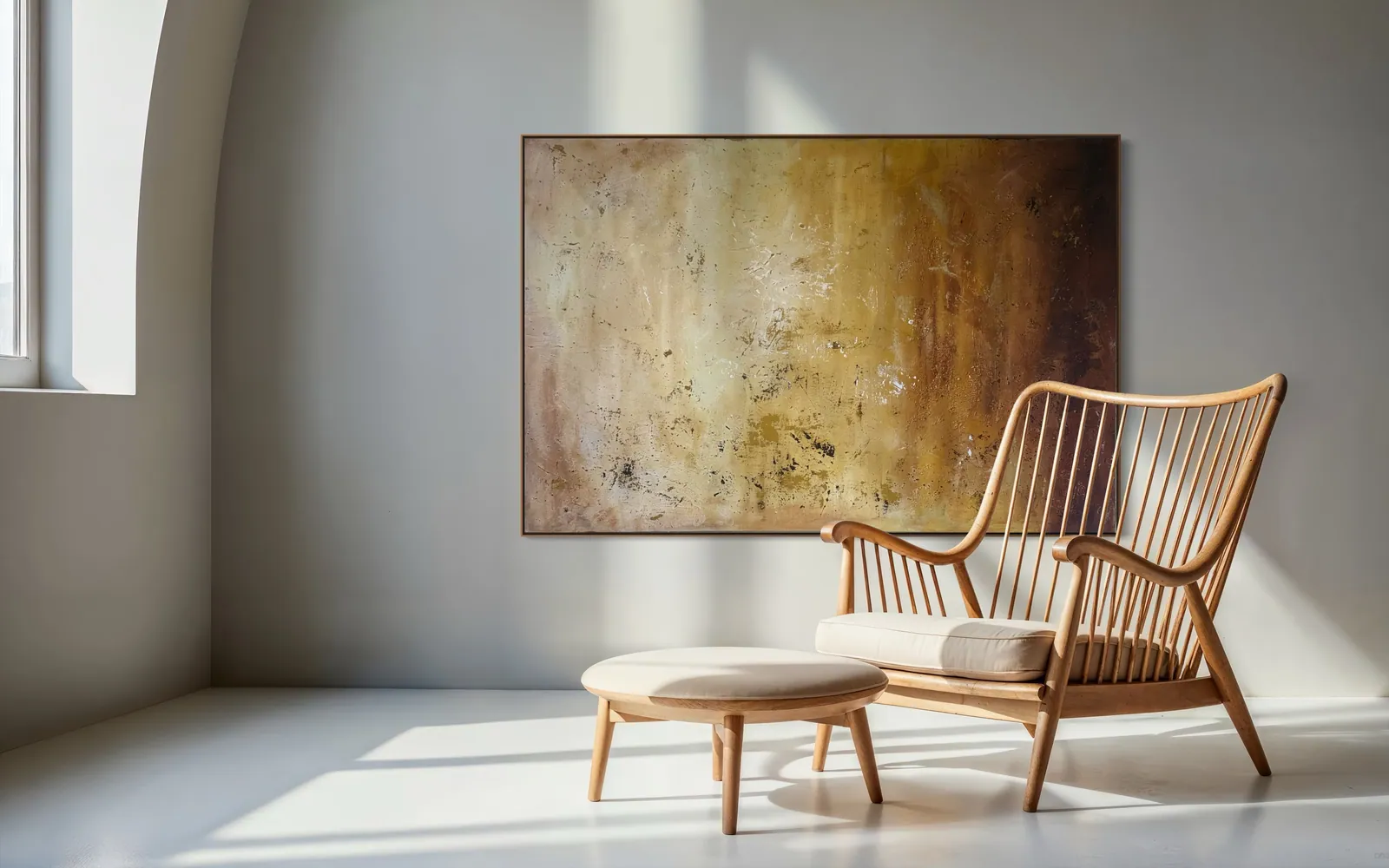
The real price ladder, by size
Across the current collection (18 available works, made in 2025 and 2026), price follows a fairly predictable ladder by format — not a guess, but a calculation by area within each series:
- Small (~50 × 70 cm / 20 × 28 in): from R$ 1,800
- Medium (~70 × 100–110 cm / 28 × 43 in): R$ 2,800 to R$ 3,600
- Large (100 × 150 cm / 39 × 59 in): R$ 4,300 to R$ 4,400
- Very large (120 × 200 cm / 47 × 79 in): up to R$ 6,600
Within each band there is still some variation — two works the same size can differ in price because of layering, technique, or which series they belong to. But size is the first filter for estimating a number before even looking at the specific piece.
The six factors that move the price
Size explains most of the variation, but not all of it. The final price of an original painting usually reflects:
- Size: the dominant factor — a larger canvas means more material and more execution time.
- Technique and layering: works with more layers of paint, texture, or mixed processes take more working sessions than a single-layer piece.
- Artist's trajectory: an established name with a sales history tends to price higher than an artist earlier in her career — that is a market fact, not a statement about the work itself.
- Uniqueness: a one-of-a-kind painting is priced differently from a print or a limited edition.
- Documentation: a certificate of authenticity, work dossier, traceable Archive ID, and acquisition agreement add formal value — it is what supports the piece as an asset, not only as decoration.
- Sales channel: buying direct from the studio or through a gallery changes the final price, as explained below.
Why the same artist costs more in a gallery
A common misunderstanding is thinking a painting's price is fixed regardless of where it is bought. It is not. Commercial galleries typically retain a meaningful commission on the final sale value — that is how the gallery model sustains itself, and it is a legitimate arrangement between artist and gallerist. The exact percentage varies by gallery and by contract; there is no single published market rate.
That means for the artist to receive the same net amount, the public price has to be higher when it passes through that channel. In a direct acquisition from the studio — with no intermediary — the buyer pays the work's value without that mark-up, and the artist receives the full amount. It is a structural difference, not a discount.
What "suspiciously cheap" usually means
A price well below the expected range for a given size and technique usually points to one of two things: (1) the piece is not a unique original — it is a print, reproduction, or edition, not an original painting; or (2) it is missing the documentation that supports the work as a traceable piece — no certificate, no Archive ID, no acquisition agreement, so authenticity and provenance cannot be confirmed later.
This does not mean a low price is a sign of bad faith — early-career artists can honestly price lower. It means it is worth asking, before buying: is this an original or a reproduction? Does it come with documentation? Without those two answers, the number alone does not say much.
From the studio
From the studio
I calculate price per square meter within each series — Heart of Chaos, Matter & Silence, Luminous Rebirth, Black & Gold, Terra & Ether — to keep a coherent ladder between paintings in the same family. It is not a number I pick by glancing at the market and "feeling" what seems fair; it is a calculation I repeat for every new piece, adjusted by size and by how much layering that specific canvas actually took.
I decided to publish the price of every work on the site because almost no studio does that — the standard market answer is "price on request," and that pushes buyers into a negotiation with no reference point before they even ask. I would rather someone considering one of my paintings already know, before we talk, whether that piece is within their range. It saves time on both sides, and it is consistent with everything else I offer: clear documentation, traceable provenance, no fine print.
Frequently asked
What is the price range for original works at Perfeito Studio?
The 18 available works in the current collection range from R$ 1,800 to R$ 6,600, depending mainly on the size of the canvas. The equivalent in USD or EUR moves with the exchange rate on the day of purchase, so prices are always quoted in Brazilian reais.
Are prices negotiable?
Prices are set per work using the size-and-series ladder described above, so they are not adjusted case by case. What can vary is payment structure. If you have a specific budget in mind, it is worth a direct conversation — there may be a work in the collection that already fits it.
Does shipping affect the final cost?
Yes. The published price is for the artwork itself; shipping, insurance, and any import duties or customs fees for international delivery are calculated separately based on destination and are quoted before purchase, not folded into the sticker price.
What is included in the price of a Perfeito Studio painting?
A certificate of authenticity, a work dossier, a conservation guide, a traceable Archive ID, and an acquisition agreement — all included with the piece, at no additional cost.
Is a very low price a warning sign?
It can be. It is worth asking whether the piece is an original (not a print or edition) and whether it comes with provenance documentation. Without both answers, the price alone does not guarantee anything — though an early-career artist can also honestly price lower.
Want the price of a specific work?
Every piece in the collection has a published price and full documentation. Reach out directly to Alyne with questions about a single work or the collection as a whole.
Talk to the studio on WhatsApp
Published on