Art for a waterfront apartment
Salt air, wide humidity swings when the apartment sits closed, and sunlight reflected off the water are the three real risks to a painting near the coast, not the view itself. Acrylic on canvas tolerates humidity swings better than oil, and an interior wall protects it better than the water-facing one.
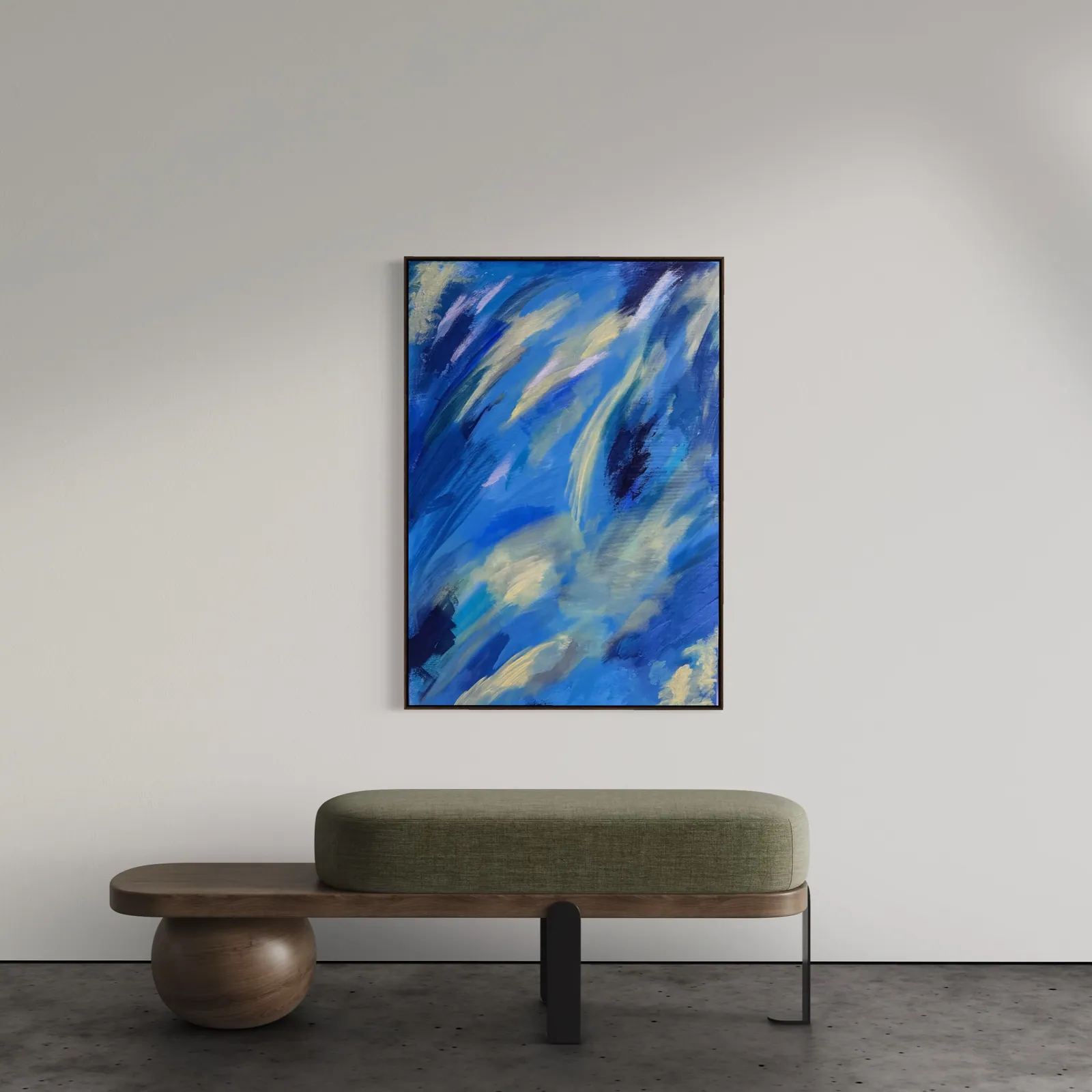
Humidity swings are the real risk, not humidity itself
The conventional advice for paintings is a stable relative humidity of roughly 40–60%, with no more than about 10% variance in any 24-hour period — a range professional paintings conservators recommend because the swing does the damage, not any single number. The Canadian Conservation Institute (CCI) has documented that relative-humidity fluctuations larger than 10% create internal stress in a paint film that can eventually cause cracking, and that oil paint specifically becomes brittle and starts to crack once relative humidity drops below 35%.
A waterfront apartment produces exactly this kind of swing, often without anyone noticing. Sea air keeps ambient humidity high while the apartment sits closed for a week, a month, or a season — a second home used only some weekends, with the air conditioning off to save energy. When someone returns and runs the air conditioning hard to cool the space quickly, indoor relative humidity can fall sharply within hours, the reverse of the humid, closed-up period that came before it. It is this back-and-forth, more than the coastal address by itself, that stresses a painting over time.
Here the medium matters. CCI's own notes on painting materials state that acrylic paint forms a more flexible film than oil paint and seems less prone to cracking under these conditions. Nearly every current Perfeito Studio work that suits this scenario, Celestial Drift among them, is acrylic on canvas or acrylic-based mixed media — one practical reason acrylic tends to be the more forgiving choice for a home that will not always be climate-controlled.
Salt air corrodes the frame and the hardware before it reaches the canvas
Salt does not attack a paint film directly the way it attacks metal. CCI's own comparative test on relative humidity and corrosion is the clearest demonstration available: a clean iron key held at 85% relative humidity developed only light corrosion after 18 days, while an identical key contaminated with salt and dust — simulating a polluted, coastal atmosphere — showed visible corrosion spots after a single day. High humidity alone corrodes metal slowly; high humidity combined with salt corrodes it far faster.
In a painting, the metal at risk is not the canvas but everything holding it to the wall — the D-rings, the hanging wire, staples inside the frame, and any exposed hardware on a metal frame profile. Balcony doors left open for cross-ventilation, and air conditioning units that draw in outside air, both give salt-laden air a direct path to that hardware. The practical response is ordinary rather than exotic: stainless-steel or powder-coated hanging hardware, a sealed dust cover on the back of the frame, and avoiding raw, untreated metal frame profiles. It matters more in a waterfront unit than it would inland.
Reflected light off the water changes how much exposure the painting gets
A wall of glass facing water does something an ordinary window does not: it bounces additional sunlight into the room off the water's surface, on top of whatever comes through the glass directly. Conservation lighting guidelines, such as those published by the Conservation Center for Art & Historic Artifacts (CCAHA), place paintings — including oil paintings — in a "less sensitive" category with a recommended maximum of around 150 lux, well above the roughly 50 lux ceiling set for works on paper or textiles, but still a real ceiling rather than an open one. The same guidelines cap ultraviolet radiation at 75 microwatts per lumen, with 0–10 microwatts per lumen considered ideal.
Nobody measures lux in a private living room, and the general point holds without a meter: a painting hung on the wall directly facing a water view, especially one with strong, unobstructed afternoon sun, accumulates more light over the years than the same piece on an adjacent or interior wall. UV-filtering film applied to the water-facing glass reduces the ultraviolet component specifically, and curtains or shades drawn during the brightest hours reduce total exposure without asking anyone to give up the view permanently.
Where to hang it, and what to do when the apartment sits empty
Given the two risks above, the wall that usually works best in a waterfront apartment is an interior one — perpendicular to or facing away from the water-facing glass, close enough to be part of the room, far enough from the direct light path and from balcony doors that let salt air in. It is also, in practice, usually the wall with the most stable temperature, since it is not backed by exterior glass that heats and cools with direct sun.
For a property used seasonally or left closed for extended periods, the safer setting is a low, continuous level of air conditioning or dehumidification rather than switching the system off completely and running it hard on return. This follows directly from the fluctuation principle above: a steady, moderate environment stresses a painting less than an extreme swing, even when that steady environment is not the exact midpoint of the ideal range.
From the studio
From the studio
Before a piece leaves for a client's apartment, I ask about the wall before I ask about the wall color — which one, whether it faces the water, and what the light does to that room at four in the afternoon. I trained as an architect before I trained as a painter, and I have never been able to think of a painting as separate from the volume of space and the light path around it; a wall by the water is never a neutral wall.
Most of my work is acrylic on canvas, sometimes built up with texture paste or metallic fragments over that acrylic base, and I think of that as a practical decision as much as an aesthetic one — it is a paint that keeps its flexibility through the kind of swings a home by the water goes through, closed for weeks and opened again. When a collector tells me a piece is going somewhere coastal, that is usually the first thing we talk about, before framing or delivery dates.
Frequently asked
Will living near the water damage a painting, just from the ocean view itself?
Not directly — a water view is not a hazard on its own. What comes with it is what matters: salt-laden air that can corrode metal hanging hardware over time, humidity that swings widely when the apartment is closed and reopened, and, on a water-facing wall, more reflected sunlight than an equivalent inland room gets. All three are manageable with placement and basic hardware choices; none require avoiding a coastal apartment as a home for original art.
Is acrylic really more resistant than oil paint in this environment, or is that just a sales line?
It is a documented property, not a sales claim. The Canadian Conservation Institute's own notes on painting materials state that acrylic paint forms a more flexible film than oil paint and is less prone to cracking, while oil paint specifically becomes brittle and can crack once relative humidity drops below 35%. That does not make acrylic invulnerable to every condition, but for the humidity swings typical of a part-time coastal home, the more flexible acrylic film has a real, documented advantage.
Do I need UV-filtering glass or a special frame to protect the piece?
Not strictly, but it helps on a water-facing wall. Conservation guidelines cap ultraviolet exposure at 75 microwatts per lumen for displayed artwork, with under 10 considered ideal, and reflected light off water adds real cumulative exposure over years. A UV-filtering film on the window itself, rather than on the painting's frame, protects the whole room and is usually the simpler fix — most works in this collection are not shown behind glass, so filtering the light source is more practical than filtering the artwork.
What should happen to the air conditioning when the apartment is closed for weeks or months?
Leave it running at a low, steady setting rather than switching it off completely. The damage to a painting comes less from any single humidity level and more from a large swing between a humid, closed-up apartment and air conditioning run hard on return. A steady, moderate setting avoids that swing, even when it is not the exact center of the 40 to 60 percent range conservators recommend.
Where in the apartment should the painting actually hang?
An interior wall, rather than the wall facing the water directly, usually works best. It receives less direct and reflected sunlight, sits further from balcony doors or windows that let salt air in, and tends to have a more stable temperature than a wall backed by exterior glass. In most open-plan apartments the view is still visible from that wall — the painting simply is not competing with it for the same light.
Ask about a piece for a water-facing wall
Tell Alyne which wall you're thinking of, and whether it faces the water — she'll suggest a size and a piece suited to the room, and answer any question about framing or care.
Sources
Published on