Journal · Exhibitions & museums
What to see at the Art Institute of Chicago
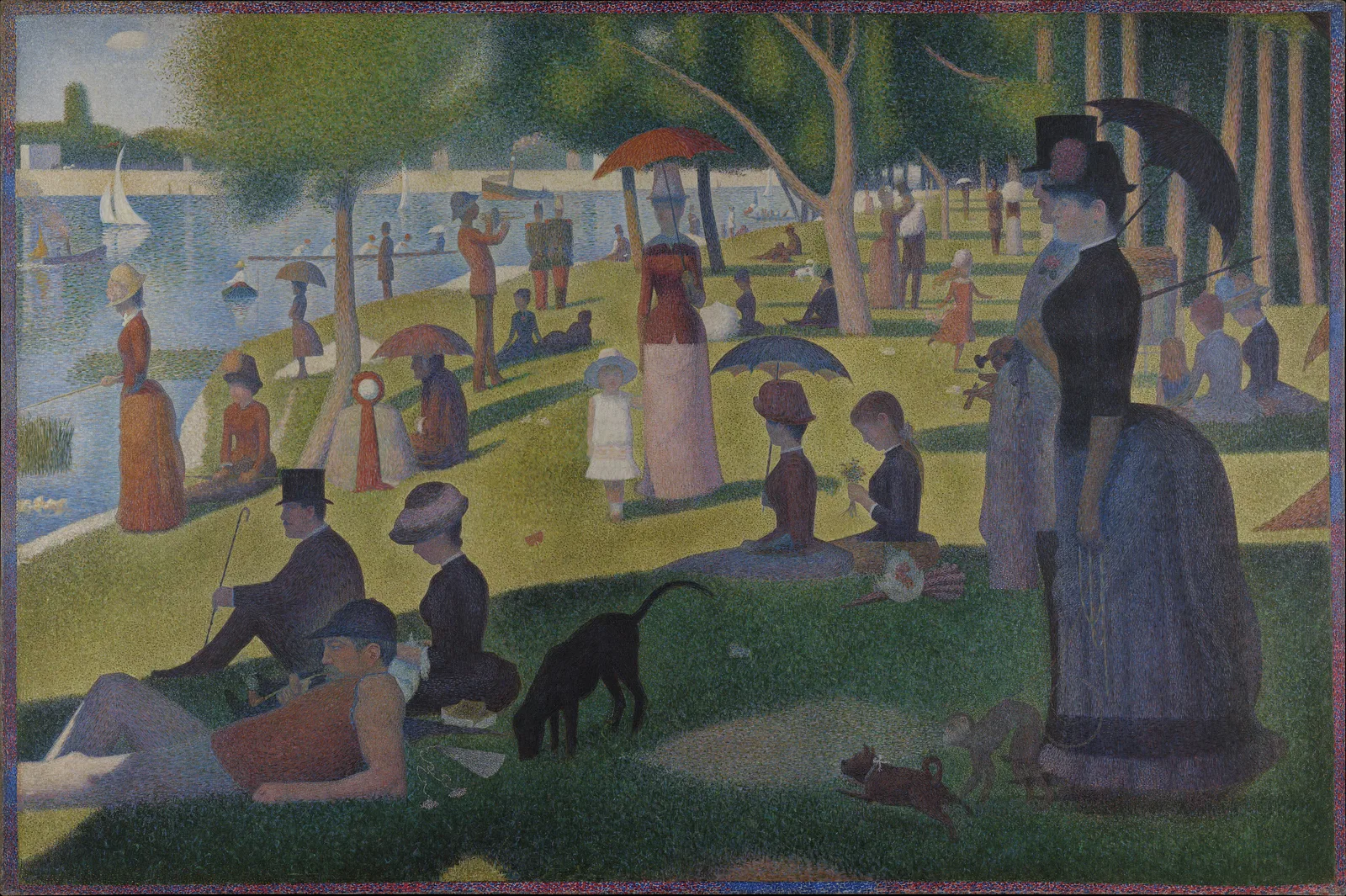
The Art Institute of Chicago's collection is too large to see in one visit, so start with four works: A Sunday on La Grande Jatte (Seurat), Nighthawks (Hopper), American Gothic (Grant Wood), and The Old Guitarist (Picasso) — together they cover Post-Impressionism, American Regionalism, and the Blue Period in a single morning.
The works that define the collection, and what to look at in each
Three paintings anchor the Art Institute's reputation, each for a different reason. American Gothic (1930), Grant Wood's portrait of a farmer and his daughter in front of a Gothic Revival house, is in the Art Institute's collection and rewards a close look at the pitchfork's tines, echoed in the stitching of the man's overalls and the window behind them — the repetition is what turns a simple portrait into a study of rural American severity.
Nighthawks (1942), Edward Hopper's late-night diner scene, is built almost entirely on artificial light: the fluorescent glow inside the diner has no warmth, and the street outside is darker than it would be under real streetlamps. Look at how the counter and the wedge-shaped building isolate the three customers from each other despite sitting a few feet apart.
The Old Guitarist (late 1903-early 1904), from Pablo Picasso's Blue Period, is in the Art Institute's collection painted almost entirely in blue-green tones, with the guitarist's bent frame folding into the shape of the instrument itself. Under raking light, an earlier composition — a woman and child — is faintly visible beneath the surface, since Picasso reused the canvas out of necessity.
Seurat's La Grande Jatte: pointillism seen from two distances
A Sunday on La Grande Jatte (1884-86, with a border added in 1888-89), Georges Seurat's monumental park scene, is the single best in-person lesson in the collection about how painting actually works. Up close, the canvas dissolves into thousands of individual dots of pure, unmixed color — orange next to blue, yellow next to violet — applied with a discipline that took Seurat roughly two years to complete on a canvas over three meters wide.
Step back several meters and the dots resolve into a specific Sunday afternoon: a woman with a monkey on a leash, a couple strolling in silhouette, a girl in a white dress catching the light. The painting only works as a whole from a distance most visitors don't bother to find — moving between close and far is the point, and it's a rare case where the physical act of walking toward and away from a canvas is part of understanding it.
The Impressionist and Post-Impressionist holdings
The Art Institute holds one of the largest groups of Impressionist and Post-Impressionist paintings outside France, and three works make the case. Paris Street; Rainy Day (1877), Gustave Caillebotte's large view of a rain-slicked Parisian intersection, uses a photographic sense of perspective rare for the period — the cobblestones and the umbrellas are cropped at the edges as if caught mid-frame, not composed in the studio.
Stacks of Wheat (End of Summer) (1890-91) is one of Claude Monet's grainstack paintings, part of a series in which he painted the same haystacks at different hours and seasons to track how light alone changes a subject. And The Bedroom (1889), Vincent van Gogh's view of his own room in Arles, uses tilted perspective and flat, saturated color deliberately — Van Gogh wrote that he wanted the simplified lines to suggest rest, even though the room itself is slightly off-kilter in every direction.
What most visitors walk past
Visitors moving quickly toward the Impressionist galleries tend to miss two very different parts of the museum. The Thorne Miniature Rooms, a set of dozens of rooms built at one-inch-to-one-foot scale, recreate interiors from centuries of European and American design in obsessive detail — down to functioning miniature hardware — and take only a few minutes to walk past, though they reward much longer.
The architecture and design collection is easy to skip entirely, which is a mismatch for a museum in the city that invented the skyscraper: Chicago's Home Insurance Building (1885) is generally credited as the first, and the Art Institute's holdings of architectural drawings and models trace that lineage directly. Two later 20th-century works round out what gets overlooked: Nightlife (1943), Archibald Motley's electric view of a Bronzeville nightclub, and America Windows (1977), Marc Chagall's stained-glass tribute to Chicago and to artistic freedom, tucked in a corridor that many visitors pass without stopping.
From the studio
What I look at in the Art Institute's collection, as a painter
I have never stood in front of these paintings myself, but La Grande Jatte describes something I think about on every canvas I paint: distance changes what a painting is. I work in layers and texture — some areas built up thick, some left almost bare — and Seurat's dots are the most extreme version of that idea taken to its logical end. A painting is not a fixed object; it is a relationship between the mark and the distance from which it is seen, and that relationship is exactly what I'm deciding when I choose the scale of a canvas for a specific wall.
That's a practical question as much as an aesthetic one. A large work meant to be seen from across a room needs different handling than a small one meant to be seen up close, and getting that wrong is one of the most common mistakes in how people commission or place a painting. Seurat built an entire method around that single fact — it's worth remembering before deciding where a canvas will hang.
Frequently asked
What are the most important works at the Art Institute of Chicago?
<p>Among the most cited are <strong>A Sunday on La Grande Jatte</strong> (Seurat), <strong>Nighthawks</strong> (Hopper), <strong>American Gothic</strong> (Grant Wood), and <strong>The Old Guitarist</strong> (Picasso) — four works from different periods and departments that together give a strong sample of the collection.</p>
Does the Art Institute of Chicago have paintings by Van Gogh?
<p>Yes. The collection includes <em>The Bedroom</em> (1889), Van Gogh's view of his own room in Arles, among other works by the artist.</p>
Why is A Sunday on La Grande Jatte considered so important?
<p>It is the defining example of pointillism, built entirely from small dots of pure color that only resolve into a coherent scene when viewed from a distance — a technique Georges Seurat spent roughly two years developing on this single canvas.</p>
What do most visitors miss at the Art Institute?
<p>The Thorne Miniature Rooms and the architecture and design collection are frequently skipped in favor of the Impressionist galleries, along with later 20th-century works like Archibald Motley's <em>Nightlife</em> and Marc Chagall's <em>America Windows</em>.</p>
Is American Gothic really at the Art Institute of Chicago?
<p>Yes. Grant Wood's <em>American Gothic</em> (1930) is in the Art Institute's collection and is one of the most recognized paintings in American art.</p>
Sources
- Art Institute of Chicago — 2026-07-26
- Art Institute of Chicago — 2026-07-26
- Art Institute of Chicago — 2026-07-26
- Art Institute of Chicago — 2026-07-26
- Art Institute of Chicago — 2026-07-26
- Art Institute of Chicago — 2026-07-26
- Art Institute of Chicago — 2026-07-26
- Art Institute of Chicago — 2026-07-26
- Art Institute of Chicago — 2026-07-26
- Art Institute of Chicago — 2026-07-26
Planning your visit to the Art Institute of Chicago?
If any of these works shaped how you see paintings, talk to the atelier about the pieces in the Perfeito Studio collection.
Talk to the studio on WhatsApp
Published on