Journal · Exhibitions & museums
MoMA or the Whitney: which to visit in New York
MoMA collects modern and contemporary art internationally, across six departments and roughly 200,000 works. The Whitney collects only American art, describing itself as the only museum dedicated to American art and artists. Choose MoMA for the widest survey of world art movements; choose the Whitney for depth in American painting, from Edward Hopper to today.
What each museum actually collects
MoMA was founded in 1929 by three progressive patrons of the arts -- Lillie P. Bliss, Mary Quinn Sullivan, and Abby Aldrich Rockefeller -- as an institution the museum itself describes today as "a catalyst for experimentation, learning, and creativity, a gathering place for all, and a home for artists and their ideas." Today it holds roughly 200,000 works across six curatorial departments: Painting & Sculpture, Drawings & Prints, Photography, Film, Media & Performance, and Architecture & Design. The scope is explicitly international -- artists from anywhere are eligible, and the collection is organized by medium and movement, not by nationality.
The Whitney is built on a narrower, more specific premise. Sculptor and collector Gertrude Vanderbilt Whitney founded it in 1930 after the Metropolitan Museum declined her offer of contemporary American works; the museum describes itself, in its own words, as "the only museum dedicated to American art and artists." Its collection runs to more than 27,000 works by more than 4,100 artists, spanning the early twentieth century to today -- all of it American.
The same generation, read two different ways
Neither museum publishes a public tally of how many Abstract Expressionist works it holds, so a precise numeric comparison is not something either institution supports. What differs is framing, not necessarily depth. MoMA's collection includes some of the movement's most internationally recognized single paintings: Jackson Pollock's One: Number 31, 1950, acquired in 1968, and Willem de Kooning's Woman I (1950-52), acquired in 1953 -- both shown as part of a global survey running from Post-Impressionism through Cubism to Pop and beyond.
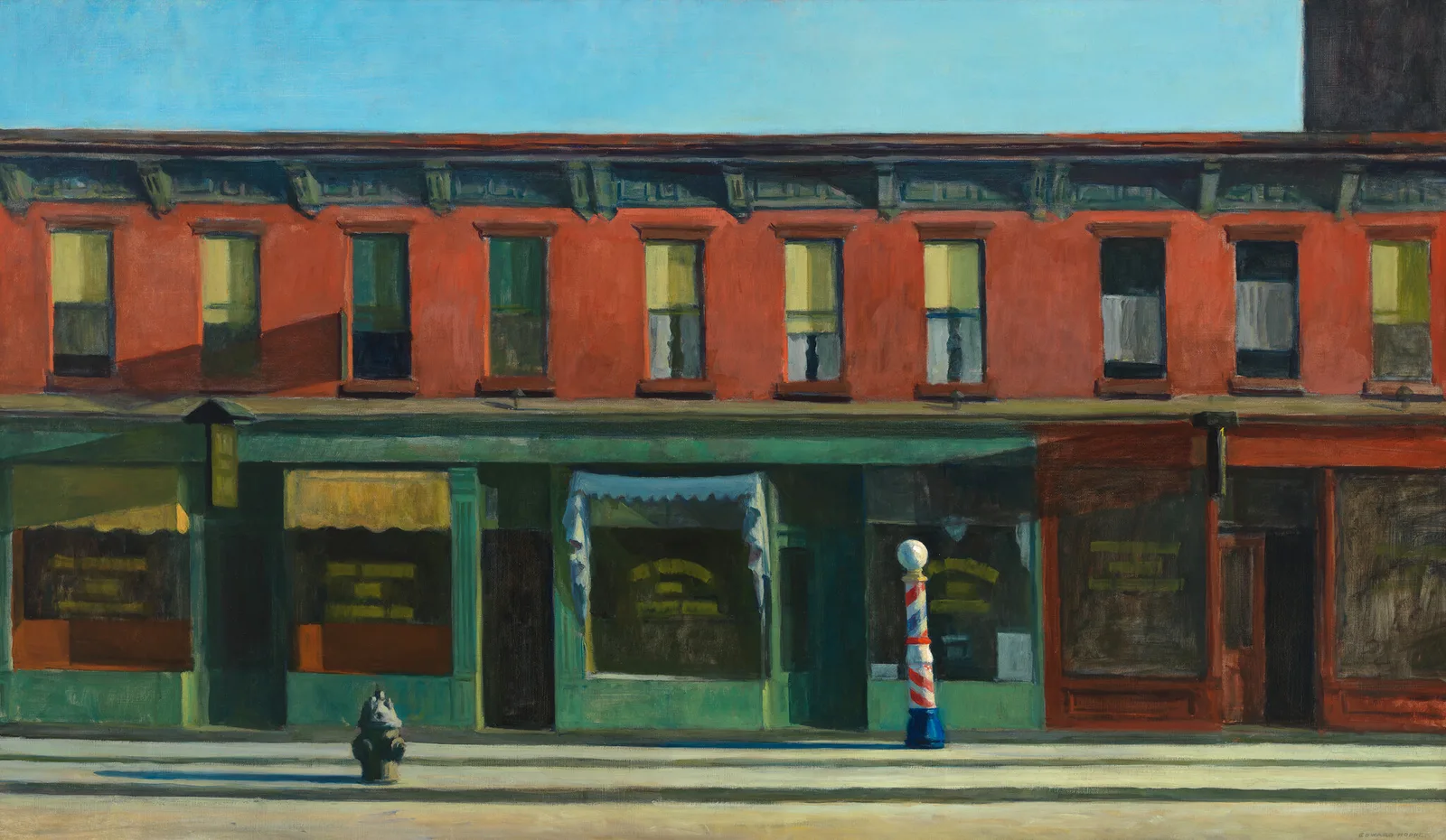
The Whitney holds the same American generation but as one chapter in an all-American chronology rather than a chapter in world art. Its collection reaches back further into American realism -- Edward Hopper's Early Sunday Morning (1930), the painting on this page, entered the collection just months after Hopper finished it, bought with funds from Gertrude Vanderbilt Whitney herself. At the Whitney, Abstract Expressionism sits alongside Hopper, Georgia O'Keeffe, and the American realists who came before it, rather than beside European and Latin American modernists.
The Whitney's building is part of what you're visiting
The Whitney moved into its current home, designed by Renzo Piano, on May 1, 2015. The building sits on Gansevoort Street between the High Line and the Hudson River, in the Meatpacking District -- a nine-story structure with tiered terraces that step back toward the Hudson River as the building rises. It holds roughly 50,000 square feet of bright, double-height galleries with views over the river, plus outdoor terraces used as exhibition space in their own right, something MoMA's Midtown building does not offer at the same scale.
That difference matters for how a visit feels, not just where you stand. A gallery wall interrupted by a window onto the Hudson, or a sculpture placed on an open-air terrace, changes how a work reads compared with a sealed interior room -- and it is one more reason the Whitney rewards unhurried time rather than a quick pass between two stops on a busy day.
How to choose, and whether to do both
If this is a first visit to New York and the goal is the broadest possible survey of modern and contemporary art -- painting through film, design, and photography, from artists working anywhere in the world -- MoMA is the better use of limited time.
If the interest is specifically American art -- its own separate lineage from Hopper's realism through Abstract Expressionism to the artists shown in each Whitney Biennial, a survey of recent American art the museum has organized since 1932 -- the Whitney holds the deeper, more focused collection on that exact subject, in a building built for it.
Doing both in the same trip is realistic if they get separate blocks of time. MoMA sits in Midtown at 11 West 53 Street; the Whitney is well downtown in the Meatpacking District at 99 Gansevoort Street. The two addresses are in different neighborhoods, not within a comfortable walk of one another -- a subway ride or a taxi connects them more sensibly than a stroll, so treat them as two separate outings rather than one rushed day.
From the studio
From the studio
I trained as an architect, so the Whitney's building argues with me before I even reach the paintings. Renzo Piano gave it stepped terraces and double-height galleries that open onto real daylight off the Hudson, which means a canvas can sit near a window instead of inside a sealed white box -- the wall itself becomes part of the composition, the way a shift in natural light changes a room over the course of an afternoon. MoMA's galleries, by contrast, are built for consistency: even, controlled light that treats every work the same way regardless of hour or season, which suits a collection meant to represent a hundred and fifty years of art on equal footing.
It is close to a decision I make at a much smaller scale in my own studio. A large piece from Terra & Ether, built up in layers that catch light differently depending on the angle it falls from, behaves one way under a gallery's flat fluorescent wash and another way entirely near a window at the end of the day. Neither approach is wrong -- but knowing which kind of light a piece was made for changes where it belongs in a room, and that is as true of a Hopper hung near the Hudson as it is of a canvas from my own studio.
Frequently asked
What's the difference in focus between MoMA and the Whitney?
MoMA collects modern and contemporary art internationally, across six departments including painting, photography, film, and design, with roughly 200,000 works by artists from around the world. The Whitney collects only American art -- it describes itself as the only museum dedicated to American art and artists -- with more than 27,000 works by more than 4,100 artists working in the 20th and 21st centuries. One is a global survey; the other is a single-country deep dive.
Which museum is better for contemporary American artists?
The Whitney, because its entire collecting mandate is American art and its exhibition program is built around it, including the Whitney Biennial, a survey of recent American art the museum has organized since 1932. MoMA also collects living American artists, but as one part of an international program spanning painting, film, design, and photography from around the world, not as a dedicated focus.
Can you visit both in one day in New York?
It is possible but not comfortable. MoMA sits in Midtown at 11 West 53 Street; the Whitney is downtown in the Meatpacking District at 99 Gansevoort Street. The two neighborhoods are not within an easy walk of each other, so getting from one to the other means a subway ride or a taxi, not a stroll. Most visitors get more out of giving each museum its own block of time rather than rushing between them.
Which museum has more abstract expressionist works?
Neither museum publishes a public count to compare, so treat any specific number with caution. What differs is framing: MoMA holds some of the movement's most recognized single paintings, including Jackson Pollock's One: Number 31, 1950 and Willem de Kooning's Woman I, shown as part of a global survey of modern art. The Whitney holds the same generation of American painters as a chapter of its all-American collection, alongside earlier realists like Edward Hopper.
Are the two museums within walking distance?
Not in a way most visitors would call comfortable. MoMA is in Midtown Manhattan and the Whitney is well downtown in the Meatpacking District, in different neighborhoods separated by a significant stretch of the city. Combining them in one visit works better by subway than on foot.
Does the Whitney only show contemporary art?
No. Its collection runs from the early 20th century to today, including Edward Hopper's Early Sunday Morning (1930), acquired within months of the museum's founding era. Contemporary programming like the Whitney Biennial gets more public attention, but the permanent collection covers the full span of American art the museum was founded to preserve, not only current work.
Sources
- The Museum of Modern Art (official press fact sheet) — 2026-08-13
- The Museum of Modern Art — 2026-08-13
- The Museum of Modern Art (Archives, Library, and Research Collections) — 2026-08-13
- The Museum of Modern Art — 2026-08-13
- The Museum of Modern Art — 2026-08-13
- Whitney Museum of American Art — 2026-08-13
- Whitney Museum of American Art — 2026-08-13
- Whitney Museum of American Art — 2026-08-13
- Whitney Museum of American Art — 2026-08-13
- Whitney Museum of American Art — 2026-08-13
- Whitney Museum of American Art — 2026-08-13
- Fondazione Renzo Piano — 2026-08-13
- Wikimedia Commons — 2026-08-13
Choosing between MoMA and the Whitney?
If Hopper's American realism, or the question of a global collection versus a single-country one, stayed with you, the studio is happy to talk through the pieces in the Perfeito Studio collection.
Talk to the studio on WhatsApp
Published on