Journal · Exhibitions & museums
MoMA or the Guggenheim: which one to visit in New York
MoMA holds the broader collection -- painting, sculpture, photography, film, and design spanning from roughly the 1880s to today. The Guggenheim holds fewer works, but the building is part of the experience. If breadth is what you want, choose MoMA; if you want a building to change how you see the art, choose the Guggenheim.
What each collection actually covers
MoMA collects modern and contemporary art from roughly the 1880s to the present, across six curatorial departments: painting and sculpture, drawings and prints, photography, film, media and performance, and architecture and design. That range is unusual for an art museum -- most institutions this size stop at painting and sculpture, but MoMA has run a design department since 1932 and a full public film program from its own archive, alongside one of the world's most important photography collections. It is, by scope, the wider of the two.
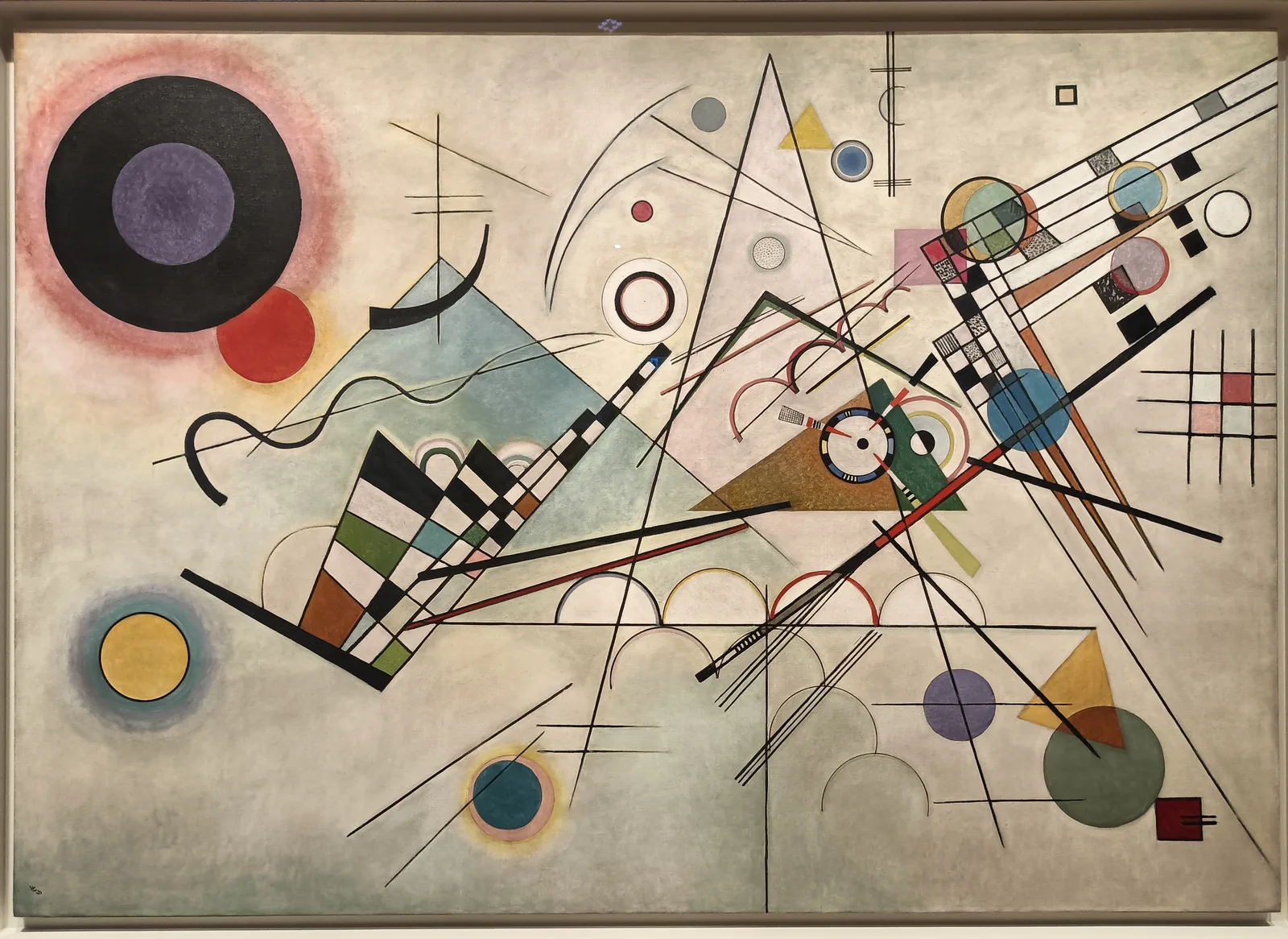
The Guggenheim's collection is narrower and more specific. It grew out of Solomon Guggenheim's own collecting, which turned decisively toward European abstraction after he visited Wassily Kandinsky's studio in Dessau in 1928. Kandinsky's Composition 8, purchased in 1930, was the first of what is now more than 150 works by the artist in the museum's collection -- one of the largest holdings of Kandinsky anywhere, alongside the Centre Pompidou in Paris and the Lenbachhaus in Munich. The Guggenheim has since broadened into contemporary programming, but the core of its permanent holdings still centers on that early-twentieth-century lineage of abstract painting.
The Guggenheim's building as the argument
The Solomon R. Guggenheim Museum opened on Fifth Avenue on October 21, 1959, six months after its architect, Frank Lloyd Wright, died. Wright spent sixteen years on the design and produced hundreds of sketches before settling on a single continuous ramp that spirals upward around an open central well, lit from a glass dome overhead. There are no separate rooms in the usual sense: the building is one uninterrupted, gently rising path, and the curved wall along it leans slightly outward rather than standing flat and vertical the way a conventional gallery wall does.
That decision changes how paintings are seen, not just where they hang. Because the wall leans and the floor slopes, a visitor is rarely standing square in front of a canvas the way a flat white-cube gallery -- like most of MoMA's -- is built to allow. Works are also encountered in a fixed sequence set by the ramp's direction, rather than in the free room-to-room wandering a conventional museum layout permits. At the Guggenheim, in other words, the architecture is not a neutral container for the art; it is part of what the visit is about.
How to choose, by what you care about
If this is a first visit to New York and the goal is the widest possible survey of modern art under one roof -- painting through film, design, and photography -- MoMA is the better use of the time; its breadth of departments has no equivalent at the Guggenheim.
If the pull is toward architecture as much as painting, and toward experiencing a building that changes how art is viewed, the Guggenheim is the more memorable stop, whatever else is on the itinerary.
If the specific interest is the history of abstraction -- Kandinsky above all, along with the early-twentieth-century European painters who shaped non-objective art -- the Guggenheim holds the deeper collection on that exact subject.
If design, industrial objects, or the history of film matter as much as painting, MoMA is the only one of the two with dedicated departments for either.
Doing both in one day
Both museums sit close enough to Central Park that combining them in one day is realistic. MoMA is in Midtown, a few blocks south of the park's southeast corner; the Guggenheim sits directly on the park's edge further north, on the stretch of Fifth Avenue known as Museum Mile. A common pattern is to start with the broader collection at MoMA, then walk or take a short ride north along the park to the Guggenheim, treating the building itself as the close of the day rather than another stop among many.
The order matters less than the proximity: neither museum has to be cut from a short New York itinerary because of distance. What each visit needs is unhurried time in front of the work, not a race between two addresses.
From the studio
From the studio
I trained as an architect before I trained as a painter, so I read the Guggenheim's ramp before I get to the paintings hanging on it. Wright's design means a visitor is almost never standing directly square to a canvas the way you would in a conventional gallery: the wall leans outward as it rises, the floor itself carries a slope, and most works are approached at a slight angle, mid-stride, on the way past rather than head-on. For Kandinsky's compositions specifically, that reads as a strength rather than a flaw -- his geometric forms already imply rotation and movement, and meeting them from a body in motion on a curved ramp is not a bad match for paintings built on tension between line and curve.
But it is also the honest case against the building: any painting made to be studied dead-on, at a fixed distance, on a flat vertical wall, loses something on Wright's ramp. That is the trade a museum makes when it lets architecture take equal billing with the work inside it -- and it is close to a decision I make at a much smaller scale in my own studio, choosing whether a piece is meant to be met straight-on or discovered at an angle as someone moves through a room.
Frequently asked
Should I visit MoMA or the Guggenheim first in New York?
<p>Either order works. Some visitors prefer MoMA first, since its collection covers a wider span of modern art and sets context; others prefer the Guggenheim first, arguing the building is easier to appreciate before fatigue sets in. Neither order changes what each museum actually offers.</p>
Does the Guggenheim really hold that many Kandinsky paintings?
<p>Yes. The collection includes more than 150 works by Wassily Kandinsky, beginning with <em>Composition 8</em> (1923), which Solomon Guggenheim purchased in 1930 after visiting the artist's studio in Dessau -- one of the largest public holdings of Kandinsky's work anywhere.</p>
Is the Guggenheim's building really worth the visit on its own?
<p>For most visitors, yes. Frank Lloyd Wright's continuous spiral ramp, completed in 1959, is widely considered one of the twentieth century's most significant works of museum architecture, and it changes the physical experience of looking at art -- not just the setting around it.</p>
Can I see MoMA and the Guggenheim in the same day?
<p>Yes. Both sit close to Central Park -- MoMA a few blocks south of it in Midtown, the Guggenheim directly on its edge further uptown -- which makes combining the two in a single day a realistic plan for most visitors.</p>
Does MoMA only show temporary exhibitions?
<p>No. MoMA holds a large permanent collection spanning roughly the 1880s to the present, across painting and sculpture, photography, film, and architecture and design -- the breadth of that standing collection is one of the main reasons visitors choose it over a museum with a narrower focus.</p>
Sources
- MoMA -- Mission Statement — 2026-07-26
- MoMA -- Museum History — 2026-07-26
- The Guggenheim Museums and Foundation -- Kandinsky, Composition 8 — 2026-07-26
- Britannica -- Guggenheim Museum — 2026-07-26
- Wikimedia Commons — 2026-07-26
Choosing between MoMA and the Guggenheim?
If Kandinsky's compositions or the question of architecture and art stayed with you, the studio is happy to talk through the pieces in the Perfeito Studio collection.
Talk to the studio on WhatsApp
Published on