Journal · Exhibitions & museums
The best art museums to visit in Berlin
Berlin's essential art museums are five, mostly gathered on Museum Island: the Altes Museum, Neues Museum, Alte Nationalgalerie and Bode-Museum, plus the Pergamonmuseum, a UNESCO World Heritage ensemble since 1999. Add the Gemäldegalerie for Old Master painting and the Neue Nationalgalerie, Mies van der Rohe's glass pavilion devoted to twentieth-century art.
Museum Island: five museums, one UNESCO ensemble
Museum Island (Museumsinsel) sits on the northern tip of an island in the Spree river, in the historic center of Berlin, and gathers five museums built in stages between 1830 and 1930: the Altes Museum (1830), the Neues Museum (completed 1855), the Alte Nationalgalerie (opened 1876), the Bode-Museum (1904) and the Pergamonmuseum (1930). UNESCO inscribed the ensemble as a World Heritage Site in 1999, recognizing it as a coherent architectural project spanning a full century of museum design under the Prussian state and its successors. Between them, the five museums hold collections running from prehistory and antiquity — Egyptian, Greek, Roman, Byzantine and Near Eastern — through nineteenth-century European painting, so a single walk across the island covers a longer arc of art and material history than most single-city museum districts anywhere.
The Alte Nationalgalerie: Caspar David Friedrich and German Romantic painting
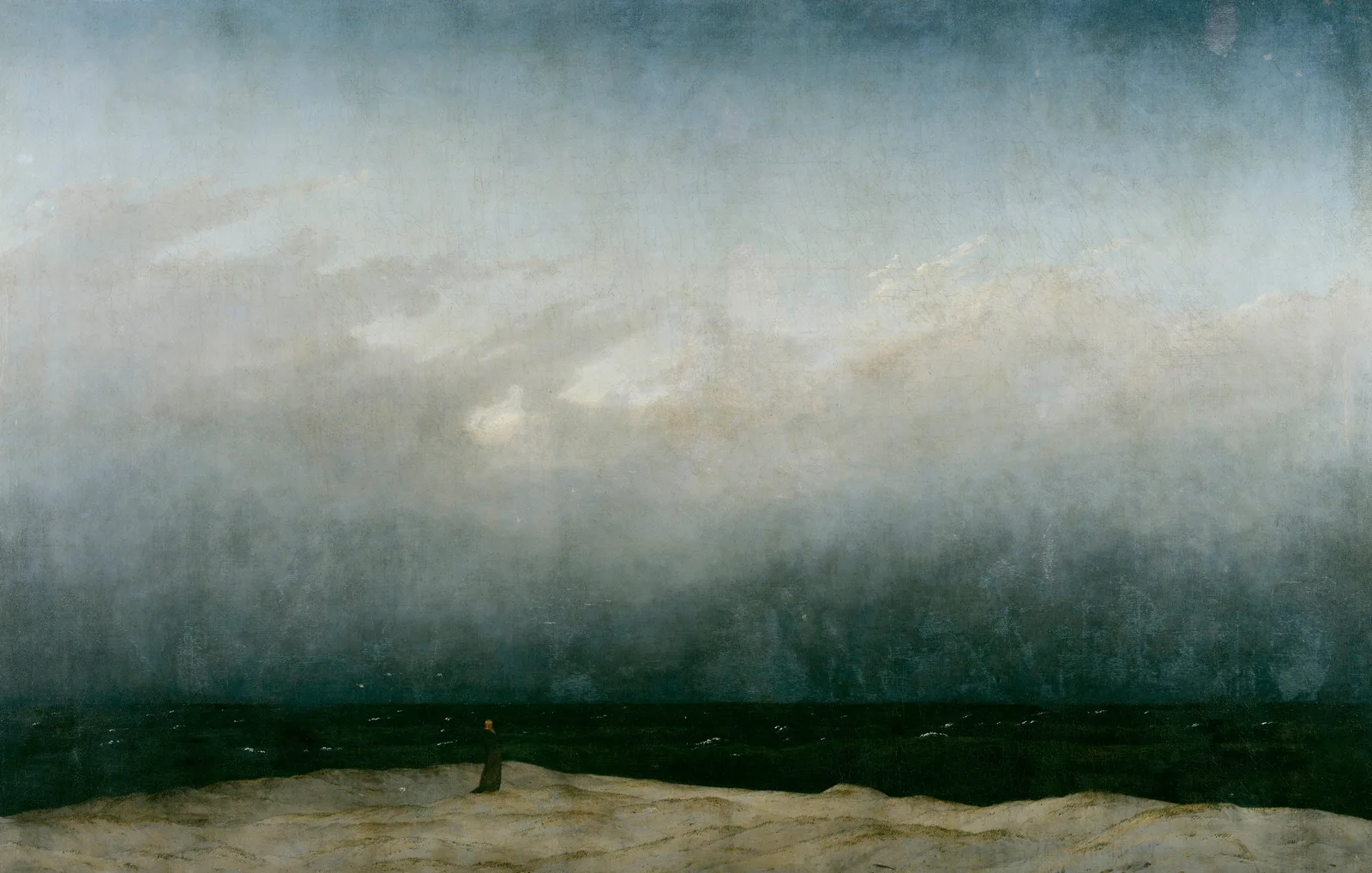
The Alte Nationalgalerie holds Berlin's collection of nineteenth-century painting and sculpture, from Neoclassicism through German Romanticism to early Modernism. The museum was founded in 1861 around a bequest of 262 paintings from banker Johann Heinrich Wilhelm Wagener, and the building itself — designed by Friedrich August Stüler and Johann Heinrich Strack in a Neoclassical, temple-like form with a grand external staircase — opened in 1876. Its holdings of Caspar David Friedrich are among the largest anywhere, including The Monk by the Sea and The Abbey in the Oakwood, and Moonrise by the Sea. The collection also covers Adolph von Menzel, Karl Friedrich Schinkel's paintings (alongside his better-known architecture), and French Impressionism through Monet and Manet — a wider reach than the museum's Romantic reputation alone suggests.
Neues Museum: Egyptian antiquities and the bust of Nefertiti
The Neues Museum houses Berlin's Egyptian Museum and Papyrus Collection, together with the Museum of Pre- and Early History. Its best-known object is the bust of Nefertiti, dated to around 1345 BC and attributed to the sculptor Thutmose. A German archaeological team led by Ludwig Borchardt excavated it at Amarna, Egypt, on 6 December 1912; the bust was shipped to Berlin in 1913 and presented to James Simon, who had sponsored the excavation, before being permanently donated to the Berlin museums in 1920. The building itself has its own history: designed by Friedrich August Stüler and completed in 1855, it was severely damaged in the Second World War and later reconstructed by architect David Chipperfield, reopening in October 2009 with the Nefertiti bust returned as its centerpiece.
Gemäldegalerie: Old Master painting at the Kulturforum
The Gemäldegalerie, at the Kulturforum museum district near Potsdamer Platz, holds one of the world's principal collections of European painting from the thirteenth to the eighteenth century — around 1,250 works on its main display floor, spread across 72 rooms. The collection's roots go back to Prussian state acquisitions beginning in 1815, including the 1821 purchase of 677 paintings from the Edward Solly collection, and it first opened to the public in 1830 inside the Altes Museum on Museum Island. Its current building, completed in 1998 to a design by Munich architects Heinz Hilmer and Christoph Sattler, gives the collection its present home at the Kulturforum. Holdings include Jan van Eyck, Pieter Bruegel the Elder, Albrecht Dürer, Raphael, Titian, Caravaggio, Peter Paul Rubens, Rembrandt van Rijn and Johannes Vermeer — a span of Northern European, Italian, Flemish, Dutch and Spanish painting rarely assembled under one roof outside the Louvre or the Prado.
Neue Nationalgalerie: twentieth-century art inside a modernist landmark
The Neue Nationalgalerie is Berlin's museum of twentieth-century art, and the building is as much the subject as the collection inside it. Designed by Ludwig Mies van der Rohe and opened on 15 September 1968, its upper level is a glass pavilion of roughly 2,683 square meters, held up by eight cruciform steel columns beneath a black steel roof plate 1.8 meters thick that cantilevers 18 meters past its supports — a demonstration of structural minimalism from one of the architects who defined it. The permanent collection sits below, in a hall three-quarters underground with about 10,000 square meters of space. Its holdings run through Cubism, German Expressionism, the Bauhaus and Surrealism, with works by Pablo Picasso, Ernst Ludwig Kirchner, Wassily Kandinsky, Joan Miró and Barnett Newman among the museum's core names.
From the studio
From the studio
I trained as an architect before painting became the studio's full practice, and Mies van der Rohe's Neue Nationalgalerie is a building I keep coming back to when I think about how a large canvas should meet a room. The logic up top is almost embarrassingly simple on paper — eight columns, one flat black roof, glass on every side — and yet the whole pavilion reads as weightless, because the structure actually doing the work is hidden inside that 1.8-meter roof plate rather than announced by more columns. I think about that trade constantly in the studio: how much of a piece's real weight — the layered pigment, the metallic dust, the organic texture in a piece like Elemental Veins — should stay legible on the surface, and how much should simply be felt as presence once the work is on a wall. The museum's permanent collection, by contrast, sits almost entirely below ground, in a hall that depends on artificial light rather than the sky. Two rooms in the same building, two different decisions about what light is for. When I talk with collectors and architects about where a piece should hang, that is usually the real question underneath the practical one — not just how much wall, but whether the room wants a work to catch daylight the way the upper pavilion does, or hold its own light the way the lower hall has to.
Frequently asked
What are the must-see art museums in Berlin?
Seven stand out. Museum Island brings together five state museums — the Altes Museum, Neues Museum, Alte Nationalgalerie, Bode-Museum and Pergamonmuseum — covering everything from Egyptian antiquities to nineteenth-century painting inside a single UNESCO World Heritage ensemble. Off the island, the Gemäldegalerie at the Kulturforum holds Old Master painting from the thirteenth to the eighteenth century, and the Neue Nationalgalerie, designed by Ludwig Mies van der Rohe, covers twentieth-century art inside one of the defining buildings of modernist architecture.
Where is Berlin's Museum Island, and which museums are on it?
Museum Island (Museumsinsel) occupies the northern tip of an island in the Spree river, in the center of Berlin. It holds five museums built in stages between 1830 and 1930 — the Altes Museum, the Neues Museum, the Alte Nationalgalerie, the Bode-Museum and the Pergamonmuseum — recognized together by UNESCO as a World Heritage Site since 1999. Their combined collections span prehistory, Egyptian and Near Eastern antiquity, Greek and Roman sculpture, Byzantine art and nineteenth-century European painting.
Is the Neue Nationalgalerie focused on modern or contemporary art?
Modern, specifically twentieth-century art rather than contemporary work from recent decades. Designed by Ludwig Mies van der Rohe and opened in 1968, the museum's collection centers on Cubism, German Expressionism, the Bauhaus and Surrealism, with core holdings by Pablo Picasso, Ernst Ludwig Kirchner, Wassily Kandinsky, Joan Miró and Barnett Newman. Visitors looking specifically for contemporary art by living artists are better served by other Berlin venues, which sit outside the scope of this guide.
Can you visit Museum Island in a single day?
It is possible to walk through all five museums in a single day, but it means moving quickly and being selective inside each one — between them, the five museums hold thousands of years of material culture. Most visitors get more out of the trip by choosing two or three museums that match their actual interest rather than covering all five: the Alte Nationalgalerie and the Neues Museum pair well for a day focused on painting and antiquity, without the rush of trying to see everything the island holds.
Is there a combined ticket for Berlin's state museums?
Yes. The Museum Pass Berlin, sold by the city's state museum administration, covers entry to more than thirty museums and exhibitions across the city for three consecutive days, including every venue on Museum Island, the Gemäldegalerie and the Neue Nationalgalerie. It suits visitors planning to see several museums during one stay rather than a single afternoon. Some temporary exhibitions require an additional time-slot ticket on top of the pass, so it is worth checking each museum's own site before a planned visit.
Sources
- berlin.de (official Berlin city portal) — 2026-08-08
- Wikipedia — 2026-08-08
- Wikipedia — 2026-08-08
- Wikimedia Commons — 2026-08-08
- Wikipedia — 2026-08-08
- Wikipedia — 2026-08-08
- Wikipedia — 2026-08-08
- Wikipedia — 2026-08-08
- visitBerlin.de (official Berlin destination marketing organization) — 2026-08-08
- Wikipedia — 2026-08-08
Ask the studio directly
Planning a museum trip to Berlin, or wondering how an original piece would travel from Brasília to your own space? Alyne answers her own messages, in English or Portuguese, and ships original work internationally with full documentation.
Talk to the studio on WhatsApp
Published on