Journal · Technique & materials
Palette knife vs. brush: painting techniques compared
A palette knife spreads paint in thick, unblended ridges that catch light and cast real shadow — raised, sculptural texture a brush cannot produce, because bristles smooth and thin the paint as they move. A brush, by contrast, builds smoother gradients and finer detail. Many paintings, including several at Perfeito Studio, use both in the same canvas.
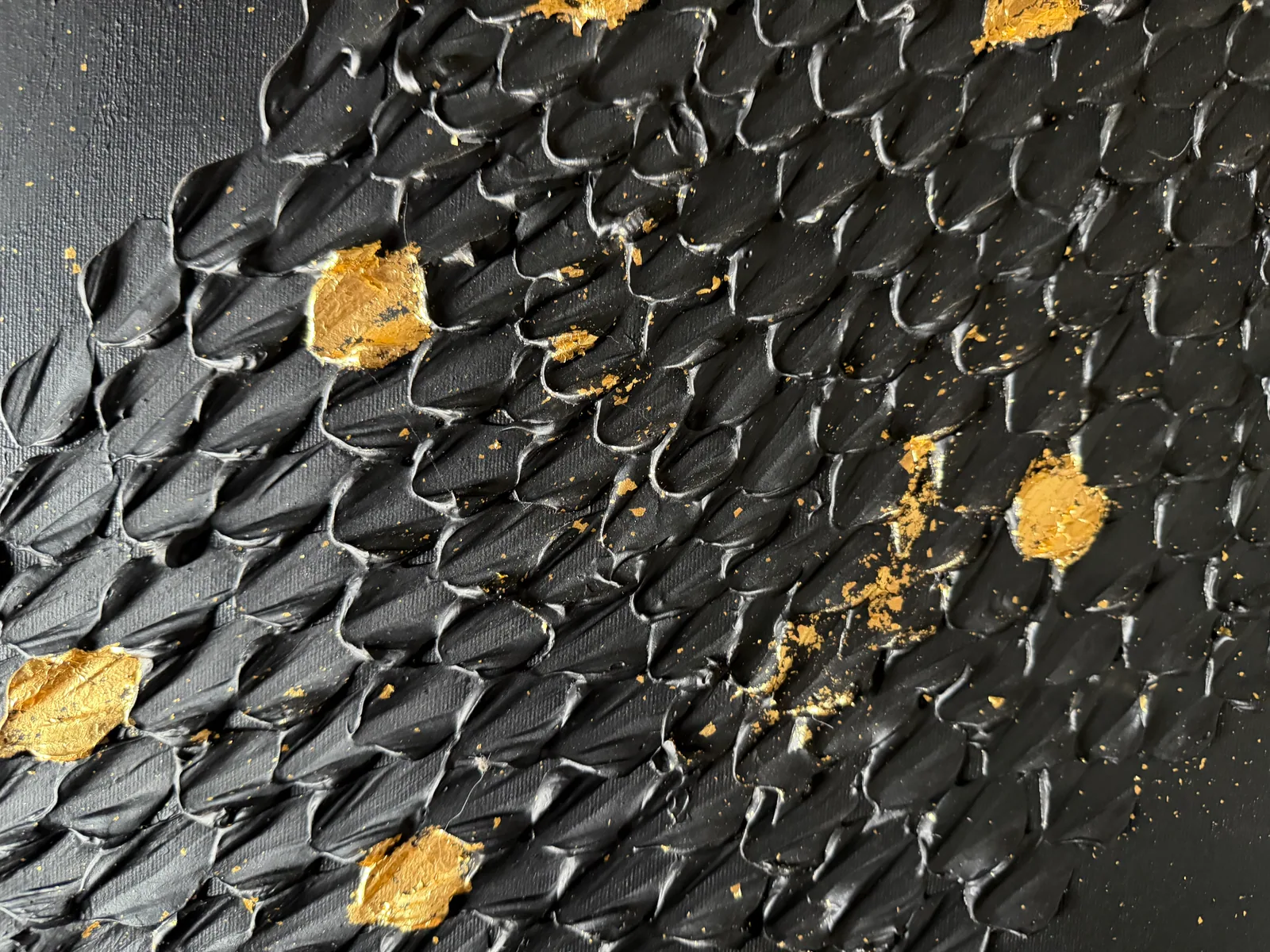
What raised texture a palette knife creates that a brush can't
The technical term for this raised paint is impasto — paint applied thickly enough that the mark of the tool used to lay it down stays visible once the paint has dried. Tate's definition is precise on this point: impasto is "an area of thick paint, or texture, in a painting," where the physical surface of the paint becomes part of what the work communicates, rather than a smooth, invisible carrier for an image behind it.
A palette knife achieves this more directly than a brush because the blade doesn't absorb or scrub the paint the way bristles do. It deposits color in a single pass, holding whatever shape the stroke leaves — a stabbing motion builds short peaks, a dragging motion builds a ridge with a furrow trailing behind it, and a flat pass leaves a sharp, faceted edge where the blade lifted off. Because the paint isn't worked back into itself, the color also stays purer: less mixing on the canvas means less muddying between adjacent passages.
What a brush does that a knife can't
A brush works the opposite way: bristles flex, hold a reservoir of paint, and release it gradually as they move — which is exactly what lets an artist blend one color into the next, thin a passage into a soft gradient, or draw a fine, controlled line. None of that is possible with a rigid blade, which is built to place paint, not to feather it. Glazing — building thin, semi-transparent layers of color over one another to shift a hue without flattening it — is brush-only work; a knife has no way to lay paint thin enough for light to pass through several layers.
The practical trade-off is depth of control versus depth of surface. A brush gives an artist fine control over value and edge; a knife gives the paint its own physical depth, at the cost of that fine control. Most representational detail — a face, a hand, a precise architectural line — stays brush territory for exactly this reason.
Many paintings combine both — including several at Perfeito Studio
Neither technique is exclusive in practice. A common working order is to block in color and form with a brush first — establishing the base tones across the canvas — and then bring in the palette knife for the passages that need to stand forward: a foreground element, a highlight, a textured accent. The knife work sits physically on top of the brushwork, so it reads as nearer to the viewer even before color does any of that work.
The technical sheets at Perfeito Studio show the same pattern. Golden Passage (Black & Gold series) is listed as mixed media, texture paste, and gold leaf on canvas — the texture paste is knife-built relief, raised before the gold leaf is pressed into it, while the surrounding black field is worked in flatter acrylic passages. Echo of Silence and Veil of Light, both carrying sculpted texture on their technical sheets, push further toward the knife end of that spectrum, with the composition carried mostly by relief rather than by color transition.
Paint volume, drying time, and what that changes for care
Because the blade deposits paint in a continuous, undiluted layer rather than stretching it thin the way bristles do, palette-knife passages use noticeably more paint than an equivalent area of brushwork — a single loaded stroke can carry roughly what a brush would spread across several passes. Thick impasto also dries slower than a thin brushed layer, since the paint under a raised ridge has less surface exposed to air relative to its volume.
That has a practical consequence once a piece is finished and ready to ship. A flat, brush-built canvas travels like most flat paintings do. A canvas with real knife-built relief needs its raised passages cushioned separately from the flat ground, since a ridge proud of the surface is the first thing to take an impact in transit — the same logic Perfeito Studio applies to every mixed-media or sculpted-texture piece, professional packaging included with every acquisition regardless of technique.
From the studio
From the studio
In Golden Passage I lay the texture paste down first with a palette knife, in a diagonal band that has to hold its own ridge before anything else happens — if the paste goes on too thin it collapses flat under the acrylic passages I brush in around it afterward, and the whole point of the piece is that diagonal path standing proud of the black field. I press the gold leaf into the raised edges only once the paste has set, never into the flat black beside it, because the ridge is what catches the light and lets the gold read as a spark rather than a sticker.
You can see the difference under raking light in the studio photos: the knife passages throw a small, hard shadow that the brushed black around them never does. It's the same reason I keep the two tools for different jobs rather than picking one — the knife gives the piece a surface that changes as you walk past it, and the brush gives me the control to keep everything around that ridge quiet enough for it to read as the event, not just texture for its own sake.
Frequently asked
What visual effect does a palette knife create that a brush can't?
A palette knife lays paint in thick, undiluted ridges that hold their shape once dry — what's technically called impasto, where the tool mark itself stays visible as texture rather than blending away. Tate defines impasto as an area of thick paint or texture in a painting, where the physical surface becomes part of what the work communicates. A brush can build texture too, but because bristles flex and spread paint thinner, they rarely produce the sharp, faceted ridges and hard little shadows a rigid blade leaves behind.
Can a single painting combine both brush and palette knife?
Yes, and it's common practice rather than an exception. Many artists block in color and tone with a brush first, then bring in the palette knife for the passages meant to stand forward — a highlight, a foreground element, a textured accent that reads as physically nearer the viewer. At Perfeito Studio, Golden Passage combines flatter acrylic brushwork in the black field with knife-built texture paste and gold leaf along its raised diagonal band, so both tools are present in the same canvas.
Does palette-knife work use more paint than brushwork?
Generally, yes. A brush spreads paint thin across a wide area because bristles distribute a small amount of pigment efficiently, while a palette knife deposits paint in a continuous, undiluted layer — a single loaded stroke can carry roughly what a brush would spread across several passes. The thicker the impasto, the more paint it consumes, and thick passages also take longer to dry than an equivalent area of thin brushwork, since less of the paint's volume is exposed to air.
How can I tell from a photo if a painting used a palette knife?
Look for hard-edged ridges that cast a real shadow rather than a soft blended transition — knife strokes have faceted, angular edges because the blade lifts off cleanly, while brush marks taper and blend into the surrounding paint. Photos taken under raking, angled light show this most clearly, since the light catches the raised edge of a knife ridge and throws a small shadow beside it; a flat photo taken straight-on can hide texture that's obvious in person.
Which technique is more common in contemporary texture painting?
Neither has replaced the other — the choice depends on what the piece needs. Palette-knife work has become closely associated with contemporary texture painting specifically because it produces raised, tactile surfaces without extra material, but brushwork remains the default for color transitions, detail, and any passage meant to recede rather than project. Most contemporary mixed-media pieces, including much of the current catalog at Perfeito Studio, use brushwork for most of the surface and reserve the knife for targeted texture.
Ask about the texture in person
Every piece ships with a technical sheet noting exactly how it was built — message the studio on WhatsApp before you decide.
Published on