Journal · Technique & materials
How Abstract Paintings Get Their Titles
Abstract painters title work in three basic ways: a descriptive or poetic name, a number or "Untitled," or a title added only after the piece is finished. None is more correct than the others -- each signals how much the artist wants language to shape what a viewer sees before they actually look.
Three ways an abstract painting gets a title
Every title on an abstract painting is a decision, not a formality, and it tends to fall into one of three categories. The first is descriptive or poetic: a name that points toward a mood, a material, or an image evoked by the composition, without claiming to depict anything literal. The second is numbered, or left "Untitled" -- a deliberate refusal of language, so the viewer meets color and form before any word gets in the way. The third is really a question of timing rather than wording: some painters settle on a title before a brushstroke is made and work toward it; others wait until the canvas is finished and name only what is actually there.
None of the three is more legitimate than the others. A number can carry as much intention as a phrase -- and a poetic title, chosen carelessly, can mislead a viewer more than no title at all.
Why some painters chose numbers instead of names
The clearest case for numbering is Mark Rothko. Early in his career he gave his paintings descriptive titles, in keeping with the figurative and mythological subjects he was still working through. By 1947, as his mature style of stacked, softly bordered color fields took shape, he had largely abandoned conventional titles, distinguishing one canvas from another with a number or, at times, a color name instead. He resisted explaining what a painting meant in words at all: "Silence is so accurate," he said, wary that language would "paralyze" a viewer's own mind and imagination before the painting had a chance to work on it.
The same refusal shows up elsewhere in abstraction stated in a single word instead of a number. Cy Twombly, for instance, left a 2008 canvas now held by Tate in London titled simply Untitled (Bacchus). In both cases the artist is declining to pre-interpret the work on the viewer's behalf.
Titled in advance, or named after the fact
Separate from the wording is a question of sequence: does the title exist before the painting does, or only after? A planned title can function almost like a brief -- the artist works toward an idea already named, and the finished canvas is judged, in part, against that intention. A title added afterward works the opposite way: the painting comes first, and the name is chosen, or discovered, by looking at what actually happened on the canvas once the process was done.
Abstract painting leans toward the second sequence more often than figurative work does, for a practical reason: a gestural or textured composition can shift substantially between the first mark and the last one, in ways a representational subject usually does not. A title fixed at the outset risks describing an intention the finished piece no longer matches. Naming after the fact avoids that mismatch, at the cost of the clarity a working title can offer during the process itself.
What a title signals to the person looking at the painting
A title is a small amount of information, and abstract art gives a viewer very little else to go on -- no recognizable scene to orient against. That makes the choice of title, or the choice to withhold one, a real signal. A poetic or descriptive title tells a viewer the artist is comfortable pointing toward an interpretation, even loosely, and is willing to risk narrowing what the work can mean. A number or "Untitled" tells the viewer the opposite: the artist trusts color, surface, and scale to do the entire job, and would rather the viewer arrive at their own reading than start from a prompt.
Neither approach is a claim about quality. It is a claim about how much the artist wants to steer the encounter -- worth noticing whether the painting in question is by a historical figure in a museum catalogue or a working artist selling directly from a studio today.
From the studio
The Atelier's Perspective
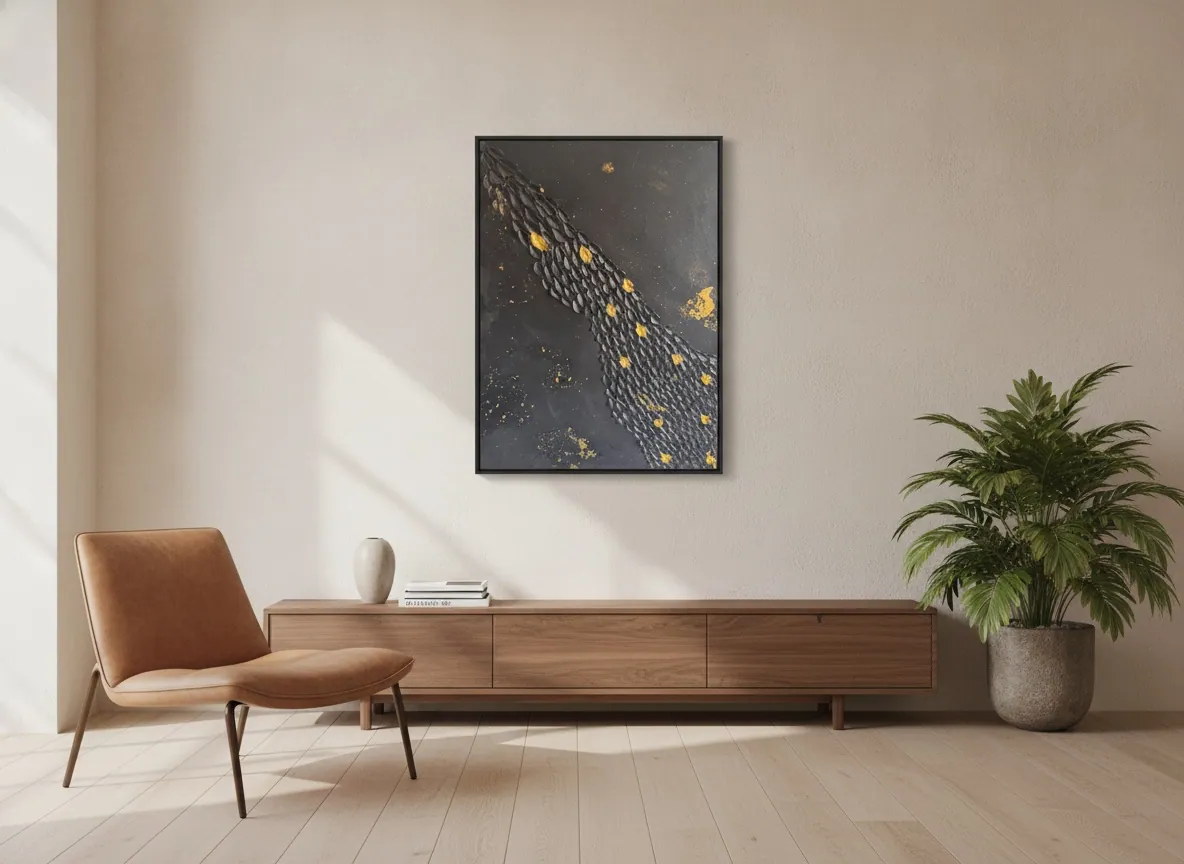
Every title in the Perfeito Studio catalog is descriptive, and it is chosen to name something that is actually visible in the piece, not applied afterward as a flourish. Silent Interval is the most literal case: the painting is built from a single dark gesture falling through a wide field of warm bone-white, with a block of blue anchoring the base, and the true subject is the gap between the two marks -- the interval itself. The title names exactly that gap, because that is what the composition is actually doing. Golden Passage works the same way from a different material: a diagonal of sculpted, textured black with fragments of gold leaf breaking through it, so the title's "passage" is the path the eye is meant to travel across the dark field toward each point where gold appears. Crossing Currents follows the same logic again -- fields of blue intersected by browns and flashes of yellow and white, read as forces in motion rather than a fixed image, which is exactly what "crossing currents" describes.
I do not number my work the way Rothko did, and I would not claim his reasons as my own -- I want a title to orient a collector toward what I actually built, not withhold it. But the underlying discipline runs the same direction as his numbering, from the opposite side: a title should earn its place by matching the painting, not by decorating it. If a name does not describe something a viewer can actually find on the canvas, it does not go on the piece.
Frequently asked
Why do some abstract paintings have no title at all?
Leaving a painting "Untitled," or giving it only a number, is a deliberate choice rather than an oversight. Mark Rothko largely stopped giving his paintings descriptive titles by 1947, using numbers or colors instead, because he did not want words to shape a viewer's response before they had actually looked. The same logic shows up across abstraction more broadly: a title withheld is the artist declining to pre-interpret the work on the viewer's behalf, leaving color, surface, and scale to do the entire job.
Are numbered titles like Rothko's just a naming convention, or do they mean something?
They are a considered choice, not a shortcut. Rothko explained his resistance to titles directly, saying "Silence is so accurate" and that he feared words would "paralyze" a viewer's imagination. Numbering his paintings, rather than naming them, was one part of that same resistance, distinguishing one canvas from another without supplying any interpretation. The number itself carries no meaning; the absence of a descriptive title is the meaning.
Do artists usually decide a title before or after finishing an abstract painting?
Both approaches exist, and abstract painting leans toward naming after the fact more than figurative work does. A gestural or textured composition can change substantially between the first mark and the last, so a title fixed in advance risks describing an intention the finished piece no longer matches. Naming only once the canvas is resolved, looking at what is actually there and describing that, tends to produce a title that fits the object rather than the original plan.
How does Alyne Perfeito title her paintings at Perfeito Studio?
Every title in the Perfeito Studio catalog describes something genuinely present in the piece rather than a slogan added afterward. Silent Interval names the charged gap between a single gesture and a block of color; Golden Passage names the path fragments of gold leaf trace across a dark, textured field. Titles are chosen to match what a viewer can actually find on the canvas, not to promise more than the work itself delivers.
Does a poetic title change how much an abstract painting is worth?
No -- a title is a piece of information, not a value driver. What affects an artist's market position is body of work, materials, scale, and reputation built over time, none of which a name can substitute for. A poetic title can help a viewer approach a piece, and a number can do the opposite on purpose, but neither raises nor lowers what a specific painting is worth on its own.
See the Titles Behind the Work
Golden Passage and Silent Interval are both in the current collection, each with a title chosen to match what is actually on the canvas. Original, signed, with a Certificate of Authenticity.
Sources
- PBS American Masters (essay credited to the National Gallery of Art) — 2026-09-26
- Tate — 2026-09-26
Published on