Guernica by Picasso, explained
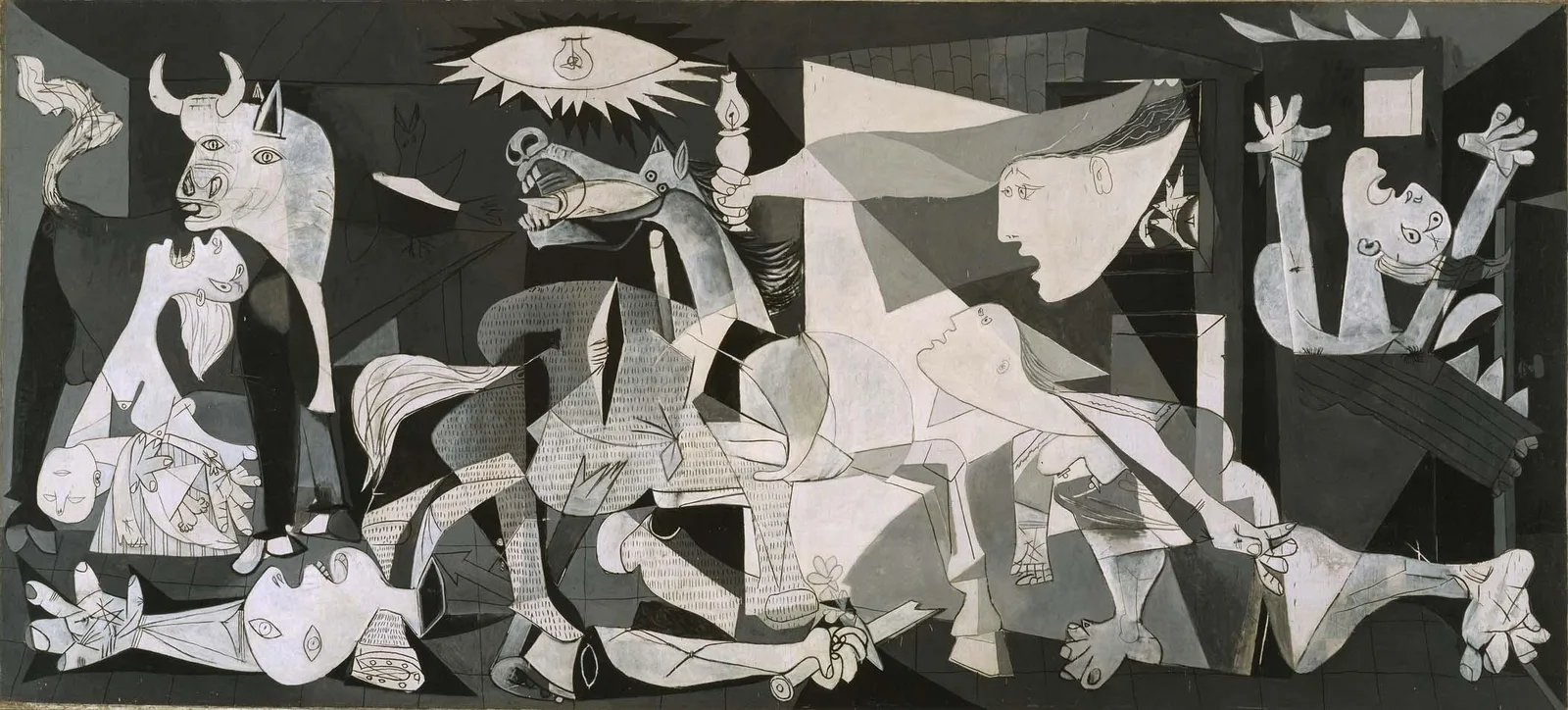
Guernica is Pablo Picasso's 1937 protest painting against the German and Italian bombing of the Basque town of Guernica on 26 April 1937. Painted in Paris for the Spanish Pavilion at that year's World's Fair, the black, white and grey mural — 3.49 × 7.76 metres — has hung at the Museo Reina Sofía in Madrid since 1992.
The bombing that provoked it
On 26 April 1937, warplanes from Nazi Germany's Condor Legion and Fascist Italy's Aviazione Legionaria bombed Guernica, a market town in Spain's Basque Country, in support of General Francisco Franco's Nationalist forces during the Spanish Civil War. The raid destroyed roughly three-quarters of the town's buildings. Casualty figures have long been disputed: contemporary reports claimed over 1,600 dead, while later historical research puts the toll far lower — estimates now range from around 170 to 300 fatalities, with one detailed study putting a provisional figure at 153 victims.
Picasso was in Paris at the time, already commissioned by the Spanish Republican government to produce a mural for the Spanish Pavilion at that year's Paris International Exposition, but without a settled subject. News of the bombing reached the international press within days. Picasso began the canvas on 1 May, five days after the attack, and finished it on 4 June — thirty-five days for a mural nearly eight metres wide.
Reading the image
Guernica does not depict the bombing literally — there are no airplanes, no burning buildings. Instead a small group of figures, compressed into a shallow, ambiguous space, carries the weight of the event. At the composition's center, a horse collapses in agony with a gaping wound in its side; beneath it lies a dismembered soldier, one broken arm still gripping a shattered sword from which a single flower grows. To the left, a bull stands over a woman cradling a dead child. Further right, a woman leans through a window holding out a lamp, while another figure staggers toward the center of the scene. Above the horse's head, a bare light bulb — read by many as a mechanical, unblinking eye — hangs over the whole composition.
Picasso left the exact meaning of these symbols deliberately unresolved rather than assigning each one a fixed, one-to-one interpretation, which is part of why the painting has supported so many readings — an indictment of fascism, a general statement on the suffering of war, a specifically Spanish allegory — without settling on any single one.
A palette reduced to black, white and grey
Guernica is painted in oil, almost entirely in black, white and grey — a striking restriction for an artist whose work is otherwise defined by color. Picasso specified a matte house paint for the mural, chosen to keep the surface's gloss to a minimum, so the canvas absorbs light rather than reflecting it back at the viewer.
Formally, the painting fractures its space with the diagonal, overlapping planes of Cubism — the setting reads as ambiguous, at once interior and exterior, near and far — while pushing the distortion of the figures toward an expressionist register: screaming mouths, splayed limbs, a body language of pain rather than description. The combination is why the painting reads simultaneously as reportage and as outcry, without settling comfortably into either register alone.
From the Spanish Pavilion to Madrid
Guernica was unveiled in July 1937 at the Spanish Pavilion of the Paris International Exposition. Its reception there was mixed: the painting drew little immediate attention, some Spanish officials objected to its modernist style and pushed to replace it with a more conventional work, and some Marxist critics faulted it for lacking overt political messaging. Others — among them the critic Jean Cassou and the poet José Bergamín — praised it immediately as a defining Spanish statement.
After Paris, the painting toured Scandinavia, England, and the United States to raise international awareness and funds for Spanish refugees. With the outbreak of the Second World War, Picasso entrusted it to the Museum of Modern Art in New York for safekeeping, and in 1958 extended that loan indefinitely, on the explicit condition that the painting return to Spain only once democratic government was restored there. It arrived back in Spain in September 1981, and was first shown behind bulletproof glass at the Casón del Buen Retiro in Madrid. It has hung at the Museo Reina Sofía, under accession number DE00050, since 1992.
From the studio
From the studio
I've never stood in the room with Guernica. Like almost everyone who knows the painting, what I have is reproduction — and reproduction is exactly the wrong instrument for a work whose entire argument depends on scale. A canvas 7.76 metres wide doesn't just depict an event; it occupies a wall the way a body occupies a room, and that confrontation disappears the moment the image shrinks to a screen.
I think about scale as an architect before I think about it as a painter — how much wall a piece needs to hold its own, where the eye is allowed to enter a large composition and where it's allowed to rest. Guernica pushes hard against one edge of that question: almost eight metres wide, restricted to black, white and grey, refusing every comfort a wider palette usually offers a viewer. I work the same discipline from the opposite direction in my Matter & Silence series — sculpted relief on near-monochrome surfaces, where withholding colour is what makes a single gesture legible.
As a contemporary Brazilian artist selling directly from the studio, without a gallery between me and the collector, I take documentation seriously for a similar reason a painting like this needs an accession number and a room assignment: provenance shouldn't depend on an institution existing to hold it. Every work that leaves Perfeito Studio carries a signed Certificate of Authenticity, a dossier, and an internal Archive ID — the same insistence on a legible paper trail, at a very different scale. For collectors outside Brazil, international shipping is quoted per destination; the crate travels, but the record stays as complete as if the piece had never left the archive.
Frequently asked
What does Guernica depict?
Guernica shows the aftermath of an aerial bombing through a small group of anguished figures rather than a literal battle scene. At its center, a horse falls in agony with a gash in its side; beneath it lies a dismembered soldier, his broken sword sprouting a single flower. A bull stands at left over a woman grieving a dead child, while another woman reaches through a window holding a lamp, and a bare light bulb — often read as an all-seeing eye — hangs above the horse's head. Picasso left the exact symbolism deliberately open rather than assigning each figure one fixed meaning.
Why did Picasso paint Guernica?
In early 1937 the Spanish Republican government commissioned Picasso to produce a mural for the Spanish Pavilion at that year's Paris International Exposition. He had not settled on a subject when, on 26 April 1937, German and Italian warplanes bombed the Basque town of Guernica in support of Francisco Franco's Nationalist forces. News of the attack reached Picasso in Paris within days, and he began the canvas on 1 May, finishing it 4 June — about five weeks after the bombing.
Where is Guernica displayed today?
Guernica has hung at the Museo Reina Sofía in Madrid since 1992, catalogued under accession number DE00050. Before that, the painting spent over four decades away from Spain: Picasso entrusted it to the Museum of Modern Art in New York during the Second World War, and in 1958 extended the loan indefinitely, on condition it return to Spain only once democracy was restored. It arrived back in September 1981, and was first shown at the Casón del Buen Retiro in Madrid before moving to the Reina Sofía in 1992.
What technique and palette did Picasso use for Guernica?
Picasso painted Guernica in oil on canvas, using a palette restricted almost entirely to black, white and grey — a striking choice from an artist otherwise associated with strong color. He specified a matte house paint for the mural to minimize gloss, so the surface absorbs light rather than reflecting it. Formally, the composition combines Cubist fracturing — diagonal planes that make the setting ambiguous, at once interior and exterior — with an expressionist charge in the distorted, anguished figures, a synthesis historians point to when explaining why the painting reads as both reportage and outcry.
Is Guernica considered Cubist or something else?
Guernica isn't purely Cubist. Picasso draws on Cubism's fractured, multi-angle planes to flatten and destabilize the space — the setting reads as both indoors and outdoors, near and far, at once — but the emotional register belongs more to Expressionism: contorted bodies, screaming mouths, and a bull and horse rendered as symbols rather than descriptions. Historians generally describe the painting as a synthesis, using Cubist structure in service of an anti-war statement that owes as much to the urgency of reportage as to any single art movement Picasso had worked in before.
Sources
- Museo Nacional Centro de Arte Reina Sofía — 2026-08-15
- Museo Nacional Centro de Arte Reina Sofía — 2026-08-15
- Wikipedia — 2026-08-15
- Wikipedia — 2026-08-15
- Wikipedia — 2026-08-15
- Wikipedia — 2026-08-15
- Wikipedia — 2026-08-15
- Wikipedia — 2026-08-15
Talk to the studio about scale and restraint
Genesis of Flame works a similar tension between chaos and control at architectural scale. Message the studio in English for sizing, installation and international shipping details.
Talk to the studio on WhatsApp
Published on