The Starry Night by Van Gogh, explained
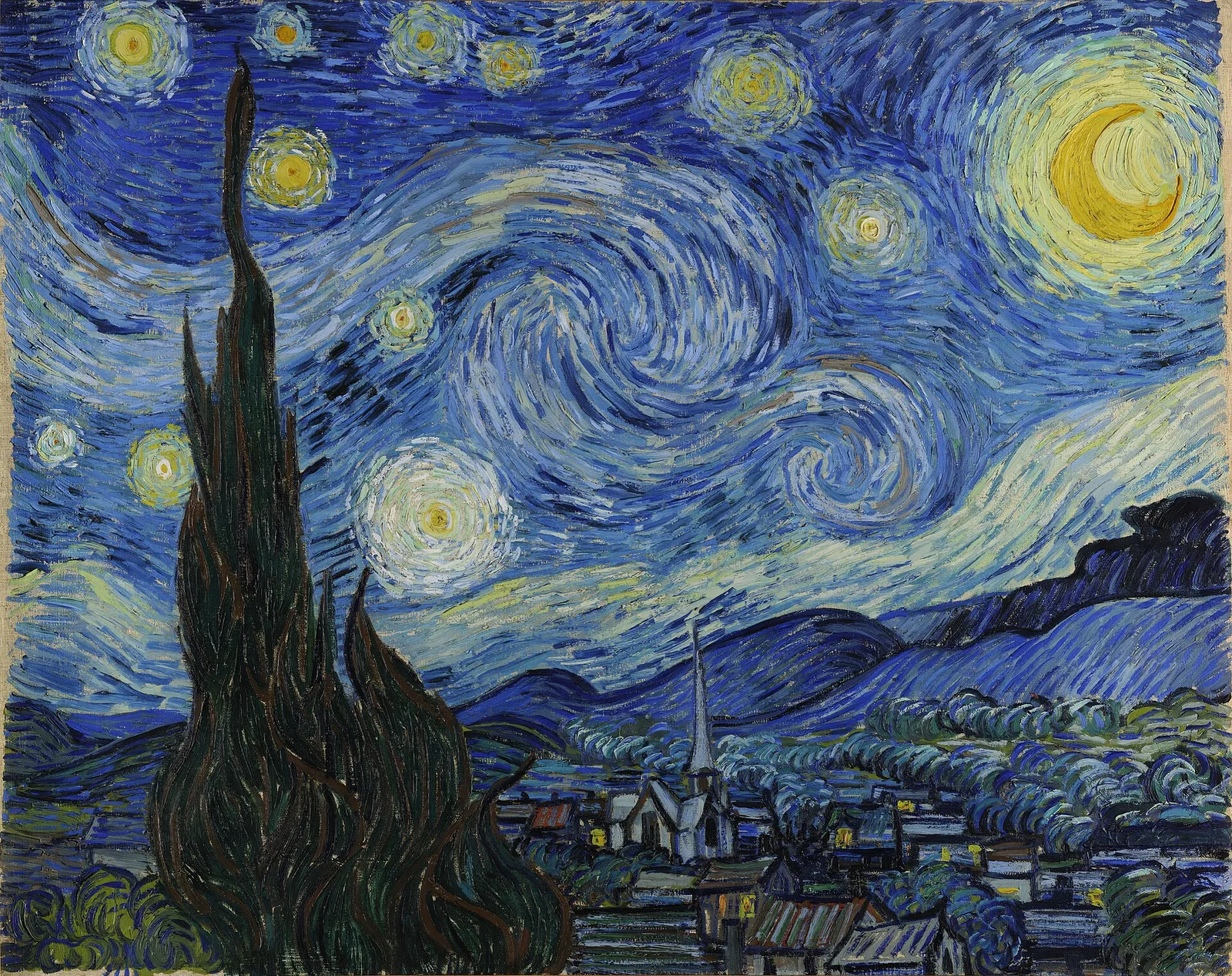
Van Gogh painted The Starry Night in June 1889 at the Saint-Paul-de-Mausole asylum in Saint-Rémy-de-Provence, working largely from memory and invention rather than direct observation. The painting has been held by the Museum of Modern Art in New York since 1941 and is not, and has never been, for sale.
When and where Van Gogh painted it
Van Gogh admitted himself to the Saint-Paul-de-Mausole asylum in Saint-Rémy-de-Provence on 8 May 1889, following a breakdown in Arles. He was given two rooms — a barred bedroom on the second floor facing east, and a small studio on the ground floor. He painted The Starry Night there in June 1889, and mentioned it directly in a letter to his brother Theo dated on or about 18 June 1889: "At last I have a landscape with olive trees, and also a new study of a starry sky."
The work is oil on canvas, 73.7 × 92.1 cm (29 × 36 in). Biographers Steven Naifeh and Gregory White Smith connect the painting to a moment when, in their words, Van Gogh's "defenses had been breached" — they read the swirling sky as emerging from that heightened, unguarded state, linking it to the epilepsy-related condition that shaped his final years.
What's real in the view, and what he invented
The painting reads as one continuous view, but it mixes direct observation with invention. The cypress dominating the left foreground was a real tree near the asylum, though Van Gogh enlarged it well past its actual scale — and scholars still disagree on whether it was even visible from his east-facing window. Ronald Pickvance argued it wasn't; Albert Boime maintains the cypresses were visible to the east. The village nestled below the hills is invented outright: no such village could be seen from Van Gogh's room, and he built it from other sketches and memory.
The bright point of light beside the cypress has been identified as Venus, and researchers have confirmed the planet really was visible at dawn over Provence in the spring of 1889 — matching Van Gogh's own description in a letter: "This morning I saw the countryside from my window a long time before sunrise with nothing but the morning star." The sky, in other words, is closer to documentary than the land beneath it.
Color and technique: what the paint itself carries
Van Gogh worked from a narrow, deliberate palette for the sky: ultramarine and cobalt blue, with Indian yellow together with zinc yellow for the stars and moon. He painted it in impasto — a technique, as Tate's own definition puts it, where an area of paint is left thick enough that the texture and the shape of the brushmark carry feeling directly, rather than the paint simply describing a color. Van Gogh is counted among the artists most associated with the technique.
That physical build-up is part of why reproductions of the painting always lose something: a photograph or a screen records the color accurately enough, but it flattens the ridge and ripple of the paint into a single plane. In the object itself, raking light changes what the surface tells you depending on where you stand — information no digital copy carries.
How it reached MoMA, and why Van Gogh thought it had failed
After Van Gogh's death, the painting passed to his brother Theo, then to Theo's widow, Jo van Gogh-Bonger, who sold it in 1900 to Julien Leclercq and, in 1901, to the painter Émile Schuffenecker. Jo later repurchased it and sold it to the Oldenzeel Gallery in Rotterdam in 1906; from there it passed to the collector Georgette P. van Stolk (1906–1938) and then to the dealer Paul Rosenberg. In 1941, Rosenberg exchanged the painting with the Museum of Modern Art for two paintings by Cézanne and one by Toulouse-Lautrec, and it entered MoMA's collection through the Lillie P. Bliss Bequest — where it remains today, under accession number 472.1941.
Van Gogh himself never considered it a success. In letters to the painter Émile Bernard written in November 1889, he called it a "failure," and he initially left it out of a batch of canvases he sent Theo in Paris. The reversal — from a painting its own maker doubted to one of the most recognized images in Western art — happened entirely after his death, and after MoMA acquired it, as the twentieth century built the version of Van Gogh that culture now takes for granted.
From the studio
What Van Gogh's ridges of paint have to do with my own canvases
I've never stood in front of the actual canvas — it lives in New York, and everything I know of it comes from reproduction, same as almost everyone who has ever loved this painting. What I notice, working the way I work, is exactly what a photograph of The Starry Night can't give you: the paint has height. A screen flattens ridge and peak into flat color; only raking light across the real surface tells you where the brush pushed hardest, and that changes depending on where you're standing.
That's the same problem I solve for, at a smaller scale, in my own studio. In Silent Interval, the black line that falls down the canvas isn't painted flat — it thickens, thins, and pools into a raised deposit of paint that you can only really read by moving around it, the way the light on it changes through the day. Veil of Light works the same blue-into-dark register Van Gogh worked in that sky: a single ridge of raised, textured paint running down the canvas, separating a paler light from a deeper indigo without ever fully resolving into either one. I photograph every finished piece for the site, and every time, the photograph is a compromise — the closest thing to being there, never the thing itself. That gap between the image and the object is most of what makes a painting worth owning instead of just looking at on a screen.
Frequently asked
Where is The Starry Night located today?
The Starry Night has been in the permanent collection of the Museum of Modern Art (MoMA) in New York since 1941, catalogued under accession number 472.1941. It entered the museum through the Lillie P. Bliss Bequest, after the dealer Paul Rosenberg exchanged it for two paintings by Cézanne and one by Toulouse-Lautrec. It is not for sale and is not routinely loaned to other institutions.
What makes The Starry Night's brushwork distinctive?
Van Gogh worked in impasto, applying paint thickly enough that the brushstrokes stand as physical ridges on the canvas rather than lying flat — a technique closely associated with his late work generally. For this painting specifically, he kept the sky to ultramarine and cobalt blue, and used Indian yellow together with zinc yellow for the stars and moon, a narrow and deliberate palette rather than a wide range of color. Texture and color work together on the surface, which is part of why reproductions always lose something of the original.
Is The Starry Night based on a real view?
Partly. Van Gogh painted it from the asylum at Saint-Paul-de-Mausole in Saint-Rémy-de-Provence, and the cypress at left was a real tree near the building, though he enlarged it well beyond its size — historians even disagree on whether it was visible from his window at all. The village below the hills, by contrast, is invented outright; no such village could be seen from his room. The bright point of light beside the cypress has been identified as Venus, and research confirms the planet was visible at dawn over Provence in spring 1889, matching Van Gogh's own letters.
How much would The Starry Night be worth today?
There is no verified figure, because the painting has never been sold and MoMA has never published an appraisal or insurance value for it. As a permanent-collection work central to the museum's identity, it isn't on the market and isn't expected to be, so any specific dollar figure circulating online is speculation, not documented fact. What can be said with confidence is that it would rank among the most valuable paintings in the world if it were ever offered for sale.
Why is The Starry Night considered a turning point for Van Gogh?
Not because Van Gogh thought so — he called it a failure in letters to the painter Émile Bernard in November 1889, and initially left it out of a batch of canvases sent to his brother Theo. The turning point is retrospective: it marks a moment where Van Gogh worked more from memory and invention than from direct observation, combining a real cypress, an imagined village, and an astronomically accurate Venus into one composition. That shift is what later critics pointed to as the painting became, decades after his death, one of the most recognized images in Western art.
Drawn to how light moves through dark color?
Veil of Light and Silent Interval both work with that same tension between shadow and emerging light, built up in real texture you can only fully read in person. Message the studio in English or Portuguese for close-up photos and a video of the surface in raking light.
Sources
- Wikipedia — 2026-08-01
- Wikipedia, citing the Van Gogh Museum & Huygens ING Van Gogh Letters Project, letter 782 — 2026-08-01
- Wikipedia, cross-checked against the Wikimedia Commons file record — 2026-08-01
- Wikipedia — 2026-08-01
- Wikipedia — 2026-08-01
- Wikipedia, citing Pickvance (1986) and Boime (1984) — 2026-08-01
- Wikipedia, citing the Van Gogh Letters Project — 2026-08-01
- Wikipedia — 2026-08-01
- Wikipedia — 2026-08-01
- Tate — 2026-08-01
- Wikimedia Commons — 2026-08-01
- Wikipedia (citing Naifeh & White Smith, Van Gogh: The Life) — 2026-08-01
Published on