Famous paintings with gold in them
Historical paintings that use real gold as a material, not just gold-colored paint, include Duccio's 1311 Maestà altarpiece in Siena and Gustav Klimt's Golden Phase portraits. Gold appears as hammered metal leaf bonded to the surface, catching and scattering light rather than reflecting it flatly the way pigment does. The technique spans religious, ceremonial, and modern painting.
Gold leaf vs. gold paint: what makes the shimmer real
Gold-colored paint — whether a historic shell-gold pigment or a modern metallic acrylic — reflects light the way any paint does: flatly, from a single plane. Real gold leaf behaves differently. It is gold hammered into sheets a few micrometers thick, thin enough to bend around every ridge of the surface beneath it, so it scatters light unevenly instead of mirroring it back in one direction. That difference is a large part of why paintings built with actual gold leaf still read as luminous centuries later, while gold paint tends to look flat and static by comparison.
The Getty Museum's own account of gold-ground Sienese painting describes artists' "creative use of gold and paint to achieve remarkable luminous effects" — gold wasn't decoration added on top of a finished picture, it was structural to how the image was built, laid onto a prepared panel before the painted figures went in.
Duccio's Maestà (1308–1311): a gold-ground altarpiece scattered across the world
Duccio di Buoninsegna's Maestà is one of the largest and most ambitious gold-ground paintings ever made — a double-sided altarpiece in tempera and gold leaf on wood panel, commissioned in 1308 for the high altar of Siena Cathedral and installed on 9 June 1311 after being carried through the city in a formal procession.
The altarpiece stayed on the high altar for four and a half centuries. In 1771 it was taken down, dismantled, and sawn apart so its panels could be distributed between two side altars — a process that damaged some paintings outright and scattered others through sale or loss. Today the largest portion, including the central front and back panels, remains in Siena's Museo dell'Opera del Duomo, while individual predella scenes are held by the National Gallery in London, the National Gallery of Art in Washington, the Frick Collection in New York, the Kimbell Art Museum in Fort Worth, and several smaller institutions — a single altarpiece now readable only by visiting half a dozen museums on two continents.
Klimt's Golden Phase: Adele Bloch-Bauer I, and a brief word on The Kiss
Gustav Klimt's most gold-heavy period, roughly 1898 to the early 1910s, is known as his Golden Phase. Its clearest showcase is Portrait of Adele Bloch-Bauer I (1903–1907), painted in oil combined with gold and silver leaf on a 140 × 140 cm square canvas — a treatment so central to the picture that it is now often nicknamed "Woman in Gold." The Nazis seized the painting from the Bloch-Bauer family in 1941; after a long restitution case, Maria Altmann recovered it in 2006 and sold it that same year to collector Ronald Lauder for US$135 million, then a record price for any painting. It now hangs at the Neue Galerie in New York.
Klimt's other defining Golden Phase work is The Kiss (1907–1908), painted the following year in the same gold, silver, and platinum leaf technique. We've covered its full history — materials, its home at the Belvedere, and who the two figures likely are — on its own page, so here it's enough to note that Adele Bloch-Bauer I and The Kiss were painted almost back to back, and together they define what "Klimt gold" means.
Why gold recurs in religious and ceremonial painting
Gold shows up disproportionately often in religious and devotional painting, and that's not simply a matter of taste. Because gold leaf scatters candlelight and daylight instead of absorbing it the way pigment does, a gold ground reads as active and shifting rather than static — historically read as a stand-in for divine or uncreated light rather than a depicted physical space. That logic runs through Duccio's altar-gold, Byzantine mosaic backgrounds, and centuries of icon painting that came before either of them.
Gold in painting isn't exclusively religious, though. Klimt's Golden Phase is a secular, decorative use of the same material, and gold leaf shows up in contemporary studio practice for reasons that have nothing to do with liturgy. Not every gold surface is making a devotional claim — it's worth checking a painting's subject before assuming the metal is doing religious work.
From the studio
Working gold leaf into texture, not over it
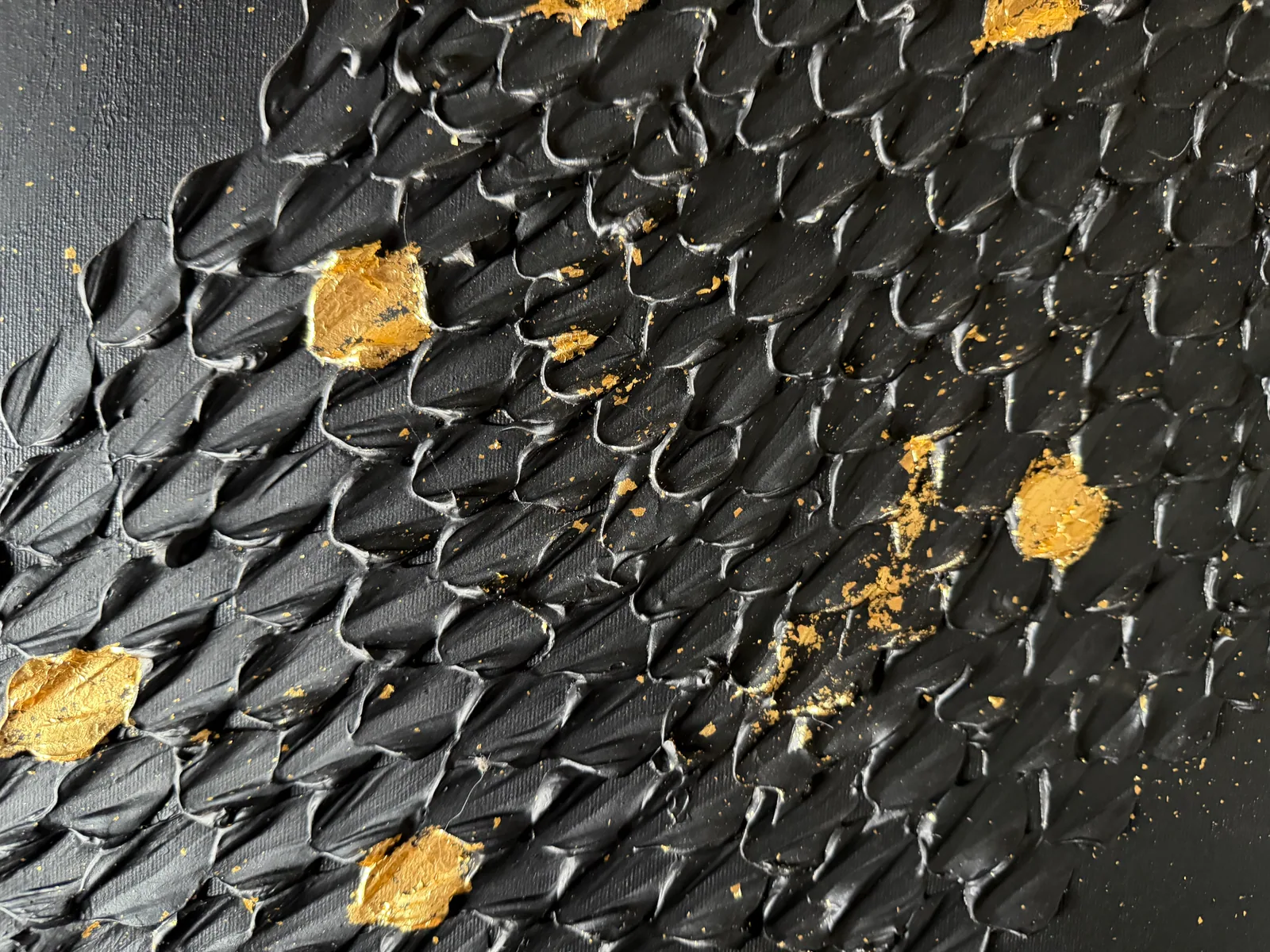
Every piece in my Black & Gold series uses real gold leaf, never gold-colored paint, for the same reason historical painters chose it: paint sits still, leaf catches light differently depending on where you stand. But my process is closer to construction than to gilding. I build up texture paste first, let it dry into an uneven, sculptural surface, and only then work fragments of gold leaf into the ridges and folds — instead of laying it flat over a polished ground the way traditional water-gilders did on gesso.
In Golden Passage, that shows up as a diagonal path of gold breaking through a black field — not a gilded background the way Duccio or Klimt used it, but small interruptions of light moving through darkness. I think about restraint as much as I think about the gold itself: how much black stays untouched decides how much the gold means. A field of gold and three fragments of gold say very different things, even though the material is identical.
Frequently asked
What is the most famous painting that uses real gold leaf?
Gustav Klimt's The Kiss (1907-1908) and Portrait of Adele Bloch-Bauer I (1903-1907) are probably the best-known paintings built with real gold leaf, both from what art historians call his Golden Phase. Adele Bloch-Bauer I is sometimes called Woman in Gold and now hangs at the Neue Galerie in New York; The Kiss has remained at the Belvedere in Vienna since 1909. Further back, Duccio's Maesta (1308-1311) in Siena is one of the largest gold-ground paintings ever made, though it is less widely known outside art history circles.
Why did some historical periods use gold in paintings so heavily?
Gold leaf was especially common in medieval and early Renaissance religious painting because it scatters candlelight and daylight instead of absorbing it like pigment, so a gold background reads as active, shifting light rather than a flat depicted space. That effect was historically associated with divine or sacred presence, which is why gold grounds appear so often behind saints and altarpieces, from Byzantine mosaics through painters like Duccio. The technique later resurfaced for secular, decorative reasons too, as in Klimt's Golden Phase.
Is gold leaf still used by contemporary painters today?
Yes. Contemporary painters use gold leaf for the same physical property historical artists valued, since it scatters light instead of reflecting it flatly, but they often apply it differently than the traditional gesso-and-bole method used on wood panels. In the studio's own Black & Gold series, gold leaf is worked directly into wet mixed-media texture rather than laid over a smooth gilded ground, so it catches light unevenly across a sculpted surface instead of forming one continuous flat field.
Does gold in a painting always mean religious or ceremonial subject matter?
No. Gold grounds and gold leaf were historically associated with religious and devotional painting because of how the material behaves with light, but the connection isn't automatic. Gustav Klimt's Golden Phase portraits, including The Kiss and Adele Bloch-Bauer I, use the same gold leaf technique for entirely secular, decorative purposes. Contemporary painters who use gold leaf, including in the studio's own work, are typically working with its physical and material qualities rather than making a religious statement.
How is gold leaf physically applied to a canvas?
In the traditional method used on wood panels for centuries, gold leaf goes down over a prepared ground, usually a smooth gesso layer followed by a colored adhesive layer called bole, and is burnished to a shine once dry. That approach assumes a flat, polished surface underneath. The studio's own process departs from it: gold leaf is worked into wet texture paste while it is still workable, so the gold follows the sculpted surface instead of sitting on a mirror-smooth ground, and it is never burnished flat.
Sources
- Wikipedia, "Maestà (Duccio)" — 2026-08-09
- Wikipedia, "Portrait of Adele Bloch-Bauer I" — 2026-08-09
- Wikipedia, "The Kiss (Klimt)" — 2026-08-09
- The Getty Museum, exhibition page "The Shimmer of Gold: Giovanni di Paolo in Renaissance Siena" — 2026-08-09
Curious how gold leaf looks up close in the studio?
Golden Passage, from the Black & Gold series, works gold leaf directly into a sculpted mixed-media surface rather than a flat gilded ground. Message the studio in English or Portuguese for close-up photos and a video of the gold catching light.
Talk to the studio on WhatsApp
Published on