The Kiss by Gustav Klimt, explained
Klimt painted The Kiss in 1907–1908, applying oil, gold leaf, silver, and platinum to a 180 × 180 cm canvas. The Austrian state bought it in 1908–1909, still unfinished, for 25,000 Kronen — then a record for a living artist — and it has hung at the Belvedere in Vienna ever since. It belongs to Klimt's 'Golden Phase.'
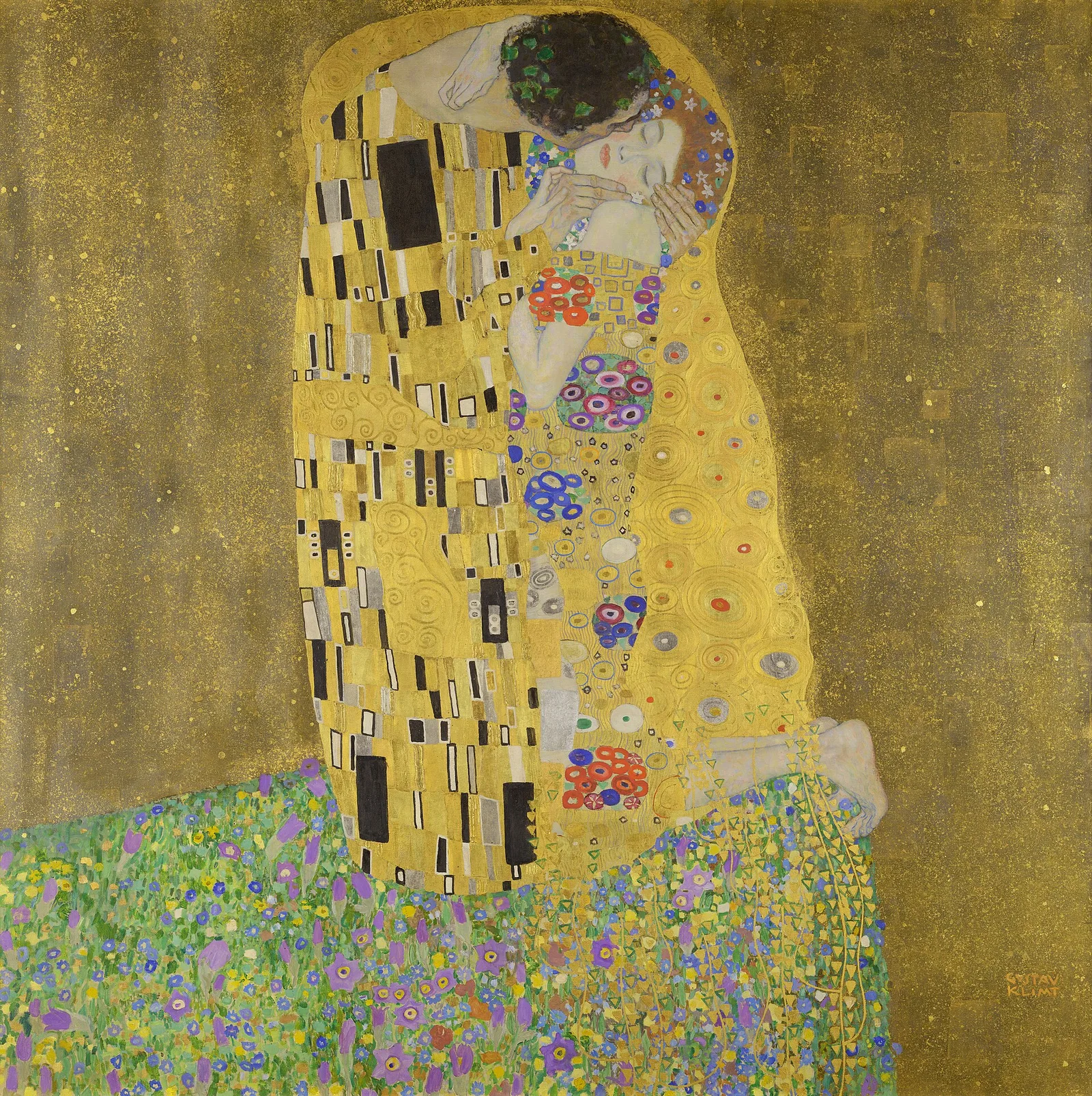
Where and when Klimt painted The Kiss
Klimt worked on The Kiss through 1907 and 1908. It debuted, still unfinished, at the Kunstschau exhibition in Vienna, which ran from 1 June to 15 November 1908 and coincided with Emperor Franz Joseph I's sixtieth anniversary on the throne. The reception was warm — a sharp contrast to the controversy that had followed Klimt's earlier Vienna Ceiling paintings, which critics had condemned as pornographic.
The Austrian Ministry of Education and Culture purchased the painting at the exhibition, still incomplete, for 25,000 Kronen — at the time the highest price the state's Modern Gallery had ever paid for a work by a living artist. The finished canvas was formally received into the collection on 22 July 1909. It remains there today, catalogued under inventory number 912, on permanent view at the Upper Belvedere in Vienna.
The materials: gold leaf, silver, and platinum
According to the Belvedere's own catalogue record, The Kiss is executed in gold leaf, silver leaf, and platinum leaf combined with resin oil colors on a primed canvas. The background is built from composition gold — a brass-based gold substitute — applied and glazed, with flakes of metal leaf worked into the surface rather than laid perfectly flat. That is part of why the gold in the painting still catches light unevenly today: it was never meant to behave like a smooth printed sheet.
The canvas is square, 180 × 180 cm, which was itself an unusual format for a figurative painting at the time and reinforces the flatness of the ornamental field. Klimt reserved naturalistic modeling for the two faces, the woman's hands and feet, and small patches of skin — everything else, the robes, the meadow, the halo of gold that frames the couple, is rendered as pattern.
Why the gold: Klimt's debt to Byzantine mosaics
Klimt's turn toward gold is generally traced to trips to Venice and Ravenna, where he saw the Byzantine mosaics that fill churches such as San Vitale — works built from thousands of small pieces of glass and gold leaf, with no attempt at depth or perspective. Historians who have studied the painting point out that it was precisely the flatness of those mosaics, and their lack of any illusion of space, that intensified their golden brilliance. Klimt appears to have carried that lesson directly into The Kiss.
The result is a deliberate tension in the same canvas: the ornamental gold field reads as pure surface, almost abstract, while the two heads are painted with enough anatomical care to feel specific and human. That contrast between decorative flatness and observed detail is one of the reasons the painting still reads as startling rather than simply decorative.
Who are the two figures, and where The Kiss sits in Klimt's 'Golden Phase'
The identities of the couple were never documented by Klimt, and no records confirm who modeled for it. The most widely repeated theory holds that the woman is Emilie Flöge, Klimt's close companion from the early 1890s until his death — a relationship generally described as intimate but likely platonic, and never fully clarified. Other names circulate in less-substantiated accounts, including the composer Alma Mahler and a model referred to only as 'Red Hilda,' but none of these carry the same documentary weight, and the painting is best treated as an image of a couple in a general sense rather than a confirmed double portrait.
Art historians place The Kiss within what is now called Klimt's Golden Phase, a period beginning around 1898 and marked by his heaviest use of gold leaf and metallic surface. Pallas Athena (1898) is usually cited as its opening work; Portrait of Adele Bloch-Bauer I, painted the same year Klimt began The Kiss, is its other best-known example. The Kiss is generally regarded as the phase's high point — the painting where the gold, the flatness, and the ornament reach their fullest expression before Klimt began moving away from them in his final years.
From the studio
What Klimt's gold field has to do with my own canvases
I've never worked with actual gold leaf at the scale Klimt did — his gold is a field, mine is closer to a scatter. In Golden Passage, from the Black & Gold series, I let small fragments of gold leaf surface across a black ground the way sparks surface in darkness: not as a covering, but as interruptions. Reading how the Belvedere describes his materials — gold, silver, and platinum leaf worked into glazed composition gold, never laid perfectly flat — I recognized something I do on a much smaller scale in my own studio: gold behaves differently depending on how much of it you allow to sit against dark or bare ground.
What I keep coming back to in Golden Passage is restraint rather than abundance. The black field is left mostly untouched, and the gold appears sparingly, guiding the eye instead of dominating the surface — closer, in spirit, to the small gold accents you find in older devotional painting than to a field of gold the size of The Kiss. It's a reminder that gold leaf doesn't need to cover a canvas to carry weight; a few honest fragments, placed with intention, can hold as much presence as a whole gilded background.
Frequently asked
Where is The Kiss by Klimt on permanent display?
The Kiss has been part of the Österreichische Galerie Belvedere's collection in Vienna since 1909, and it hangs on permanent view at the Upper Belvedere palace. It is catalogued in the museum's records under inventory number 912. It is not on loan to other institutions and has not left the Belvedere's collection since it was acquired.
What is the gold leaf technique Klimt used in The Kiss?
Klimt combined gold leaf, silver leaf, and platinum leaf with resin oil colors on a primed canvas. The background is built from composition gold (a brass-based gold substitute), applied and glazed with flakes of metal leaf worked into the surface rather than laid perfectly smooth. He developed this approach after seeing Byzantine mosaics in Venice and Ravenna, where flatness and the absence of perspective intensified the gold's brilliance.
Who are the two figures depicted in The Kiss?
Their identities were never documented by Klimt, so there is no confirmed answer. The most widely repeated theory identifies the woman as Emilie Flöge, Klimt's close companion for decades, in a relationship generally described as intimate but likely platonic. Other names, including the composer Alma Mahler, circulate in less-substantiated accounts. The painting is best understood as depicting a couple in a general sense, not as a documented double portrait.
What period of Klimt's career does The Kiss belong to?
The Kiss was painted in 1907–1908, during what art historians call Klimt's Golden Phase — a period of roughly 1898 to the early 1910s defined by his heaviest use of gold leaf and metallic surface. It followed the controversy over his Vienna Ceiling paintings and arrived at a moment of strong public and critical reception, when the Austrian state purchased it for a record price.
Is The Kiss part of what's called Klimt's 'Golden Phase'?
Yes. Along with Pallas Athena (1898), which opens the period, and Portrait of Adele Bloch-Bauer I (1907), The Kiss is one of the phase's defining works and is generally considered its high point — the painting where gold leaf, flatness, and ornament reach their fullest expression in Klimt's output.
Drawn to how gold catches the light against dark ground?
Golden Passage works with the same idea Klimt did at a very different scale — sparing fragments of gold leaf over a black field, guiding the eye rather than covering the surface. Message the studio in English or Portuguese for close-up photos and a video of the gold in raking light.
Sources
- Österreichische Galerie Belvedere — Sammlung Online (official collection catalogue) — 2026-08-02
- Wikipedia, "The Kiss (Klimt)" — 2026-08-02
- Wikipedia, "Gustav Klimt" — 2026-08-02
- Wikimedia Commons — 2026-08-02
Published on