What are the most expensive paintings ever sold by living artists?
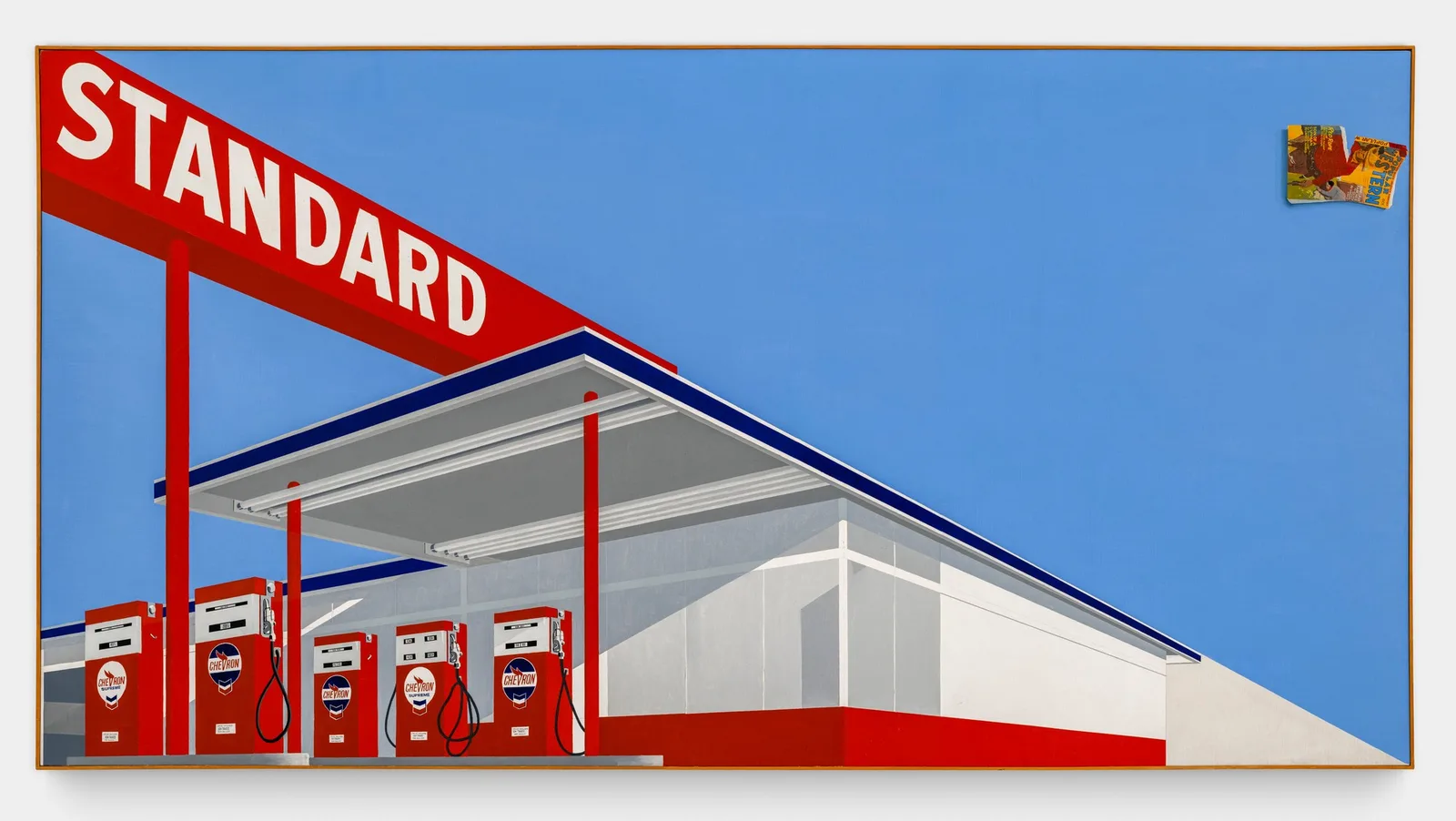
No single number holds forever: the highest price ever paid for a painting by a living artist is Jasper Johns's Flag (1958), sold privately in 2010 for a reported $110 million. At auction, Ed Ruscha's Standard Station (1964) now leads at $68.3 million — after David Hockney's record sale left the "living artist" count when he died in June 2026.
The record depends on how you define "sold" — private sale vs. auction
The single highest price ever paid for a painting by a living artist did not happen at auction at all. In 2010, hedge fund manager Steven A. Cohen bought Jasper Johns's Flag (1958) in a private transaction reported at $110 million — still the record today, since Johns, born in 1930, is alive and continues to work from his studio in Connecticut.
Johns holds the second spot too. In 2006, Kenneth Griffin paid $80 million for Johns's 1959 painting False Start, a price that itself set the "most expensive painting by a living artist" record at the time, before being overtaken by his own Flag four years later.
At public auction, the record changed in 2026 — because the previous holder died
Private sales are negotiated privately and never confirmed by a public hammer price, so most trackers of this record use a more transparent number: the highest price set in an open auction room. That title belonged to David Hockney for eight years. His 1972 painting Portrait of an Artist (Pool with Two Figures) sold for $90,312,500 at Christie's in New York on 15 November 2018 — at the time, the highest price ever paid at auction for a work by a living painter.
Hockney died at his home in London on 11 June 2026, at age 88. The moment he passed, his painting stopped counting toward the "living artist" record — a reminder that this particular title can change without a single new painting being sold, purely because of who is still alive to hold it. With Hockney removed from the count, the auction record for a painting by a living artist currently belongs to Ed Ruscha: his 1964 painting Standard Station, Ten-Cent Western Being Torn in Half sold for $68.26 million at Christie's New York on 19 November 2024 — already the artist's own auction record at the time, and now the highest publicly auctioned price among painters confirmed to be living today.
Why this list looks so different from the all-time "most expensive paintings" ranking
The overall record for any painting ever sold — living or dead — belongs to artists no longer working: names whose entire output is fixed and whose reputations have had decades or centuries to settle. Estates and museums control a shrinking supply, scarcity is absolute, and a masterwork changing hands becomes a historical event in itself.
A living artist's market works differently. Prices can still move as the artist keeps producing, exhibiting, and building institutional recognition — buyers are, in effect, pricing a career that has not finished being written. That is also part of why even the top prices for living painters sit well below the very top of the all-time list: the "living artist" ranking measures market confidence in an unfinished story, not settled art-historical consensus.
It's also worth separating medium from artist. The highest price ever paid at auction for any work by a living artist is not a painting at all: Jeff Koons's stainless steel sculpture Rabbit (1986) sold for $91.1 million at Christie's in May 2019 — six months after Hockney's $90.3 million painting sale — but a sculpture, so it falls outside a ranking of paintings specifically.
What these numbers mean for someone starting a collection today
Nothing about a $110 million private sale or a $68 million auction night changes the reality for most people building a collection: the large majority of original paintings, by established and emerging artists alike, sell for a small fraction of these figures. The paintings that reach nine figures are, almost without exception, by artists in their eighties or nineties with fifty-plus years of exhibition history behind them — not a price tier that exists for someone acquiring a first original work.
What these record sales are useful for is context: they mark the ceiling of a market that, at every other level, runs on the same basic logic — documented authorship, a coherent body of work, and a price that reflects where an artist actually stands in their career. Acquiring work from a studio early in its documented archive, decades before any auction record is even a possibility, is a different exercise altogether — closer to supporting a practice directly than to bidding on a name already fixed in art history.
From the studio
The view from the studio: pricing a career still in progress
I read a story like Ed Ruscha's record with more curiosity than envy. His 1964 painting sold in 2024 for a price that reflects sixty years of work, museum retrospectives, and a reputation built over most of a lifetime — that is not a stage of career I am anywhere near, and I do not think it is honest to talk about my own paintings as if it were.
What I do think about, every time I price a new piece, is scale and honesty: the size of the canvas, the real cost of gold leaf or metallic pigment, the hours a sculpted texture takes to build up and cure properly. My prices today sit where a studio in an early, documented stage of its own archive should sit — accessible, tied to real production cost, with every piece registered under an Archive ID so its place in that story stays traceable from the first sale onward. Where that story eventually goes is not something I will promise; it is something the work itself has to earn, one piece and one collector at a time.
Frequently asked
Why do paintings by living artists usually sell for less than works by deceased masters?
Mostly because the market for a living artist is still being written. Estates of deceased masters control a fixed, shrinking supply tied to a reputation already settled by decades of museum shows, scholarship, and prior sales — buyers are paying for certainty. A living artist's body of work is still growing and their institutional recognition is still being built, so prices reflect that unfinished story rather than a closed one, which keeps even record-breaking sales for living artists well below the top all-time prices for deceased masters.
Who currently holds the record for the most expensive painting sold by a living artist?
It depends on the type of sale. Counting private transactions, the record is Jasper Johns's Flag (1958), sold privately in 2010 for a reported $110 million — Johns, born in 1930, is still alive. Counting public auctions only, the record now belongs to Ed Ruscha's Standard Station, Ten-Cent Western Being Torn in Half (1964), which sold for $68.26 million at Christie's New York in November 2024; the previous auction record holder, David Hockney, died in June 2026 and is no longer counted among living artists.
Does the record change often, or has it stood for years?
Both, depending on which record. The private-sale record — Jasper Johns's Flag at $110 million — has stood since 2010. The auction record, on the other hand, just changed for a reason unrelated to any new sale: when David Hockney, who had held it since 2018, died in June 2026, his painting was removed from the "living artist" count, handing the title to the next-highest result still standing, Ed Ruscha's 2024 sale. A record like this can shift purely because of who is still alive to hold it.
Which living artists have works that have sold for the highest prices at auction?
Among painters specifically, Ed Ruscha currently leads at $68.26 million (2024). Gerhard Richter is also among the highest-selling living painters at auction — his Abstraktes Bild (1986) sold for $46.3 million at Sotheby's London in 2015. Outside painting, Jeff Koons holds the overall auction record for a living artist with the sculpture Rabbit (1986), which sold for $91.1 million at Christie's in 2019 — the highest price paid at auction for any work, of any medium, by a living artist.
Does a high auction price for one work mean all of that artist's work is worth that much?
No. A record price applies to one specific piece — usually a large, historically important work from a pivotal moment in the artist's career — not to everything that artist has made. The same artist's smaller works, works on paper, or pieces from less sought-after periods routinely sell for a small fraction of the auction record. A single headline number says more about that particular painting's place in art history than about the typical price of the artist's work overall.
Curious what an original painting costs before a market like this exists?
Perfeito Studio's current works are priced for an artist early in a documented career. Tell the studio what space you're working with, and see what's available now.
Sources
- Guinness World Records — 2026-09-14
- Phillips — 2026-09-14
- Wikipedia — 2026-09-14
- Guinness World Records — 2026-09-14
- Al Jazeera — 2026-09-14
- HENI — 2026-09-14
- Wikipedia — 2026-09-14
- HENI — 2026-09-14
- Wikipedia — 2026-09-14
- Smithsonian Magazine — 2026-09-14
Published on